I wake in winter

I wake in winter ten till four,
Ascend the stairs to start the fire,
Subdue a spark of hope for more
Than cold endured, a hand for hire.

I need a shock, no hint will do.
If feet could speak, with sound reprised
They’d shirk in word my fears anew—
They live like deer, and die surprised.

Afraid of death, from life estranged,
In flight from fact, left meek and mild,
The ox which once grew strong and ranged
Amid the wild goes cowed, beguiled.

The pleas for peace are made in war
Which none will win; to win’s to die
And live with loss across the door
Where one is true and pairs the lie.

I wake in winter ten till five,
Descend the stairs to light the fire:
The twigs ignite, the flame survives,
Returns to fan the heart’s desire.

Day 29: Reflection on Travel and Motivation, Comfort and Deprivation, Freedom and Frustration

The harshness and discomfort of the road should be softened by short periods of comfort. A single night of sleeping indoors on a pillowed bed, taking a shower with soap, eating a dinner of meat and vegetables rather than the usual rice and beans, drinking good filtered water, and fueling up with a large breakfast in the morning can do much to offset the anemic and ascetic weariness that comes from depriving oneself of those pleasures for weeks on end. All you need is one night to relax and not have to worry about getting what you need. Without this sporadic comfort, you begin to lose sight of your purposes for traveling, one of which was to recover your joy and wonder at life. You get tunnel vision. Before going out on the road, you had worked a menial job, lived a humdrum existence, read books of adventure in your spare time, and hungered for the excitement of travel, the inspiration you’d surely feel, the soulful people you’d meet along the way. Now you just want it to be over, get to the end, be where there is no more road. You hunger to sleep in a warm bed. The road becomes something to complete, the journey something to be finished and done with. The path in front of you something to put behind you.

Besides your thirst for indoor comforts, you want to get to the end partly because you think the end will mean no more feeling like an eternal beginner. To live on the road is to exist as an eternal beginner. The vagabond has no profession to master, no trade to become expert in, or at least pretend to be proficient at. In each new town he wakes up knowing he must start over again, learn anew how to be alive, find some way to make it to the next town. He cannot fall back on old ways. There is no falling back; there is only going forward.

But when the man on the road starts to get tunnel vision, this idea that “there is only going forward” becomes distorted. He goes forward not to grow and be shocked awake by the new but simply to get to the end where he can sleep in peace, where he does not have to work hard for every mile, where comfort is a given, though taken rather than received with gratitude, and does not need to come as some kind of reward. He has lost perspective; he has forgotten that one fully appreciates what one has only after being deprived of it. Compassion comes not through happiness but through sorrow. Connection with other human beings is deepest not through daily and habitual interaction but when it occurs unexpectedly after you have experienced the depths of loneliness and isolation. You take most pleasure in the sweet and simple things of life not when you feel no pain but when pain itself has made your heart soft enough to appreciate those moments when it is full.

The man goes out on the road because he imagines that travel will fill his heart. Then, once on the road, he feels his heart empty, and instead of experiencing this emptiness, he rejects it as not part of his plan and imagines a life off the road where his heart will be full. He feels on the road, more intensely than he ever felt off it, his isolation. People see him riding alone on the side of the highway and perhaps are reminded of their own isolation, which they had tried to repress. They honk or curse or make rude hand gestures. By his mere presence, he has dared to call into question the solidity of their illusions, the unsturdy foundations of their fragile lives, of the fragility of all human life. But the honker is the exception. Most people are easily able to see themselves in the voyager, the pilgrim forced by a heart made restless by the intensity of his longing, to live with no home, close to the edge of being and non-being. Instead of rejecting that what they see in this restless heart is their own restlessness, these people welcome the wanderer as they would their own son. Having experienced his isolation deeply, the traveler is all the more appreciative of this welcome.

Even so, the feeling of rejection that comes when a car honks, as you pedal at a snail’s pace for miles up a steep grade, is enough to cancel out ten occasions of welcome and support. Aliveness quickly becomes deadness, aloneness turns to loneliness, and what had seemed purposeful almost instantly seems purposeless. You wonder what in hell you are doing, where you are going, why you put up with the frustrations that are part and parcel of life lived out of doors. And yet the frustrations are bearable. You chose to experience them when you left the comfortable house, where your frustration stemmed from feeling confined and constricted. Everywhere you go you face frustration. Now, outside the house where there was too much peace, you are frustrated that you can’t find any peace at all, that you can’t seem to be happy even though you are free.

Dreaming of what life could be always makes life as it actually is feel drab, without color, uninspiring. My purpose for living life on the road is to understand, by actual experience, what life actually consists of, what my life means to me. Not what I wish life could be, but what it actually is. To understand who I am, I must  understand what life is. Just as I will never fully understand what life is, I will never fully understand who I am. To become whole is not to understand everything but to have the humility to admit that one does not and cannot understand all, to graciously come to terms with not being all-powerful, to rejoice at not being God.

I would rather be frustrated and free than frustrated and unfree. I would rather make the conscious choice to live on good terms with deprivation than take a lack of deprivation for granted. I must come to terms with all sides of myself. I am as much the cursing, pickup-truck-driving honker as I am the caring widow who shelters me for the night and cooks a hot meal for the two of us as the cold rain pours down on the roof. I am as much the hateful excluder as I am the peaceful protestor.

All that I experience must become my teacher. There will still be plenty of times that I don’t like what I’m experiencing and wish it could be different. I’m rather be warm than cold. I’d rather be connected than isolated. I’d rather be intimate with another than lonely. But on the road my resistance to what I experience does not have the same feeling of futile and hopeless rebellion. There is no sense of, “I should not be feeling this way.” The choice to go out on the road is the choice to put myself at the mercy of Life, and there is little point in resisting what Life gives me. When she opens her hand, why should I close my heart? When Life opens her hand, something new comes into the world, and I am on the road to come into contact with the new. Not only to come into contact with the new but to embrace it, to open my own hands in a posture of surrender and reconciliation and let Life put what she will into them, for embracing what Life places into my hands places me in the hand of Life, the only place where I will ever know what it means to be alive.


November 20, Day 23 on the Road: Riding a Train Across Texas

IMG_1428

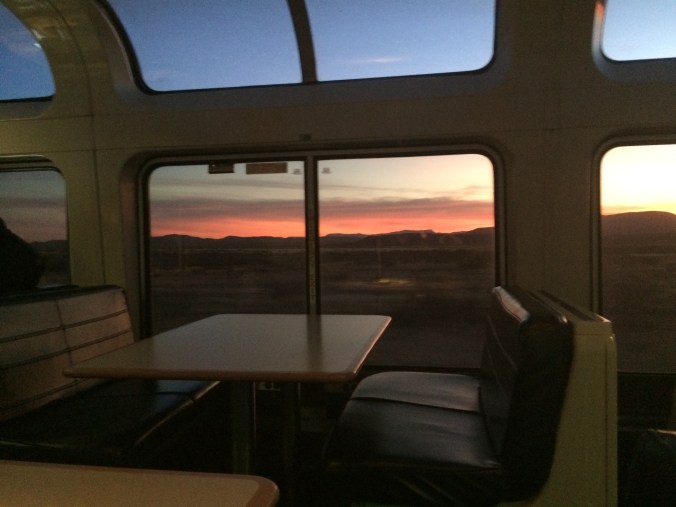
On the train the beauty of the setting sun and the rising crescent moon, of the open fields and the pecan groves, of the swampy forests and the rolling hillsides, feels somehow less deserved. The train passes by the world outside the window; the world passes you by as a ballgame passes before the eyes of a spectator, or a spectre, half-seen but never wholly appreciated. The train moves as you sit still. It is harder to feel moved. In order to feel a part of life’s movement, it seems necessary to move oneself. You can pass over a river a thousand times, see it from out the window of your car or train twice each day on your way to and from work. The real work begins when you set your kayak in the water and begin to paddle.

On the bike, you move through the landscape. What you see and pass through does not remain out there; its beauty penetrates deeply. It comes to you and through you unobstructed. Nothing separates you from it. There is no need to interpret it to fit your previous worldview. You are in the landscape, a moving piece among moving pieces, moving towards wholeness amidst what is already whole, and your view of the world stands in front of you, uninfluenced from your past views of it. Yesterday has passed but did not pass you by. All was new then and all is new now.

On the train, you sit amidst the other sitters, onlookers, bypassers. Together you sit and watch the world pass by. People read, eat, drink coffee, chat, find some way to keep busy, keep from being bored. And yet boredom comes anyways, despite or because of our many attempts to avoid it. Boredom comes on the train just as restlessness comes off it, when you hear the train’s whistle, and feel as Steinbeck felt the desire to roam.

This desire to travel is different from the traveling itself. You desire the feeling that thinking of travel gives you; you do not desire the reality. Or, in a deeper place, reality is all you desire, but you cannot access that place in dreams. Only by experiencing what is real can you begin to understand your desire for what is real, and seek reality. So, because you cannot access what you truly desire, you dream. You dream of the feeling of awe that will overtake your soul when the lounge car in the train is empty before dawn and you are up, more awake than you’d dreamed you’d ever be, the train you are on rolling with speed over the Mississippi River, heading west. You dream of the woman who will enter the train just as you get up to leave, how you will remain instead, though you’ve passed what you’d planned to be your final destination, how in her presence you will lose all your fear of people, all your resistance to everything outside the self, how your heart will open up like the sky in the desert on the first monsoon of the season.

Your desire for the road is like an amnesiac, making you forget past experiences you’d labeled as negative, neglect the fact that those very same experiences are sure to return: the cold and lonely November nights, the constant consumption of cheap food that your body finally rejects, the repetitive movements of putting one foot in front of the another, or pushing down on the pedals for one more revolution, how the monotony finally becomes terrible.

Your dream of the road is not the road, for the road is reality and includes what you’d rather reject, and your dream is illusory and occludes all except what you readily accept and rejoice in. The road is about rejoicing in and welcoming what you previously rejected, ignored, and denied. If you denied your frailty and helplessness, be on the road long enough and you will be forced eventually to confront these aspects of yourself. You’ll run out of food miles from any town; you’ll drink some bad water and be sick for a week, unable to keep any food down. You will be helpless to cure yourself, too frail to move and too sick to enjoy your rest. You will need to have the patience to wait, weak and weary, to be healed. If you’ve denied your power and capability, you will have no choice but to remember that you are powerful, capable of biking over one hundred miles in a day with eighty pounds of food, water, clothes, and shelter on the back of your bike, supporting yourself and your journey, carrying everything you need by your own power. If you have denied the support of others, rejected the fact that you are at the mercy of the goodness of other people, you will be at the receiving end of gifts and have to make the choice between open-hearted gratitude or stomach-twisting guilt.

Your dream of yourself is not who you are. Just as the road is no comfortable bed to dream upon until night turns to dawn, the self is no comfortable cocoon that you settle into to dream of who you could be when some rare red dawn magically transforms you into your dreamed-of self. The night cometh without doubt, but now it is day, and there is time to live while there is still light, and to live means to exist outside the cocoon, not to dream of paradise but to live in reality. What is reality?

What is Truth? asked Pontius Pilate, before he washed his hands of the matter and watched Truth be crucified. I sit on this train across Texas and watch the world go by. There is no dirt under my fingernails. I got a hotel room last night in Deming, New Mexico, took a shower this morning. My hands are clean.

I sit on the train and watch the sun go down. Distant shades of fire. I feel like I am, a spectator rather than a participant. Not in the fire. Detached, separate. The window is in the way. But I hear the train horn and feel the tingling run through my body. My restless blood, coming alive. I’m exhausted, strung out from three weeks on the road, in which I’ve biked close to 1,500 miles. Half the length of the country. So why do I still feel as if I do not deserve this beauty, this sky full of fire? As if anyone could earn such a free gift. What is given must simply be received.

I want to look out the window at this sunset and at the same time feel the same fierce burning in my heart. “Look at the sunset,” a woman behind me tells her companion. “Look how pretty it is.” Her companion looks and agrees. We are spectators on the train; we look and agree. The sky is pretty. And then we go right on complaining about how no one understands us, no one listens, no one cares. No one, I trust, cares less than the sun, which shares itself so freely, is as beautiful going down as it is coming up. May my life, the ending of which is so final, so definite, so unalterable, be an altar where I kneel down to the rising sun and offer my daily bread of beginnings.

Begin, begin, begin again. Rise in the morning and ride until I find a purpose to my riding. Aim until then only to enjoy my aimlessness. Let the simplicity of life on the road settle deeply into my unsettled blood. Let what I am become clear, or remain a mystery. Let what is meant to be come to be. May it bring me joy, or may it bring me sorrow. May I feel it, what is and what will come to be, as deeply and completely as possible. May reality itself make me real, myself, the person I am meant to be. I seek an unshakable faith, not in myself but in the ground I walk upon. I seek to walk upon this ground, to stand and to walk, trusting that every fall will be followed by a rise, every barren winter by a remarkable spring.

IMG_1432.JPG


November 17, Day 20 on the Road: Waking Up to Raccoons at Midnight in Eastern Arizona


IMG_1403.JPG

It’s 4 a.m., and I’m in the bathroom of Roper Lake State Park, outside of Stafford in eastern Arizona, sheltered from the cool desert night, taking what little comfort is available from the lukewarm showers here. I’ve got a cup of hot coffee beside me, in the same stainless steel cup I had at Legacy. I was a client there from February to June of 2016. Next week it will be Thanksgiving 2017, eighteen months later. I couldn’t sleep, raccoons kept coming into my campsite, trying to get at the food in my panniers. I’ve been on a bike tour for the last two and a half weeks. I’m living the adventurous life that legacy helped inspire me to live, but it’s not all warm showers and hot coffee.

It’s a long, slow road I’m on, one that often gets lonely. Slow and steady wins the race, I told myself as I pedaled two days ago up route 77, seven miles up 3,000 feet of elevation with 100 pounds on the back of my bike. What race? What victory? It’s hard not to feel deflated and defeated, to feel like a failure in life, to wonder about the futility of your own individual existence, when you wake up at midnight after three hours of sleep to the sound of raccoons scavenging through your food, and you spend ten minutes yelling yourself hoarse at said raccoons, which seem to be totally unafraid and go right on gnawing at the bag of instant rice you neglected to put away, thinking not even the coons would go for that, and now four hours later after being unable to fall back asleep, you take solace in the State Park bathroom, take a lukewarm and soap-less shower, and dry your hair under the hand drying machine, dreaming of sinking deeply into a plush comfy chair beside a wood stove fire and next to a bookshelf with hundreds of books, sipping hot tea and reading of some faraway arctic adventure as you sit in your comfortable home by the blazing fire with your steady, well-paying job and your loving and lovely wife and your sweet and adorable children. Instead, you are alone, a twenty-six year old man without a steady occupation, without a significant other, without a significant sense of your own self, leading a roving existence on the road to nowhere.

But no, every road leads somewhere. The dead end road leads to the wilderness that is the beginning of life. I’m on the road, craving this morning before dawn no longer for the temporary warmth of alcohol, my old and unforgiving mistress, but for the more permanent warmth and comfort of some place I can call my own, that I can call home. I say more permanent, for of course nothing is completely permanent. I’m on the road to recovery, and this road doesn’t end. It’s the road to rest and serenity, the road home. Home must be earned. Recovery is the victory that makes sense of this gnawing sense of defeat. Feeling like a failure precedes the success that comes when you recognize that to fail does not mean to die. You fail, and yet you live. One breath feels like a miracle, the next like your last gasp. And yet you live, and you fail, and you continue down the road.

For the last few nights, no matter how long or far I’ve pedaled, I haven’t slept well. I can’t find rest. I keep waking up, many times each night, wanting the sun to be up, wanting to be on my way. I’ve been averaging around 70 miles a day, between six and seven hours on the bike, at least a couple thousand feet of climbing, and yet I cannot sleep more than five hours a night.

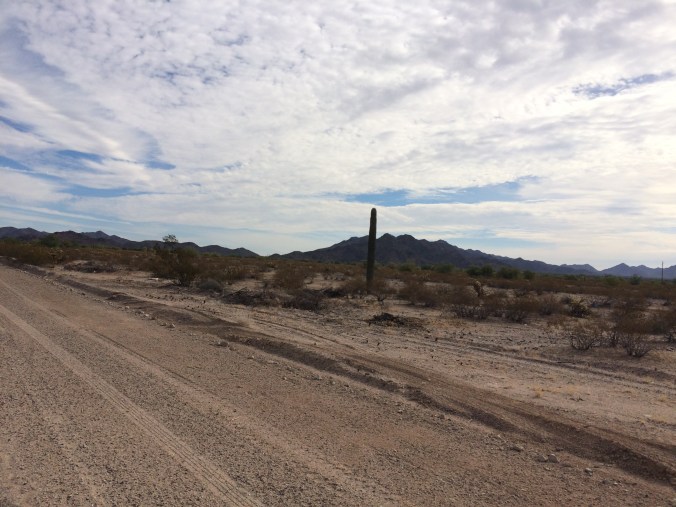
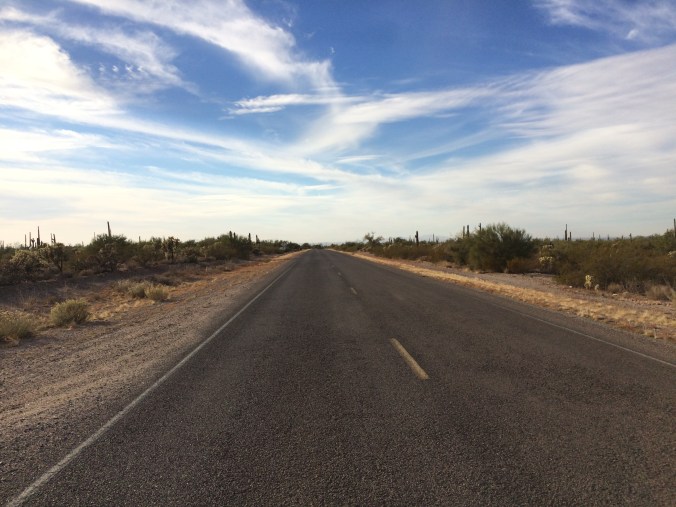
“Our hearts are restless until they rest in You,” wrote Saint Augustine. Indeed. Rest in whom? “Via con dios,” said a Mexican-American from Stockton, California who I met at the Bylas rest area on the Apache reservation. Go with God. “You’ve got angels behind you on both shoulders,” he told me. In a couple hours, light will come, and I will go. With the wind at my back or in my face, with angels on my two shoulders or alone and feeling like the most forlorn wanderer east of the Colorado and west of the Mississippi. I’ll get on my bike and go east towards the New Mexican border. My plan is to go east until I smell that salty sea water again, in the swamps of Florida. And then what? I started this trip a few miles inland from the Pacific, biked seven miles and close to 3,000 feet up route 9, and then down again back to sea level into Santa Cruz. From there I biked down the coast of California, riding through the strawberry country between Santa Cruz and Monterey, climbing high above the cliffs of Big Sur, riding under the palm trees along the sunny coast in Santa Barbara and L.A, and pedaling down past San Diego until I was a few miles away from Mexico. I decided against crossing the border and went east instead, climbing out of the San Diego area, away from the sea, up to around 4,000 feet, and then plummeting back down into the low Sonoran desert, riding beside seguaro cacti, feeling the desert sun hot on my back. From the low desert I climbed again to the high desert, and I’ll do some more climbing once I get into New Mexico. Then I’ll have the confront the gigantic mass of land that is Texas.

IMG_1375.JPG

There is much more country to see. I love the southwest, but for now I’m heading east, with all I need on the back of my bike. I may want more than I have, may crave all I don’t have, but in truth I lack nothing. Save the truth that will set me free? No, that is there too. That is here, too, and I’m on the road to find it.

“I think whoever I see must be happy,” writes Walt Whitman in Song of the Open Road. May I sing my song as I ride the open road. May I smell the happiness of juniper trees. May I take hold of this life and make it mine. My road, my life, my heart. I must find my heart, find where it sings and soars, where it weeps and groans, before I can give my heart away. I moan for man like Jack Kerouac. I weep for beauty like Everett Ruess. I’m clean and sober and learning to sing like the wind that brings me home, and I’m riding, yes I’m rolling, on down the open road.

IMG_1378.JPG


Dark Morning

Dark morning, do what you will do.
Grow light without resistance.
Spread your light to the resistant world.
But too much light too soon might blind me.
First, let my own resistance rest
in you dark hour I rest within.

No one murmurs except crickets,
no one moans for the pleasures of the past,
no one dreads the pain of the future,
for no one is here to moan or dread.
Nothing here but the dark hour.
Not a soul awake that knows my name.

Dark morning, you do what you do
not for me or anyone else,
not to be praised or celebrated.
We should all be so bold
to work in such obscurity,
to toil before the sun
and rest by light of day,
returning alone at dusk
to the desk we left at dawn
so the light within can grow
in the growing darkness without.

Moon Talk

I.

Meaning no longer carries me like a cresting wave
onto sands silvered by an uneaten moon.
So instead of seeking out the precious meaning
that’s left me in the shadow of half-eaten lunacy
I take a bite out of an apple. I will eat fruit to cope
with the fact that my moon has been eaten.
The grape will be my purple moon, the orange
my sunned moon, and the tomato my blood moon.
Outside, July, middle of summer, who is a pale girl
the rich girls in their animal skin coats make fun of.
Winter is a frail boy who dies of pneumonia.
Summer and winter decided not to make love
and since the moon had already been eaten
they realized they had nothing to talk about.
How much like you and I. I wish my long black coat
didn’t remind me of Death, that snapping turtle
whose shell I am. When you peel the shell off me…
but don’t remind me of that, or I might just snap.
Each day I get more used to silence. I tell myself
the silence prepares me to die. Others tell me I’m only
twenty-five. Who is right? Only the one who admits
he never is. I admit: my life is not worth the absence
of wind or God. Some days are finished for me by 9 a.m.,
and as I lie back down in bed I watch the commuters,
all of them working to earn their keep, make their way,
prove themselves worthy of being alive, in vain;
the moment we were made we were made worthy
of being kept alive and well and whole.
How can we prove what we already are? I am filled
with holes: who of you will have me? I am whole,
there is not a hole in me: who will reject me?
Goddess of night, before you nix me, rejecting
my too-sunny view on life, save me from these books
on this desk that even now rebuke my uselessness.
Double-blind me, so I might forget what I have not done.
I am compelled again to finger the books’ straight spines.
My own spine is bent-over, bony and ornery.
I have trouble believing the evidence of my senses:
that the people still speak, even to my muteness;
that the birds still sing, even to my deafness;
that the sun still shines, even on my blindness.

Stray Cat

I search for the sun in the cave
and the moon on the sand

and only the stray cat
will lead me to heaven.

My path is to follow the stray.
I’ve strayed from the path, I’d say.

I’ve drifted from my vocation,
said the drifter.

I live too much like a fat cat
too comfortable to wander.

Come, wanderer: hand over this over-fullness
to the empty space

that still calls you
to live with silence, and not by name.

Crickets at Midnight

I want to write something tonight
that will be remembered.
I don’t want to be forgotten.
I don’t want to forget
what crickets sound like

in the Virginia summer.
I do want to stop wishing
I had someone to hold tonight,
but my body doesn’t care
what I want or don’t want.

I hear the crickets.
You know what they sound like.
Do I need to tell you everything?
No. I want to tell you one thing
and then fall into a dreamless sleep.

I want to speak the truth of my heart,
but don’t you dare tell me to speak.
I don’t make it a habit to be told things.
I let the crickets speak for me.
They do a good job.

I’m up past my bedtime
but not ready to sleep yet.
I’m not ready to die either.
Death doesn’t care
if I speak the truth of my heart

or if I never speak again.
And life? Life speaks for itself.
I’ll speak for this self, alone
in this dark room, listening.
I don’t feel the presence of God.

I’m not thinking of anyone
I once knew nor of those
I’ll know in the future.
I’m here. Of course, I want more
than what is here, so I suffer.

I don’t want to be forgotten, and so
I suffer more. But I won’t forget
what’s here: the crickets here
that I hear from outside the window.
And there is no one who can tell me—

tell this small, suffering, forgettable self—
that hearing this music on a July night
does not make me proud
to be an ear, and glad
to be alive.

No Wind

I broke into my own home
and found it empty.
I abandoned my home
and never found the way back.

I am a captive of my own need
to capture the moment.
I am a slave of my own desire
to be free.

Truth cannot be commanded.
Love cannot be won.
Peace cannot be earned.
Goodness cannot be achieved.

My lack of aliveness
would terrify me
if I were alive enough
to feel terrified.

I’d rather not be here
with what else is here
but what else is there
but what is right here?

It’s hard to love
and it’s hard to live
and it’s hard to write
without loving or living.

I want to own a Russian cat
and read Dostoyevsky
by a fire in the winter
in the woods of Arizona.

I want to speak
a word
for speaking
no words.

I am most real
when I confess
that I don’t know
what it means to be real.

It is evening now.
The dogs have stopped barking.
The rain has stopped falling.
There is no wind.

Reflection on Shine, Perishing Republic, a poem by Robinson Jeffers

Shine, Perishing Republic

While this America settles in the mould of its vulgarity, heavily thickening
to empire
And protest, only a bubble in the molten mass, pops and sighs out, and the
mass hardens,
I sadly smiling remember that the flower fades to make fruit, the fruit rots
to make earth.
Out of the mother; and through the spring exultances, ripeness and decadence;
and home to the mother.
You making haste haste on decay: not blameworthy; life is good, be it stubbornly
long or suddenly
A mortal splendor: meteors are not needed less than mountains:
shine, perishing republic.
But for my children, I would have them keep their distance from the thickening
center; corruption
Never has been compulsory, when the cities lie at the monster’s feet there
are left the mountains.
And boys, be in nothing so moderate as in love of man, a clever servant,
insufferable master.
There is the trap that catches noblest spirits, that caught – they say –
God, when he walked on earth.

—Robinson Jeffers

Before readers dismiss this poem as misanthropic, I’d advise re-reading the poem. I do not hear a misanthropic voice; I hear a realistic one. This American republic, like all republics, will perish. The flower fades to make fruit, the fruit rots / to make earth. The quicker the rise, the quicker the fall, and the sooner the earth returns to its natural state.

You making haste haste on decay. This is not a criticism or a judgment. Not blameworthy: no one deserves to be blamed for it; it is the way things are. They could be different, but Jeffers does not claim they should be different. He only says that there is another way: corruption / Never has been compulsory, when the cities lie at the monster’s feet there / are left the mountains. There is a free way, which compels no one, a way as pure as the mountain air, but whichever way human beings choose to go, life is good.

These three words are now unfortunately a slogan for some company, and my initial reaction is to make a judgment of this fact, to call it unfortunate, in which labeling I engage in hypocrisy. I make an initial judgment by saying it’s not good to criticize or make judgments about what is bad and what is good, and then I judge and disparage the use of this phrase in this advertising campaign. Life may be good for the creators of the “Life is Good” T-Shirts, according to the corrupted values of a capitalistic society, but only at the expense of very many lives which, by the definition of the same corrupt society, are not good. Luckily only the definition of each person who lives his or her own life can be considered valid. I cannot define whether another’s life is good or bad. How much less can a society define whether the lives of its members are good or bad? I cannot even judge the goodness or badness of things that happen in my own life. It is necessary for me to be open to all events and not judge them from my own narrow and limited and conditioned perspectives. And in this necessity I fail, almost without fail.

But back to the question of haste, the desperate need to do things quickly, which I am actually experiencing right now, as I rush to write these words, wanting to move on to other creative endeavors. I am not fully present with this work, and by not being fully present I am choosing to act according to the dictates of the society I judged in the above paragraph, which urges everyone to be in a state of constant tension and impatience, doing everything at the greatest possible speed.

Nature, on the other hand, does not act with haste; with patience and without undue effort she is attuned to her own law. She cannot be other than she is; only man, that changeable beast that so often becomes what he is not, can alter her course. When an individual follows the law of his own true nature, he also does not act with haste. Why should he rush? Can getting that next degree save him from death? Can being praised for his work help him achieve immortality? When he rests in his true nature, he knows there is no need to pursue eternal life, as if it is something that can be caught and held onto. You cannot try to snag Life without hitting a continual snag, without being dragged over the rocks and thorns by your effort to reach what you cannot reach, holding on so tightly as you are to the frayed rope, which you imagine is attached and therefore connected to the unreachable object, Life itself; but in fact the rope is only attached to and held by your own hands, which are unwilling to let it go, and this holding on so tightly is the actual cause of your unreasonable and relentless pain. How can you do anything useful when your hands are glued to a useless rope?

The question of excessive haste echoes Thoreau: Why should we be in such desperate haste to succeed in such desperate enterprises? If a man does not keep pace with his companions, perhaps it is because he hears a different drummer. Let him step to the music which he hears, however measured or far away. These lines are music to my ears. When I dance, I do not move to the beat of some song that isn’t playing. I dance to the beat I hear; it is the rhythm itself that stirs me into movement. I do not try to move to the rhythm; the rhythm moves me. Because I have allowed myself to be possessed, I find that I’ve been set free. The music can enter me freely, through the opening the music itself has created. The sound passes through this gap, and an invisible cord connects the beat of the music to the beat of my heart. I dance from within the sound that has entered me; my heart beats in tune with what I hear, and my body moves at the same speed that my heart beats. My heart beats fast. Meteors are not needed less than mountains. The tune I hear is not measured or far away; it is an exhilarating tune: intense, closer than my own self, and wild. Oh, but how rarely this tune stirs my heart, and how deeply I yearn to hear it always!

When the song is over, the true dancer leaves quietly. He does not bow or allow for applause. All praise belongs to that from which the music came. Some would say the music came from the musicians; others would give credit to a different, less visible source. In any respect, the dancer slips away unnoticed. Perhaps he was dancing inside; he steps outside, nothing more and nothing less than a servant of the stillness of that particular night. The stillness he follows obediently leads him unmistakably to the center of the night’s music. It is in the stillness that the music is found; the man walks in its wake. How foolish this dancer would be to call himself a master of the art he so enjoys! He is no longer in love with himself; he knows well the torturous suffering of that incestuous affair. He loves himself now no more than is necessary, and so his love is free to expand out into the night, free to rise up into the air to kiss the gentle wind at his back, free to disappear into the moonlight on the building that might otherwise lack perceptible beauty, free to bring him down to the soft earth the soles of his feet touch lightly, making little sound. He follows Jeffers’ maxim: Be in nothing so moderate as in love of man, a clever servant, / insufferable master.

The poem ends: There is the trap that catches noblest spirits, that caught – they say – / God, when he walked on earth. Looking at the text itself, the transition from one line to the next throws a little doubt into whether Jeffers himself believes this is the case. They say that God was caught in the trap of being immoderate in love of man; Jeffers declines to say whether he agrees. Does the phrase “they say” refer to the belief that Jesus is God, or to the question of whether Jesus fell into the trap, but assumes that Jesus was God, or could the doubt refer to both questions? I don’t know.

I would need to closely read the gospels in order to come to my own conclusion about whether Jesus did fall into the trap. Instead I decide to go with another tactic: I open up randomly to the King James Version of the Bible. I like this version despite or maybe because of its antiquated language. To me there is no sense that the language is somehow too old, not modern enough, to convey the truths in the words. On the contrary. And the passage I open to is from Matthew 10: Behold, I send you forth as sheep in the midst of wolves: be ye therefore wise as serpents, and harmless as doves. But beware of men: for they will deliver you up to the councils, and they will scourge you in their synagogues…And ye shall be hated of all men for my name’s sake. (10:17-18; 22)

These words do not come from an immoderate love for men alone. Rather: Beware of men. And: In the midst of wolves. An immoderate love of men would be one that somehow is blind to the divisive elements, the treacherous divorce between beast and angel, in man’s heart. There is no such blindness evident in these words. Instead, they will scourge you. Jesus is aware of how unwilling most people are to confront the truth. Let’s look back at the Jeffers’ poem: But for my children, I would have them keep their distance from the thickening / center. Jeffers has a similarly realistic wariness when it comes to dealings with the corruptions of human beings, but a different approach to that corruption. The Bible verse begins with Jesus saying: I send you forth, that is, into the world, into the very center of the corruption. Jeffers prefers a more detached stance. He advises keeping one’s distance.

Let’s look at one more passage again from Matthew 10, a few more verses on: Think not that I am come to send peace on earth: I came not to send peace, but a sword. For I am come to set a man at variance against his father, and the daughter against her mother, and the daughter in law against her mother in law. And a man’s foes shall be they of his own household. He that loveth father or mother more than me is not worthy of me: and he that loveth son or daughter more than me is not worthy of me. And he that taketh not his cross, and followeth after me is not worthy of me. He that findeth his life shall lose it: and he that loseth his life for my sake shall find it. (Mt 10: 34-39)

Again, it is certain that no immoderate love centered upon human beings is present here. This passage deserves much more time than I can give it, since my primary purpose here is to reflect on the Jeffers’ poem, and this passage, if I am diligent about trying to understand it, will perhaps take me far from that purpose. Still, what verses! Difficult to reconcile these lines with the conceptions most people have about Jesus coming to bring exactly the peace on earth that he expressly denies that he has come to bring. In fact, not only has he come not to bring peace on earth; he has come to bring a sword, a symbol of division and bloodshed and war. But before some bloodthirsty menace takes these verses as reason for declaring the next “just” war, let’s take a closer look.

I came not to send peace, but a sword. What can this mean? What kind of sword is meant here, and for what purpose? Is the sword referring to the fact that Jesus has come to set a man at variance with those of his own household? And why has Jesus come to do that? The last verse reads: He that findeth his life shall lose it: and he that loseth his life for my sake shall find it. Life that is found and experienced inside the limiting embrace of one’s household is the life that must be lost. Freedom is not finally found there. If personal love for one’s family is greater than an impersonal and universal love for the Source from which one’s family came, this love is not altogether worthy. There is too much mixed up with it. It is not a pure love. Perhaps it is a love based on what you are given; or based on preference, preferring those of your family to those outside your family; or based on the comfort you feel with your family, a comfort you don’t feel outside your family. True love is not based on preference or comfort or selfishness. One wonders if Jesus would not have found truth in Jeffers’ statement: Be in nothing so moderate as in love of man.

Not to send peace, but a sword. A corrupt peace is no peace at all. A peace that ignores the wolf in oneself is death. Peace can be life given or death chosen. Many who claim to choose life have never received Life, though abundant Life was offered freely. Now, having already given themselves over to the death of immoderate hate, they mass together to protest for life and love, and do not see their contradictions.

If I do not see that I am divided, I will stay divided. I must use the sword to divide what in myself comes from myself, and what comes from God; what is corrupt and conditioned, and what is pure and unconditioned; what is true, and what is false. If I notice that I am being false, I may discover in that instant what is true.

Immoderate love is vain, and vanity is blindness. An immoderate lover of mankind might call any change in himself an affront on human nature. He is the way he is, he says proudly, and there’s nothing he can or wants to do about it. Settling smugly in the mould of his vulgarity he would call “being himself.” The immoderate lover does not want to change; he only wants other people to think he wants to change. He will make a god out of his yearning for God and then lie at the monster’s feet praying for forgiveness, not understanding that where he lies is a lie, and that in the very act of supposedly praying, he sins, for he thinks he prays to God, when in fact he prays and falls prey to the wolf in himself.

I pray today not to fall prey, to feed neither the beast of hate nor the beast of immoderate love, to keep my head up and my eyes wide open, as I slip away unnoticed and step outside to walk the road by moonlight, to listen for the bright music in the night’s stillness, to hear the door of my heart creak open slowly, and feel the steady beating of its life force in perfect tune with the perpetual crunch of my feet on gravel, and enjoy the artless rhythm, the effortless union of body and heart; of sheep and wolf; of living man, too soon to perish, and living earth, which he knows will shine on.