This morning I am feeling willful. No longer do I long for the singing birds of poesy to stir my heart and soul. No. This morning I will begin to understand myself through the power of will.
I have waited too long for no one; Now I seek myself; I pray I do not find no one.
I will not rest until I understand why I suffer from this invisible gaping wound in my chest. What is it to wait for no one? What does it mean? Is no one God? Is God no one?
I cannot stand any of that babble this morning, and I cannot sit here and spew it. I am disgusted with it all, and I am most disgusted with myself. Yet I will be myself.
No one will take that away from me.
I will be myself by creating myself. In creation, I will find myself. My self will find itself. No one can stop me, or only no one can stop me. But who is this no one? Did I not say I was done speaking of it?
Now I speak of someone: myself. But of whom do I speak of when I speak of myself? Is the self the invisible gaping wound, or is the self that which heals the wound through visible forms of willful creation?
Can the self heal its own wounds? I must be able to. If another tried to heal me, I would not accept it. For this is true: what the other believes is healing wounds the self like no other. I would spurn the other, even if it were the blue-haired sea-creature I once let bandage and hold me. No. I must hold up these wounds to the light and let the darkness heal them.
I will understand all that ails me and I will heal all these ailments through knowledge, through understanding, through passionate understanding and through intense personal knowledge.
I will not stand back from myself and heal myself like a doctor from the outside. I can never heal myself from the outside. For this is true: to try and heal oneself from the outside is to wound the truth of the self within.
Instead I must plunge into myself to meet what explodes out of me.
A whole multitude of birds part me from sleep this morning. They sing me awake but they cannot sing me to stillness; still, I do love to hear them sing; for a few moments I give myself over to the listening. I do not want the sun to rise but would like Time to stop moving so I can remain in these moments that flee from me as the sun finds its way into my room. When the sun rises the people also rise, and whatever peace I had felt within me will turn to conflict, what clarity I had felt will turn to confusion as surely as the day begins, whatever light in me the darkness had helped to rise will fall again with the rising sun. But perhaps I will have a few moments shortly after the sun has risen when the other light lasts past its usual time. That is all I can ask of the other light this morning. Then I will willingly return to the darkness from whence I either came or willingly walked into one time, having heard that only there is one truly lit.
And who was it I heard that from? Someone who had been lit then burned and then finally cooled? Or someone whose burning slowly grew and was not extinguished? Was it someone at all who told me that? Or did no one itself tell me that?
I can be told nothing by those whose passion, though it does not have to be visible and outward, I can nevertheless clearly see has cooled or whose fire has extinguished completely. Would you believe that I can be told nothing by most people? For instance, would most people tell me to “wait for no one”? No, they would tell me instead to “seek out someone to love, seek out your soul mate, find happiness in love, find satisfaction in work, spend time with others, get out of yourself, pursue your desires and your dreams, live in the moment, do not think of the past or future, sleep well, eat well, work hard, hold on, be free, be still, find comfort and shelter, keep moving, be moderate, let go, dance with pretty young women, talk with wise old women, laugh with women always somewhere from ten to seventeen years older than you, and above all do not wait and allow all opportunities to pass from you. Above all go after what you lack, do not wait for it to come to you.” But I lack no one, and how can I go after that?
Would they harass me to speak before I am ready or would they allow me to be silent until the words arise out of me on their own accord? When finally I find someone who will tell me nothing, then I will be willing to listen. This is why I am waiting for no one. Someone is always telling me something. I have the feeling that only when no one can find me will I be told nothing. I am always listening closely to be told nothing, and that is why I wake up early when only the songbirds are up. They sing of nothing and I listen closely to their song. They tell me nothing and if I could listen to them telling me nothing all day and night as I wait for no one, I feel I would soon be given all the wisdom of the ages, which I would keep within me until the one I wait for, who is now not a one, finds me and in doing so becomes no longer no one but also still not someone.
Still I am not sure if I am even someone at all, and moreover I am not sure if I want to be someone, if in being someone I no longer wait for no one. Actually, I am quite sure I do not want to be someone. “Sure you do,” I hear from those ones who are always telling me something, “Use your talents, go after success, receive the credit due for the work you put in, give people hope, give them a reason to live, inspire them to greatness, inspire them to be someone as well. When people say to you, ‘now you are someone,’ then you will know you are someone. When people say to you, ‘you have given me the freedom to be someone, and who I have become has provided security and certainty in my life,’ then you will know you’ve done what you were put on this earth to do.”
But still I say I was not put on this earth to do anything of the sort; I was not put here to inspire anyone but rather to wait for no one. Certainly I was not put here to provide certainty for someone! If you do not understand that, you are probably someone yourself, hoping to be provided with certainty, which may well be the end of all hope, which I am not certain even exists in the first place. You’re probably always telling me something you’re certain is true. When I say I wait for no one, I am not telling you that. I am telling no one that. Remember that no one is my audience. Remember that I hope (oh yes!), yes I hope that no one reads this and comes to meet me in the place we decided on before it was decided by all those not me that I should become someone—like them. Then I was still no one; now, still not yet myself, I wait here for no one still. I feel like I’ve waited for many years, even when I did not know I was waiting. I have been waiting for no one long before I was told to be someone, and I will wait for no one long after everyone has given up on me, convinced I will never become anyone at all. By all means, I would say to them, go on being someone; I will continue to wait for no one.
I used to think I was waiting for someone. There were women I thought I longed for. Perhaps when she returns, I thought, I will be able to be myself again. She let me be myself, she loved me for the whole of who I was and also for the splits within me. If she returns I can again be the someone I no longer am. But although she brought out the someone in me, when I was with her I was no longer waiting for no one. I would forget about no one in her presence, forgetting also that before my search to be someone began I had been waiting to meet with no one, who was absent; I had been waiting for no one until I was sure I could meet it everywhere.
When I was with her, everything seemed indeed to be all that I had dreamed of and more; it seemed she was the one I had waited for, though she was not at all no one; she was someone, and someone as beautiful and fleeting as the purest snow falling in the night before the desert sun melts it the next morning. If I could not be with her while still waiting for no one, then I could not be with her at all. But it took me some time to understand the longing, time I spent longing for some woman, or other, time I did not yet know what I truly longed for, which I came to understand was for no one, in time. But how I still long!
I look at a plant for a class I take.
At first I see nothing but green.
All I see is green; yet I feel nothing
green growing within me.
There is only green on the outside,
shadow on the inside,
and space in between.
I look closer at the plant,
looking at it now not for a class I take,
looking out and looking in.
I look at nothing but I look within.
The sun is on its way down.
The plant as it faces me sits in shadow,
the opposite side sits lit up by the sun.
When the sun is on its way up,
the side facing me could be lit,
the side opposite me could be in shadow.
What is lit by morning may fade into shadow
by night.
What is obscured in shadow by night may be lit
by morning.
In the morning,
in those hours before the day begins
and before the people awake,
I am lit and obscured
by shadows in the twilight.
Perhaps wakefulness in the world works in this way:
The less people awake, the more wakefulness present,
the more wakeful those who do not sleep.
But this plant I look at
as I look in—
this plant is always wakeful,
though half of it is now in shadow,
though half of it is now in light.
Wakeful yet still,
this plant that does not blow in the wind
as much as its neighbors,
being wide and short in stature.
Wakeful yet still, and at rest,
but never dull, never colorless.
Brimming with color:
Now a soft and subtle brown at the base,
now a fierce and passionate red at the stem,
now an alive and sunlit green in the leaves.
To be brimming with color,
yet remain still;
To abound in light,
yet remain boundless in shadow;
To be unknown,
yet remain unique and one’s own:
That is to be
like this plant, the name of which
I do not know.
The same sun shining through the window in this place I must have been before, this place a blue-haired sea-creature left and I returned to only to remember she could only dance alone. Always leaving and returning, always dancing and sitting still. Always looking for the ‘always,’ for what remains, for what is ceaselessly here and does not need to leave and return in order to be here without ceasing, what does not cease but whose activity is not meaningless. For what is more confusing than unceasing and meaningless activity? Doing in order to escape being, working in order to be paid for one’s efforts in fleeing the self. Yet, what is the flight I undergo as I rip apart “what constrains my heart to this prison from which I’m fleeing?” So I ended a poem. Is this a different sort of flight? Yes, for it involves ripping apart the chains, not simply avoiding the chains or going someplace where the chains aren’t nearly so painful, a place where one can forget the chains altogether.
The flight I undergo must go through rather than under or over the chains, cannot avoid them; must go through the self, cannot flee it. It is not a flight from self but a flight from the fleeing of self, from whatever forces the self to flee; it is a forcing of the self to remain with what it wants to flee and be free from, to remain chained until it is able to rip apart what chains it. It is a flight into and then a fight within, rather than a flight away from and a fight without. The outer fight is only ever a flight away from, can only ever put distance between me and what I must come near to, can only disconnect me from myself, from the flight into and the fight within.
The absolute necessity of this flight into and fight within can make me uncomfortable in any situation which requires me to flee away from and into the outer fight which never has made any sense to me. This is why I have a lost look in my eyes much of the time, or in overcompensation I have the driven, focused look of one who pretends he knows exactly what he is after. But do I know what exactly I am after? Would it be exact if I said I am after what brings me before my essential self, what brings my false self to its knees in agonized supplication, what brings me to a place where I can share in the agonies of others, seeing through the distorted expression of the soul and into the essence of their agony? Or would that be a poetic misleading, a flowing veneer like a roaring river just before it is dammed?
Is it possible for me to be exact? What exactly is possible here? What should I hope for? Should I hope at all? Some say hope sits with love on the top shelf of the most essential virtues; others say it is an illusion and inessential. It is essential that I see through illusion, but first I must know what is illusion and what is truth. Is hope essential or is it an illusion? Or is it an essential illusion? But there are no essential illusions; the two terms are contradictory. There is much in this world and in the self that is contradictory, however, and there is much truth in contradiction as well.
There is contradiction in that the self needs to undergo the fight within yet wants to engage in some outer fight so as to avoid and distract itself from the more essential fight. Is it right to call it an inner fight? It is a fight with no victor, no one standing over the others. It is a fight that ends in reconciliation, and the casualties of the fight were never alive in the first place. It is a fight that ends in aliveness, leaving dead and forgotten on the battleground only what never had existence. It is a fight that ends in soul after going through distortions. But the outer fight leaves on the battleground bodies whose souls had the potential to become fully alive. The casualties in that battle were not yet fully alive (for who is fully alive?), but they could have become so. Now they cannot. It is a fight that ends without any sort of true reconciliation, for true reconciliation is inner unity. The peace treaty only signifies that one side was more successful at fleeing the self than the other side.
Who am I writing this for? No one. I am writing this for no one. Only if no one reads this will I be happy, for no one is my audience. The more people who read it, the less happy I will be, for then I would be getting away from my audience, who is no one. If you are reading this, you are not my audience. By all means, read on, dive right into my confusion with me and we can sink a little bit deeper, or perhaps you and I together can float along long enough to be to be rescued by no one, who was my audience in the first place. No one will be sure to come by soon enough to where we are struggling to keep our heads above water. Is it a mistake to call for no one to come rescue me from sinking? Regardless, neither no one nor anyone will come. Perhaps you should leave; remember I did say you were not my audience. I am not here to sink with you. Search for someone to save you, by all means, while I wait here for no one. But do not think I wait here for no one passively or passionlessly. It feels to me like I wait here for no one as no one has ever waited anywhere for anyone. I wait here for no one perhaps like one who still waits for a lover after many years at the intersection of Despair and Hope, where the train to Bedlam crosses the train to Bedrock, where the train that never stops running passes the train that has not yet begun, and the one who is waited for is no longer anyone to the one who waits except in dreams. Do not think I wait here simply thinking. I can no longer think. I think now only of simple things. Is it too hot? It is too cold? Should I go out? Should I stay in?
While I am thinking of simple things, which is all I can think of anymore, I feel the intensity of my longing the way I feel the unbearable summer heat of the desert, multiplied by infinite degrees. Yet who do I long for? No one. Not a single human being. Not even her. Not anymore. I know how that longing ends, and I do not want a longing that ends. Yet this longing for no one is beginning to sear me. Do you think I wait for a dream? No, I must not have made myself understood. Let me try again. Let me, without trying to make myself understood, again express my longing in such a way that it cannot help but be understood, at least by myself. Is it myself or no one who I’m writing for?
I cannot help it if you read this; just remember that I am not writing to you. Although if you are able to remember what you have forgotten, I hope you remember also that this writing is a sort of forgetting, though its final goal is remembering. And what is remembering but forgetting the present to return to the past? I have forgotten the gift which turned out to be nothing of the sort that you handed to me just before I turned from you and walked without a map into the heart of the wilderness, though I didn’t know how to find what I didn’t know I had come there for, and my heart was in such unrest that the silence of the desert could do nothing at all to still it. Had you forgotten that? I would not believe it if you told me you had, but who am I to say I always believe my disbelief?
You must for a moment suspend your disbelief, suspend yourself in mid-air with me as we circle slowly downwards towards the heat of the balloon that rises to meet us, though we are in different hemispheres and I cannot see you. Because I cannot see you, does that mean the heat that rises will not meet in the space between us? Because there is space between us, does that mean I cannot see you?
The heat that rose in me cooled the passion an unearthly sea-creature felt for me, once she realized that this rising heat was not directed towards her, had not risen for her, did not rise for any human being. Again let me remind you that I wait for no one. I know the heat that rises in me, though it may reach the space between us, will not reach either of us when there is no longer any space between us and we are in a passionate embrace that lacks the rising heat. When the heat has risen above it slowly fades from below. And as the heat slowly fades from below the one who felt the heat slowly becomes separate from it, becomes cool, detached, indifferent, without the intensity that is his greatest strength. To burn continually one must have faith that the fire will not come to the surface to be extinguished but remain where it can burn slowly but fully, ever increasing in heat. Faith and patience are necessary as well as an ability to allow oneself to feel lost, given over to the lack of gravity in space while remaining locked into the seriousness of the task, out of one’s hands yet within one’s self.
Those who feel the most confusion are typically also those who are able to express their souls’ struggle most clearly, while those who are without much confusion have little need or desire to express their own relative lack of struggle. If the latter group, the larger one, were to express their lack of confusion or struggle in a work of art, would-be appreciators would perhaps struggle not to be confused by it; the piece of art would likely lack the clarity the artist feels in life. Creative work is borne more from confusion than from clarity. It is the need to find clarity, to make sense of things, which spurs people to create. If someone is already sure of his life, if he already has a clear and well-constructed identity, then attempting to create will perhaps bring him face-to-face with the confusion he had heretofore avoided, could if he is lucky make him question whether his life is really as clear as he thought, whether looking in the unclear waters might be more in line with his no longer easily discernible purpose.
I need to write how I feel though it rarely makes any difference. The birdsong, the calm of Sunday evening, everyone in their homes, the loss of light as night overcomes the day: none of it moves me. My own unhappiness moves me least of all. It disgusts me. I went to a place where people who sometimes move me get together, but my heart did not stir. I flipped through books that had moved me before—to tears, to adventure and the road, to longing, to love for wildness and people great and small, to love for quiet and peace within me. I tossed each book down again. None of them could move me. Oh, but I would not be resigned! In the morning before the sun had risen I got on my bike, rode up in the direction of a mountain to the south for 15 miles up a steep grade. I made it to the top and flew down. But to move oneself is not to be moved, to feel oneself moving closer to some destination is not to move closer to oneself. I could see the trees pass by in a blur on the side of the road; it could not make clearer the blurred confusion within me. I moved my body but my soul was left unmoved.
Knowing I could not simulate the love for people I didn’t presently feel, I moved myself into the simulation of anger to see if that emotion could change my mood. I riled myself up. People? I despised them. Always smiling, unconscious or unable to allow themselves to feel their own suffering. It was all pretend, a never-ending game of Risk that ends with each player being dominated by the world, except in this pretend game people were stabbed for their shoes and thrown into gutters to die with rats. And me? I was experiencing my anger about people faking happiness and about the injustice of things in a superficial, fake, non-genuine way, without the compassion and sadness that I knew were deeper than the anger. That only sunk me deeper. I could not think of one happy moment.
Just two nights before, I had danced to funk, soul, and rock and roll. I could not hold the memory in my mind. It flew from me into unreality. Dancing—when I felt most myself, most able to express the truth in my soul—did nothing to me. Its restless, self-abandoning and self-revealing movement was only a way to escape the inability to be moved. It was no better than riding a bike. It was nothing but a last ditch effort to rid oneself of burdens that, at the end of the night, would come back with unforgiving vengeance. It failed like all other futile efforts. I remembered with greater clarity the visceral feelings that came into consciousness after the dancing was over and the glow from it gone: unable to sleep, pummeling the keyboard like I always do, trying to approximate in writing the feelings I get from dancing, and failing there too.
It was all failure, and success was the greatest illusion and entrapper of all. I had never succeeded, though perhaps nothing is more fortunate than this. I had lost jobs, lost prestige, lost relationships that had not even begun. No one had lost anything for me. I had lost them all the way I prided myself on being: alone. But none of those outward losses bothered me as much as the inner feelings: my felt sense of deficiency; my inverse and hidden grandiosity, the distance between who I was and who I felt like I could be; my loneliness yet my barely unconscious shattering of all possible opportunities I had to moderate that loneliness with a long-term romantic partner. But what good did that do? How could someone else take the loneliness away? It was not possible. The loneliness was there, and all I could do was understand and express it as best I could. A partner would only put temporary distance between myself and what I could not be parted from.
I could lose everything as long as I could create a work of art that expressed all the pain of those losses and the much greater pain of which those losses were only a symptom. I could not do it because I didn’t even feel any pain, only apathy and a frustration I felt would engulf me from the inside. I suppose I cannot say that I did not feel pain, but my greatest pain was being unable to express the pain I felt. Everything I wrote was inadequate. Only dancing provided an immediate and full expression of feeling. But the expression of pure and complete feeling possible in dancing was inadequate because inarticulate. Energy without meaning. I could dance and express the truth in my soul, but what was that truth? What did it mean? What good did it do after the fact? Nothing was left on the floor, though everything had been propelled out and onto it. It was depth brought to the surface with nothing that remained after the cessation of movement. Nothing that explained the contradictory feelings of overwhelming nothingness and unbearable passion impossible to keep down, the feelings that had caused the restless movement in the first place.
Soon all the feelings would plunge back in and down, become invisible, practically non-entities, as insignificant as the empty dance floor in the closed dive that only moments before had been the site of such forced exuberance. The feelings would be sucked in like dirt into a vacuum, the only thing to show for their existence and expression the fading neurotransmitters that would make it difficult to sleep for a few hours at least. And in the morning a hangover as psychologically painful as that from booze, though the night had been spent without the suspect benefits of that wrecking substance. The extreme ecstasy that dancing can bring at its most intense moments does not lead to long-term happiness and the comedown is just as severe, just as strong as that from any intensely enjoyable experience, whether naturally felt or artificially prompted. It is important to find the center, but not if it precludes the dancing, not if it prevents the soaring. Let monks and spiritual titans experience that grounded, centered equanimity. I know nothing of the center. It is as alien to me as I have become to myself.
I no longer need you, but
I do still need
to feel the hunger
I used to feel for you,
as
I no longer need to be alone, but
I do still need
to feel the hunger
I can’t help but feel
alone,
as
I no longer need to drink, but
I do still need
to feel the thirst I couldn’t help
but feel when I couldn’t drink.
I need to create
out of that endless hunger.
Don’t think
I needed
to love you.
I did anyways; I couldn’t help it.
I loved you then
the way you need him now;
I’ve heard
the way you talk to him;
it’s the same way my poems never sounded
when you read them back to me.
Well, here goes:
I hungered for you to hunger for me;
when you hungered for me,
I was glutted with you
and hungered for her,
so
I’m afraid my hunger will devour me,
that it cannot be satisfied,
and also
I’m afraid I hunger only
for what keeps me hungry.
There’s this:
If we are afraid together,
will we be half as afraid?
And this:
if we are alone together,
will we be twice as alone?
And, of course, this:
if we are hungry together,
will you take care of the bill?
Tell me:
When the storm rages
will you let me sit,
surrounded by it,
to meet with stillness?
Yet,
why some days can I sit for hours,
patient like the mountain laurel,
while other days I am a child who waits
for a roller coaster, a child who hates
roller coasters, yet in strange ways
hungers for what he hates.
Answer me:
If I say I cannot receive love
and I cannot receive enough love
and I hunger for what keeps me hungry,
I woke up before the sun rose at the campground in Lincoln City. I had gotten to the site late the night before. There had been no one at the window, so I didn’t pay for the site. I left before anyone could hassle me over that. It was before six in the morning, but when I got to the road it was still maddeningly busy.
This trip was a microcosm of the longer trip I had done from Montana to Arizona almost four years before. I experienced all the feelings I had on that trip, but in a shorter period of time. There was the same need to go, the same confused and unclear longings, the same restlessness, the same moments of doubt, the same feelings of loneliness, the same experiences of accomplishment and jubilation. The feelings were condensed on this trip; they did not have the time to fade that they would on a longer journey. They came in shorter but more intense bursts. For me, the more intense the feelings are, the more rewarding. When the road loses its intensity, it’s time to go home, if you’ve got one. If the road is home it’s time to leave home for a time, settle down for a week or two.
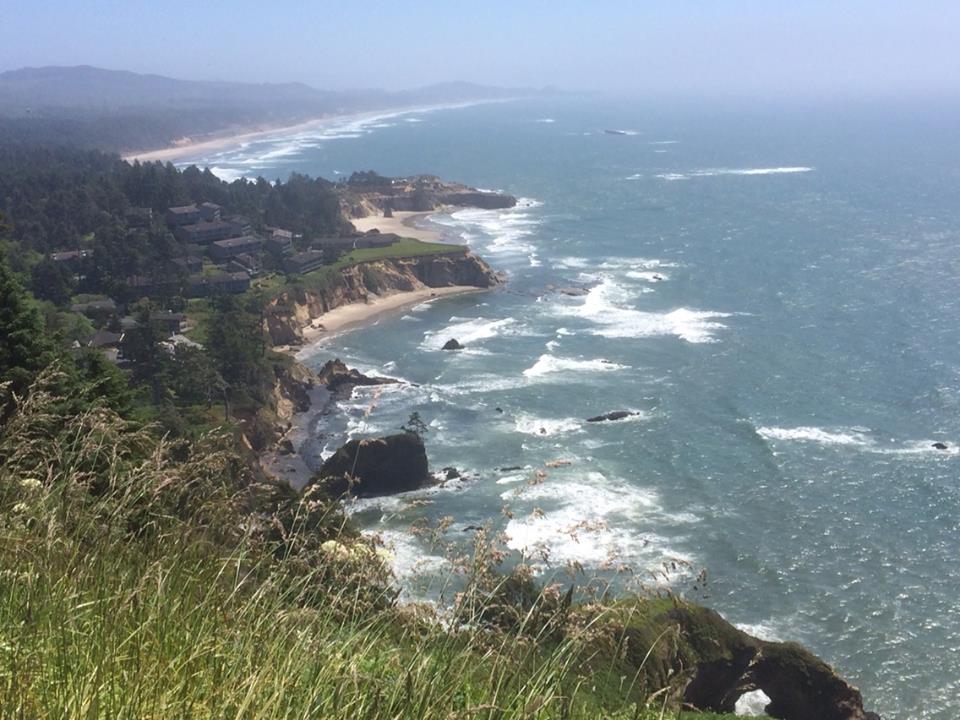
There was a streak of insanity to the journey up the Oregon Coast. Each day I rode for over ten hours. Ten the first day, almost fourteen the second, twelve on the third, and thirteen hours on the last day. Why? I had a week to do it, but I did it in four days, and when I was done I felt like I wouldn’t be able to bike for at least four more. I could have averaged more like eight hours on the road per day instead of twelve. But maybe I wanted to test my endurance, as I pedaled by the eternally enduring sea.
So the trip was a microcosm.
I experienced moments of doubt. What am I doing? Why am I doing this? These feelings are probably normal for any trip, but this one somehow seemed more purposeless to me than any. To go out while resolving not to return is one thing. I can understand that. But to go for a four-day out and back tour, even along a beautiful stretch like the Oregon Coast—that is more difficult to understand. Yet I was doing it. I felt like I needed to do it. I certainly wasn’t doing it for fun. There were moments of exhilaration, feelings of strength. But more often it was painful. The wind on the way north was relentless, that cannot be stressed enough. The going was slow. It was work more than fun, work without the weekly check. It is easy to forget how to have fun, and often times I forget. I was not taking an easy ride up the coast. I was booking it, a man on a mission, but what my mission was exactly, I couldn’t say. When I started going and the wind was relentless, I just grimaced. Very well then, into the wind. I welcomed the wind with wild grins contorted by pain.
There was something holding me in Oregon, something I felt was concurrent with my purpose as an individual, but its hold was getting looser. Still, I couldn’t go out if I wouldn’t come back. But as long as I returned I could still go. I wanted to push through all feelings without pushing any of them under. I felt as unsettled and restless as I ever have. I knew the best way for me to deal with those feelings was to keep moving, keep cranking up the revolutions and intensity until I could crank no more. On the trip, that worked; after the trip ended I felt exhausted and could barely move for a few days and then the restlessness returned with a vengeance, what had been holding me loosened its grip still more, and I ended up returning to the coast to do Oregon’s southern route.
I experienced moments of loneliness. On a solo trip, there will be loneliness. I would rather be alone and experience occasional bouts of loneliness than be with another and desire to be alone. The desire to be alone is usually stronger in me than the desire for a companion. When it is not, then I feel lonely.
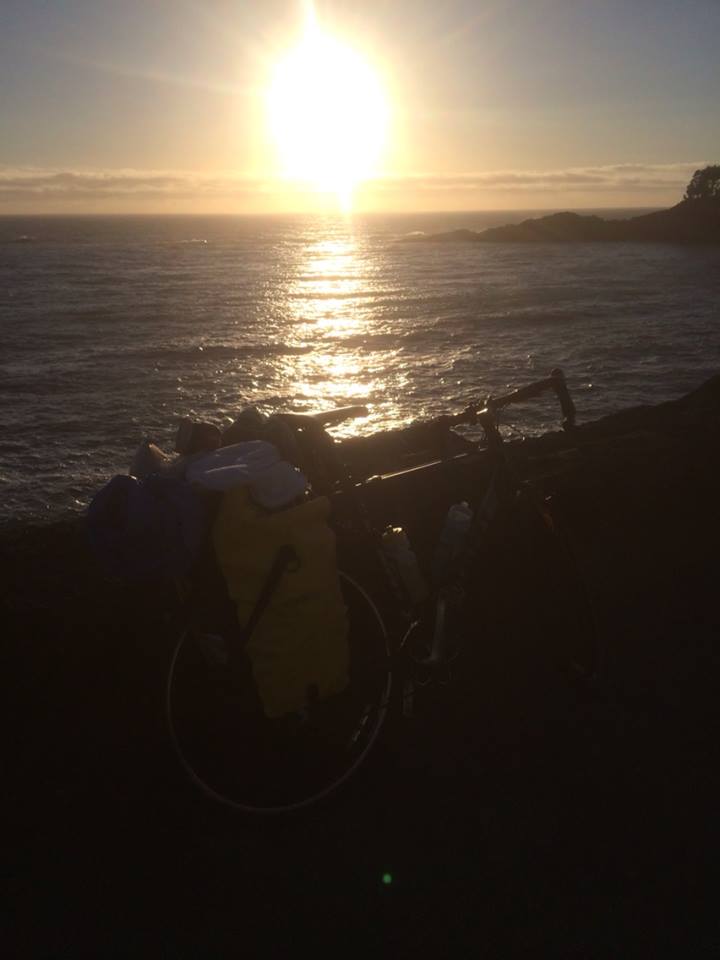
I remember passing a party on the outskirts of Tillamook on Saturday night, heading back from the Washington border. I saw a woman and man kissing out on the deck, the woman in a bikini. The sun was setting. I felt the loneliness; there was nothing to do but ride on, bringing the loneliness along for the ride.
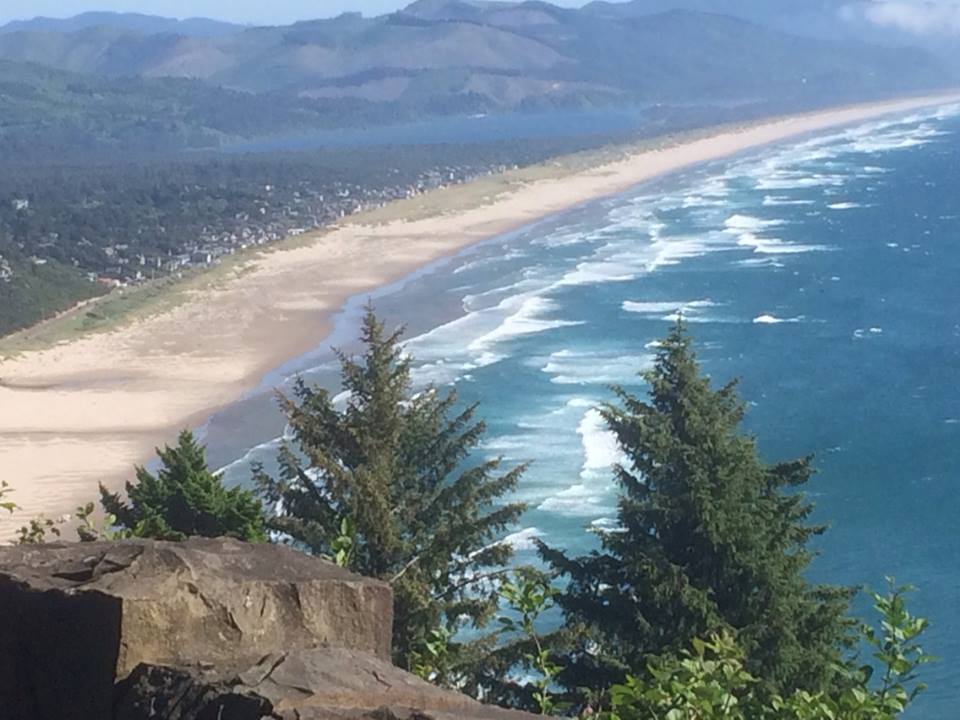
As I rode, I thought about why that particular scene brought loneliness. It seemed so much like the essence of something, some ideal I had always imagined but never realized. The vast sweep of sand stretching out below, empty of people, the magnificent and rock-islanded Oregon coast, the sun sinking slowly, and a young couple having found their place feeling a part of it all, seeing each aspect of the scene—the vastness of the beach, the power of the sea, the brightness of the sun—reflected in the other’s eyes.
A small, for some reason nearly forbidden part of me felt lonely for that life. I knew I would never experience that much contentment, that much peace and easy happiness, for longer than a few hours or minutes. I cannot understand actively pursuing that life. I take those feelings as they come, but I do not pursue them. I have never been able to let myself experience them for too long. There has to be some conflict, some war with the self, some divine discontent, in order to live a creative life. So I tell myself, at least. My creative output would have to be my romantic sunset night. I too was a part of this scene, a part of it all, not least because there was no one else there with me. My aloneness made me an integral part of what a companion might take away from. So my rationalizations went. As I continued moving, the thoughts slipped away like the sinking of the sun. I kept moving as it started to get dark.
But that was the following day. This day was still Friday, one of the most physically difficult days of the trip. I don’t know how to write about the actual biking. I just kept pedaling until I got to where I ended up, which was the brilliantly named town of Seaside. It was painful; I was in despair most of the time; I cursed the cars and wind; I belted out Dylan and Zevon again; and I talked to a long-bearded man who was walking from San Francisco to Seattle. I thought it was strange when he said he was walking. We were in the town of Tillamook, renowned for cows and what comes from cows, and we were both walking . I could see that he was walking. That was evident. I was also walking. Later when riding it hit me that he actually meant he was walking the coast, up to Seattle. That was a more impressive feat.
The long-bearded man was from Flagstaff and wearing a NAU shirt; apparently, he had spent some at the Wednesday community lunch offered at Prescott College. That was quite a coincidence. When I said I went to Prescott College, he said, “One of them, huh?” I wasn’t quite sure what that meant, but I answered, “yes and no.” I didn’t explain further but if I did I would’ve said,
“I go to the school but I do not feel like ‘one of them’, or one of anything, save the human race occasionally. And though I like being outdoors, and most people at Prescott College like being outdoors, that alone does not make me one of them. In fact, that is one of the reasons I find it hard to be there. How do I distinguish myself when there are so many others with the same interests, the same passions. The need to stand out has always been much stronger in me than the need to fit in. However, my natural inwardness does not usually allow me to stand out, except when writing takes my place, and the words are authentic and passionate. And how does it take my place? What place is there to take? Who is authentic? What is passion if invisible? And where do I go if writing takes my place? Who goes? Who writes? Who knows? Go home! You long-bearded expatriate from Flagstaff! Go moan for man! Go eat the famous Tillamook cows! And how authentic is it when it takes my place? You ask. As authentic as a place holder? Have I placed my trust in images and distorted facts? Even you, yesterday you had to ask me where it was at? I couldn’t believe after all these years, you didn’t know me any better than that?”
And then the long-bearded expatriate of Flagstaff would probably be mightily confused because indeed I had just met him less than two minutes ago and had not known him for all these years, unless he knew the Dylan song and then perhaps we would have joined in a duet, and after finishing and radically butchering most of the song I would’ve said, ‘Let’s go, I’ll walk my bike to Seattle with you’ and we would have taken off for the road north and I would never have gotten back to school because I’d be walking up the coast with this man who would call me Alias while I would call him Augustine.
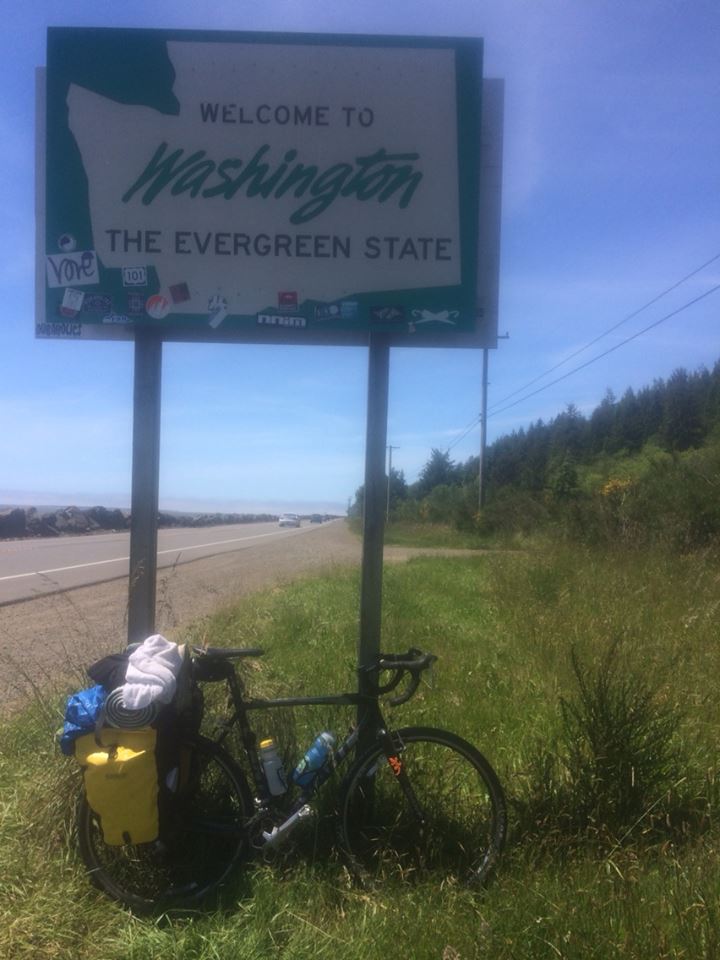
But none of that happened because I just answered, ‘yes an no.’ We talked for a few minutes, I wished him luck, then I took off again for the Washington state line.
The wind was howlin’ and outrageous but I just put my head down and pedaled slowly and steadily until I made it to Seaside close to sundown. All the tent sites were equally as outrageous in price as the wind was in power, so I camped by the side school which I hoped was closed for the summer. Anyways it was Friday night. I ate a burger in a fish joint and then went and saw a movie by myself: Spy. It was very funny but I nearly fell asleep during it for exhaustion.
I slept without issue that night by the school, woke up late, and went to a continental breakfast at the Quality Inn. Illegal! You rotten vagrant! You might roar with scorn and derision in your eyes, to which I probably shrug my shoulders and give no response. Though I was itching to get back to the road, now being only about twenty miles from the state line and the turn around point and the wind at my back, food was necessary, and also free, if illicit. No issue at the Quality Inn either, and some quality eggs, sausages, granola, blueberry muffins, and I forget what else. On previous trips I had once done this often without shame, feeling I deserved it from the riding I was doing, but I was starting to feel slightly uneasy. I was older now, nearing the age when other people were making money, maybe even sleeping at hotels and getting the continental breakfasts with good consciences and emptier wallets. Well, regardless, I was starving and felt I had the right to the food that would probably been thrown out anyways. I wasn’t causing anyone any pain. Entitlement! Rationalization! You might roar with scorn and derision in your eyes, to which I would probably shrug my shoulders and give no response, though perhaps I would secretly agree.
So I ate and went back on the road, where I would ride up to Astoria and get pummeled by wind from what felt like every direction as I rode over the bridge to Washington in order to promptly turn around and head back over the bridge to Oregon. Insanity! You might roar, enjoying yourself now with glee, to which I would openly and wholeheartedly agree, with a shrug and perhaps a wild yodel, now with the wind at my back.
I had planned on starting from Eugene but there wasn’t a place to sleep. Even the Wal-Mart was not an option. No overnight parking, a sign said. I kept driving west towards the coast. The first town off the 101 was Florence. I parked by the beach and slept in the car, the windows down so I could hear the wind and sea outside.
I woke up as the fog was clearing, changed into a swimsuit and ran up the dunes that separated me from the sea. I jumped into the ocean and got out right away. It was low 50’s in the water and not much warmer outside. I got back into the car. I wasn’t sure if I was going to start biking that day, so I had spent a couple hours trying unsuccessfully to do some writing in the library. When I finally decided to get going, it was almost noon, and the wind had picked up in earnest. It usually started about 10 in the morning. I wanted to bike down to the California state line or up to the Washington state line. Washington was further, and I had a few days, so I headed north.
I parked the car and got my panniers ready in a Fred Myers. I saw signs here that also said No Overnight Parking, but I thought I’d risk it. There wasn’t any better place to park. I was feeling somewhat paranoid. I didn’t know anyone, and I just wanted to get on the road. I didn’t want anyone to pull up and ask me what I was doing or tell me that there was no overnight parking here. Usually, I enjoy the feeling of being a stranger, unknown and passing through, but only when I’m actually passing through. Be in the same place for too long and you might start to get recognized! Better to go unrecognized. Invisibility has always been the most desirable superpower to me. As a traveler, invisibility comes naturally. You blend in on the outside while still remaining unblended on the inside. Actually, often times you don’t blend in on the outside. The weight on the back of my bike would clearly distinguish me as an outsider. Very well, an outsider is usually what I prefer to be.
I quickly threw in some food and clothes in the panniers, not thinking all that much about just what I was throwing in, loaded on the tarp and sleeping pad, checked for a second to see if I had everything, and started pedaling. It was about noon, and I moved slowly for the first few miles, the same way I moved for most of the journey north. I hadn’t reckoned with the wind, which was strong and blowing directly into my face. I would also have to get used to the weight, which was 60 pounds at the least and probably more. Hunter Thompson writes in The Rum Diary, “I had a flash of something I hadn’t felt since my first months in Europe—a mixture of ignorance and a loose, ‘what the hell’ kind of confidence that comes on a man when the wind picks up and he begins to move in a hard straight line toward an unknown horizon.”
This is how I felt. Instead of despairing over the wind, I felt reckless, adventurous. I was pedaling against a powerful force; the wind was brutal, punishing, unforgiving, and indifferent to all comers. So be it. I would rather make my way against the indifferent wind along the rocky splendor of the Oregon Coast than try to make some legal tender by going up the actively cruel ladder of human production and consumption.
The miles were hard-earned from the get-go. Highway 101 climbs out of Florence before it drops down to Yachats. So I climbed. It took me a long time to get to Yachats, maybe three hours to go the 24 miles, maybe more. I realized in my paranoid rushing in the Fred Myers parking lot, I had forgotten a phone charger. I wanted to keep my phone charged in case I decided to go a different route or to look up things to do in the towns I passed through.
John owned the ramshackle electronic shop in Yachats, cords and wires all over the place. He only took cash. ‘The grocery store gives cash back,’ he told me. ‘You can pick up a snickers.’ I realized that was exactly what I craved, so I went to the grocery store next door, picked up two snickers and an espresso drink. It was a habit I would continue through the four-day trip, during which I ate horribly. Then I went back and talked with John about the wind. That was really the only thing on my mind. The wind has that way about it, clearing the mind of anything else but itself, the force you’re biking into. John told me that the difference in temperature between the coast and the inland was as much as forty degrees this day. It stayed that way into the weekend. 60-65 on the coast, close to 100 inland. Apparently, this difference was the cause of the ferocious wind, my brutal enemy on the way north and my good dear friend on the way south. He said some other things but my mind deemed them too scientific to understand.
I wished him good health (he was just getting over a flu) and then again it was to the road. I had gotten over one mighty hilly section and for a while the terrain was relatively flat. I had passed one woman a few miles before Yachats who looked like she was in utter despair, her head in her hands on the side of the road. I felt like if I stopped it would be a while before I continued, so I didn’t stop and give her the support I couldn’t have given her anyways. Now there were bikers going the other way, with the wind, looking exuberant and light. The opposite of me. They would wave happily at me and I would grimly put up a hand. There were many of them going the other way, but in my days on the road, that one woman in despair was the only one I saw going north against the wind.
I had driven this route the previous December, when I was heading from Alaska, where I had spent the fall with my cousins, to Arizona, where I was going to start college. I remembered staying the night at the Dublin House in Yachats and then getting off the 101 the next morning, driving to Eugene and getting on the I-5. Back then, somewhere north of Florence and south of Lincoln City, somewhere around where I was biking now, I had jumped into the ocean, though both the water and the outside temperature were in the 40’s. I had written this a few weeks afterwards,
“There was a definite feeling, on this December day on the Oregon shore, that I was not an important part of this scene in any way. Whether I or anyone else was here, the sea would remain, sometimes calm and sometimes violent, the waves would crash, the islands of rock and trees would stand. It was a reassuring reminder, the patient indifference of the lively inhuman elements.
In the summer, I’m sure the beach would have swarmed with men and women and children. But today it was empty of people and full of life. I wasn’t distracted by bathers and surfers, and I was able, when I paused for a few moments before I got to the car, to appreciate the beauty that surrounded me—the massive rock islands that stood to the south, the light Irish drizzle that fell from the low grey sky, the seagulls that soared north with the coastal winds. The realization that I was irrelevant to the scene was a simple one, but it freed me from the narrowing self-absorption that comes from driving alone, one of many poor souls detained in cars on the endless road, with only billboards for company, brought me back to the larger open world around me, the sands and trees and sea, including me but not requiring my presence.”
The self-absorption that driving brings does not come as much when biking. Because cycling is a physical struggle, the mind has no time to sink into self-pity or self-absorption. It must be in tune with the body, focused on pushing forward. When the body is not moving, the mind is free to do what it pleases, to be absorbed with itself and unresponsive to the outside world. Biking allows for another type of absorption, an absorption in movement and activity. On the coast, I was able to be present and responsive to the world of rock and sea and sky and trees. I was forced to be present; I could not help but be where I was. If my mind drifted at all, the biking would quickly become more difficult. The body needed the mind in order to persevere. The coastal winds added another element that required even greater presence. To ride north on the Oregon coast in the summer is a long and arduous lesson in patience and acceptance. I had to let go of any idea of myself as strong, as physically powerful. I was no match for the wind. To work with the wind at all I had to go slowly. There was no other way. I had to put my head down and endure the pain without expending unnecessary energy.
I continued on into the night. Each time I wanted to stop for the night, I told myself to keep on for just a few more miles. Who knows why? I simply wanted to keep going.
I was also in a stretch without many places to camp for the night. Newport was fifty miles from Florence and Lincoln City was eighty. Between the two, I don’t remember seeing any places to camp other than RV campgrounds, where tent sites are exorbitant, up to $40 a night. One of my rules of the road is never paying to sleep if I can help it. If I do have to pay, the maximum price I am willing to spend is $6, the price of a tent site in the national forest and state park campgrounds. I was also riding through a busy stretch. This first day on the road was a Thursday but it might just as well have been a weekend day. The highway stayed like this all the way up from Florence to the Washington State line and back again. The noise was at times unbearable for me, and so I put in headphones, diluting my ability to be present. But most of the time, even when I was riding right next to the ocean, I could not hear it or smell it because of the noise and exhaust from the cars. So I listened to Bob Dylan, belting out his Blood on the Tracks album.
“But me I’m still on the road,
Heading for another joint.
We always did feel the same
We just saw it from another point of view
Tangled up in blue”
Or Warren Zevon:
“Gridlock, up ahead
There’s a line of cars as far as I can see
Gridlock, goin’ nowhere
Roll down the window, let me scream”
Finally, past 11, I pulled into a state park in Lincoln City, about eighty miles from where I had started in Florence.
Feeling empty in myself
I took to the highway
Where I rode under a menacing sky
Filled with vultures descending on sheep
Scattered amidst dew-covered grass by the sea
On that morning when the mist would not lift.
Feeling empty in myself
I opened and closed the cabinets of a desk
Looking for a letter she wrote me long ago
Her words overflowing with feelings
I once thought would fulfill me.
Feeling empty in myself
I filled up a notebook with words
Looking for the word
That would shorn me of myself
Long enough to be reborn.
Feeling empty in myself
I began to celebrate my fill of error
And lament my still-born success.
I undressed my undirected terror
And began to caress its undefended neck.
Feeling empty in myself
I discovered a dimly lit tavern filled with spirit.
Finding myself unable to soar with spirit
I sunk instead into soul
Until I could no longer hold under
What could only be driven up and out.
Feeling empty in myself
I imagined a life bounded by a journey never taken
Roads closing in on me as I hung on tight.
I put one hand on the ground
And raised the other to the sky
That the moon would soon overtake with light.


 Brian Leibold