Reflection on Carmel Point, by Robinson Jeffers

Carmel Point, Robinson Jeffers

The extraordinary patience of things!
This beautiful place defaced with a crop of suburban houses-
How beautiful when we first beheld it,
Unbroken field of poppy and lupin walled with clean cliffs;
No intrusion but two or three horses pasturing,
Or a few milch cows rubbing their flanks on the outcrop rockheads-
Now the spoiler has come: does it care?
Not faintly. It has all time. It knows the people are a tide
That swells and in time will ebb, and all
Their works dissolve. Meanwhile the image of the pristine beauty
Lives in the very grain of the granite,
Safe as the endless ocean that climbs our cliff.-As for us:
We must uncenter our minds from ourselves;
We must unhumanize our views a little, and become confident
As the rock and ocean that we were made from.

I am on a flight from one coast to the other. In spite of myself, I can’t stop looking up at one of the sixteen screens that hang above the seats on either side of the aisle. There’s no sound, but my eyes are drawn up by the moving images. The screens are all showing the same TV show, which I’ve never seen or heard of; I stare at it for a minute before I realize what I’m doing. A minute lost. I don’t have all time. I have only this minute, and if I fear losing it, or regret that I lost the last one, then I am not in it. In this minute I am in the center of a plane, surrounded by crying babies and soda-swilling compatriots, catered to by flight attendants, swiftly propelled across the country. Taking advantage of modern convenience. Something Jeffers may have scorned me for.

Without that convenience, though, I would not have spent the last week with my family, in California. So it is not all bad. But it is definitely not all good. If I do what is convenient all the time, what is easiest, I am not truly living. I’m moving on autopilot.

In the Jeffers poem, the first twelve lines describe the landscape, what is sometimes called the more-than-human world. Only the last three tell what Jeffers believes we, as humans, must do: uncenter our minds from ourselves, unhumanize our views, become confident as the rock and ocean. Convenience does not breed confidence. Neither does being catered to. What will breed confidence?

Jeffers single-handedly built a stone tower, what he named Hawk Tower, at his stone house on Carmel Point. It took him four years. He constructed a ramp and would roll rocks up from the beach to the cliff top where he and his wife lived. His wife loved towers, so Jeffers made her this one as an act of love. In building the tower he must have found strength and confidence. He was not hoping to construct something that would last forever, to be marveled at by coming generations. He had faith that one day the sea would cover it. But the tower stands today, one hundred years after it was built, and may stand for many more hundreds of years. Two days ago I visited the house where Jeffers lived, Tor House, and climbed the tower, looked out over the same stretch of sea, the same rocks and the same cliffs, that Jeffers did.
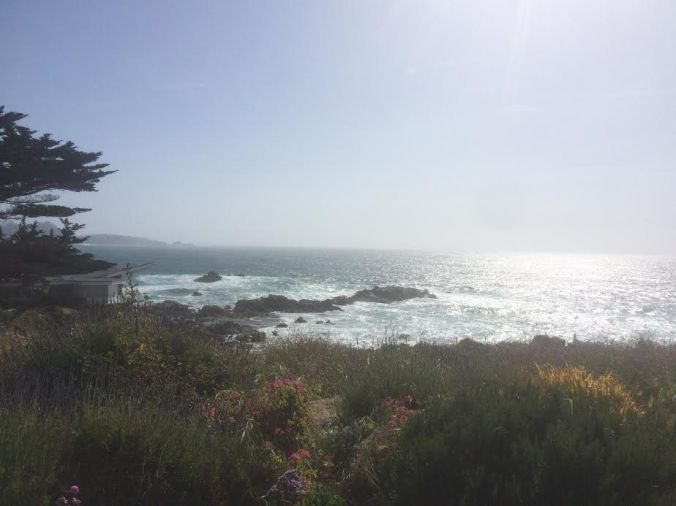
view from Hawk Tower

View from Hawk Tower

Become confident as the rock: what better way to find this confidence than by working with rocks, suffering physical hardship by bearing their weight, cementing them in place and bringing them together to form something wonderful in its austere yet elevated beauty? Each stone in the tower exists as itself and is also part of a greater something that stands as a marriage of the still and eternally patient strength of the inhuman with the creative strength of human vision. Only by imitating the extraordinary patience of the rocks could Jeffers build the tower of rocks. Jeffers would look out from Hawk Tower over the sea at night as the waves crashed against the black rocks off shore. What did he contemplate in those nights? Was his mind as empty as the clear California night sky? Or was some of his energy dissipated in resisting the human sea of houses being built behind him, beginning to suffocate his once-remote Carmel Point?
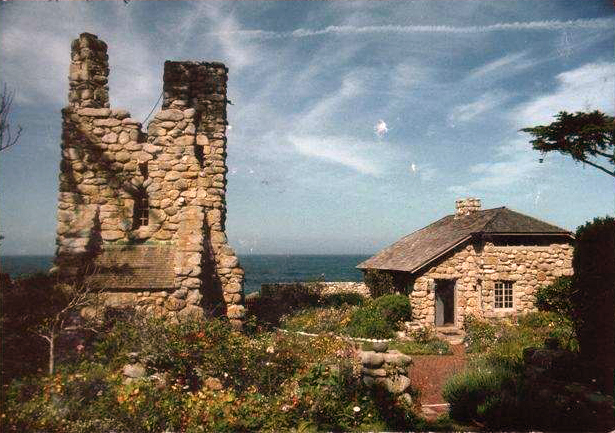
Tor House

Tor House and Hawk Tower, image from: http://patrickryanfrank.com/

It knows the people are a tide / That swells and in time will ebb, and all / Their works dissolve. Including the works of Robinson Jeffers, of course. Did he care? Who knows? Whether he cared or not was his own concern.

My concern right now is the crying baby on this plane. If it does not stop, I may go insane, and though I don’t hold on to my sanity too tightly, since it hangs by a thread most of the time anyways, I don’t really care to go insane when I’m trapped on a plane. Why does the crying baby bother me so much? For one thing, it’s loud. It makes it hard to concentrate. It brings me abruptly to the surface, jarring me out of whatever thought or feeling I was having. But is that such a bad thing? The crying baby is what is happening right now, and my reaction to it can, if I let it, if I become aware of it without resistance, teach me something about myself.

But if I try to listen to it without resistance, in the hope that it will teach me something about myself, I will learn only that I am still ignorant. I cannot try not to resist. I resist instinctively. Something in me hardens, as if protecting myself against the sound. It is not a reaction I have much control over. I can’t not do it. But what does any of this have to do with Jeffers and Carmel Point and turning to the rocks and sea to learn how to live?

Somehow I must turn and love even the crying baby, the thousands of people in the airport, the insanity of going through security, the tremendous speed of the thing, as if everyone involved is embarrassed at the fact that our trust for each other has diminished to the point that we are forced to implement these measures. It may be that I cannot love what is in front of me unless I look away from it, look out the window to the deserts of the Southwest, the book Desert Solitaire by Edward Abbey in my lap, on my way across the country to what Abbey called the ‘Siberian East. Look away towards that freer world rather than let my eyes be drawn without my soul’s consent towards the screen at the same time my ears are unable to drown out the baby’s cries. But no, I cannot look away or close my ears. I have an obligation to look everything in the eye, whether it repulses me or attracts me or awes me. I must be able to walk through the rough seas of the airport and experience the same inward love, which has all time, as I experience when I look out from Hawk Tower over Carmel Point, at the sea that has all time.

I don’t know how to do this. I hate loud noises; I hate crowds; and I hate the hardhearted attempt to strip me of my individuality and treat me like one of the crowd. Must I love what I now hate?

We must uncenter our minds from ourselves. What I need cannot come from my own action. If I try to get what I think I need, my action will be centered on myself, and I will not get what I need. I need a deeper center. But I don’t even really know what I need. I don’t know if I must love, or if I’m only saying this because I heard it somewhere. I cannot make myself love, so to say I must love is to doom myself to despair when I fail, as I must. And yet I must love, and so I must fail.

We must unhumanize our views a little. Instead of focusing on myself, looking always at how I can improve or change or accept or resist or become or be myself, I’d be wiser to let my eyes travel beyond the small concerns of a self convinced it is separate, to take in a wider view of the larger world: unbroken field, clean cliffs, endless ocean. Perhaps in contemplating the unity of that world, I will find that I have always been a part of the unity, that I have never been separate. If the world has all time, and what I truly am is not separate from the world, don’t I too have all time? But thinking is not believing. I might think it could possibly be true that I am not separate from what has all time, but I will never be convinced of this unity, and thus believe without a doubt that I too have all time, so long as I’m striving to fill what time I do have with petty concerns and desires—the desire to achieve and be admired, the desire to be comfortable and secure, the desire to take risks and so alleviate boredom and dullness, the desire to be discovered, the desire to find a soul mate, the desire to be alone, and all the other desires that seem so significant and real until my views expand a bit, and I see what else is here. Thank Heaven, writes Thoreau, here is not all the world.

Thank Earth, thank rock and sea and space, not all the world is fit for human habitation. Let me not become so habituated to human habitations that I forget what I was made from, which is intimately linked with what I was made for. As the rock and ocean that we were made from. I was not made to forget what made me, but to return to it. I was not made to live so enmeshed with the human world, so enslaved by my own human habits, that I forget to look up and see the unending beauty of the unspeaking world, and remember that it has no need to be seen and no need of me to see it. And yet I see it, and how will I receive the gift of this seeing?

Will I let myself be humbled? Will I look at the rocks against which the sea crashes, and let my heart be softened? I can only let the softening happen or resist it and impede it from happening. The river, though powerful, does not force its way to the sea. It flows on its natural course. We dam it, of course, as if that will help, and then we water-ski on the surface of the dead, defaced lake we have made, moving all together only in clockwise direction around and around, circling our falsity. We ski on the surface of the fake lake we have made, not seeing the violence we have done to the river that is still living despite our attempts to dam it from Life. We have only dammed ourselves, impeded our own growth, prevented ourselves from softening, and made a true life, one of constant renewal like the water in the river, impossible.

Well, damn.

lake powell

Glen Canyon Dam, photo from: Atlantic

There is no hope in a dam; the water from it will not last forever. It does not have all time. It ends in death and so its very existence breeds hopelessness and despair. When the river is not dammed, when its flow is not impeded, there is no need to hope that it will reach the sea. It will go where it is meant to go. I pray to uncenter my mind from myself, from my view of where I should be going. Let me climb into a canoe and be carried by the current, taking in the view of both banks, seeing at all times what is before me. Let the river teach me where I am meant to go, and let it, at its own pace that has all time, take me there.

grand-canyon-colorado-river

Colorado River through Grand Canyon

“Heartsick”: A Rap

Chewing on a toothpick,
I knew I’d end up heartsick,
the final death of the candle wick,
The light that burned out long ago,
The night I said I had to go,
I was mad as hell, you were high on blow,
How was I s’posed to show you my love
When you couldn’t catch my heat with a major league glove,
You stood above, on your throne, wooden and golden,
In your regal zone while I sat there foldin’
In on myself, like a gin-soaked elf,
Wishing I had another fifth o’ whiskey from the top shelf,
If I did this for my health, I would’ve quit before I began.
Step up to the stand and I’ll declare your rights,
You have a right to clam up, a right to dance all night,
You know I’ll choose the latter cuz it restores my sight
That you took from me, like a blind man at sea,
Like a runner without knees
I stumble off the trail, mumble to these trees,
Seekin’ to seize some sense
From their staunch presence,
Launch myself from myself and into descent,
But the deeper I go the more that I moan,
Moan for you to be near, and this lostness of soul.

Looking into the eyes of no one,
Cuz your eyes are nowhere to be seen,
Blinding my eyes with the distant sun,
Not knowing what anything means;
Now I look into the eyes of no one,
Cuz your eyes are nowhere to be seen,
Now I blind my eyes with the distant sun,
I don’t know what anything means.

Sitting here with eyes closed,
Thinking ’bout what I chose,
And back to all the shows we performed together,
Back to all the storms we endured and weathered,
You shed me then, like a bird her feathers,
And now I can’t soar, like I’m trapped and tethered,
I sit below on the ground, hopelessly lonely
Now I sink and I drown, before you controlled me
You still do from afar, and nothing consoles me,
Friends try hard to cajole me, to restore the soul of me
But nothing they can do could fill this hole, you see,
You left me; nothing can change that fact
It ends finally in rejection, in the final act
Best to reject first, before gettin’ stabbed in the back
If I tracked you now, I’d find you scheming your next attack,
Getting your mask ready, putting on a happy face,
Doin’ the tasks necessary, to give the new man a taste
Of what you are capable of, you’re like a treasure encased
And your grip is inescapable, your lust for power insatiable.
Once under your thumb, chance of escape is negligible
I was born susceptible to Beauty and Passion
And I’ve searched for them both, in my personal fashion
What I thought I found in you turned to entrapment
Now I wander the shores, and the sea is my master,
Ripped asunder by ‘the more’, closing in on disaster,
I’ve lost the ‘before’, and I don’t know what comes after,
Except for this war, remorseless, and my mind my captor.

Looking into the eyes of no one,
Cuz your eyes are nowhere to be seen,
Blinding my eyes with the distant sun,
Not knowing what anything means;
Now I look into the eyes of no one,
Cuz your eyes are nowhere to be seen,
Now I blind my eyes with the distant sun,
I don’t know what anything means.

Well, so that’s the sad view
It don’t negate the glad view
I look up at the blue sky above the canyon wild
I want to explore it all with the instinct of a child
Lost in the roadless miles, i recall your angelic smile,
But I came here to forget that, and I’ve come to resent that
I so seldom saw that smile towards the end,
Ed Abbey’s Seldom Seen could be around this next bend,
Right around where Ruess disappeared and why pretend
I connect more with these two solitaires of the desert
Than I ever did with you and the torn sweatshirt
Of our love, how much more could I get hurt
And still find some meaning before the hearse,
Hope your purse is full, and you’ve found a way to pull
Your own onerous weight, great is the wool
You’d need to pull over your own eyes not to see
Just how much suffering you’ve inflicted upon me
But I’ll let it be, it’s in the past, no need to flee
What’s already behind me, now I’m back on the grind,
And work will be my new love, I’m only at the rind,
And who knows the sweetness I could well find?
No need to remind me of what I never forgot,
My mind is taut, and I’ll teach myself, reach
For what all that can’t be touched by hand,
You understand? I stand alone under the bridge
That separates ridge from river, and yes I shiver
You were the giver, and I received too much
I perceive too much, and it pains the brain
What do I gain by a mirror stained by time?
Is it not plain that I must do more than rhyme?
Fine, clear enough, but here’s where it gets tough,
For I want–I want–I want, but what I want I cannot say,
I wanted you, and look where that’s got me today,
Getting too old to play these games, seek this fame
That doesn’t mean anything anyways. It’s all the same
Only the names are changed, and I’d gladly exchange
This lust I feel now for the love I felt then,
But without that love’s end I wouldn’t be holding this pen,
If it weren’t for that den of lions, I know I’d still be dyin’,
But now I’m living, now I’m getting out on the road,
The world I thought you held, now I get to see it unfold.

Now I look into the eye of the storm,
And I listen for what cannot be seen;
Now I look for the formless in form,
I will listen to the silence to discover what it means

On Writers

I have not met many writers, in the flesh. Which isn’t surprising, I don’t think. I am not one of those who writes who likes to be around others who write. I avoid like the plague all writing workshops, poetry readings, bohemian gatherings, and the like. Writing, like all the arts, is a solitary profession. Any place where writers are gathered together is a place not of art, but of community. The term ‘artist community’ or ‘artist commune’ is paradoxical. The only community of artists is the unspoken one of solitary people at their craft. There are no greater companions I know of than the words in the books strewn about the 300 square foot room in which I live.

The writer, for better or worse, “puts the best of himself, not the whole, into the work; the author as seen in the pages of his own book is largely a fictional creation.” So writes Edward Abbey in the introduction to his book Abbey’s Road: Take The Other. Some would say the writer hides behind his words, but that is not quite true. He reveals himself through his words, but when not writing he tends to hide. Or, he needs to be reclusive in order to be reflective, has a need to be invisible in interactions so that he can reveal himself through what he writes. Abbey says it well, continuing,

The ‘Edward Abbey’ of my own books, for example, bears only the dimmest resemblance to the shy, timid, reclusive, rather dapper little gentleman who, always correctly attired for his labors in coat and tie and starched detachable cuffs, sits down each night for precisely four hours to type out the further adventures of that arrogant blustering macho fraud who counterfeits his name. You can bet on it: No writer is ever willing—even if able—to portray himself as seen by others or as he really is. Writers are shameless liars. In fact, we pride ourselves on the subtlety and grandeur of our lies.

Who is the writer, really? The words he writes seem so different from the way he acts. HIs words may be full of life, but when you meet the author of the words he could be reserved, not all there, as if he is hiding for you, from himself, from life. You may feel in his presence a lack of presence, an absence, a wish not to be seen, to remain invisible. Abbey links the phrases, “as seen by others” and “as he really is.” But these phrases do not necessarily correspond with each other. Others do not often see us as we really are, and this is especially true for the writer, who others likely see as something of a ghost, for the impression he leaves on others is so nebulous or non-existent. At times the writer sees himself in this way, and at these moments his writing may act as a way to counteract this ghostliness, to write himself out of himself and into life, in these moments when life and the self are opposed.

But the writer must remember who he is and who he is not. He should remember not to take much account of how he is seen. Just because he is seen as a ghost does not mean he is a ghost or should see himself as one. The writer lives on a different plane, a plane that could well be closer to the ghostly. In any case, the writer seeks to express the timeless, the eternal, what has truth now, what has always had truth and always will. To do that, he cannot live completely in time; or, if he lives only in time, he does not live a complete life. It is important for any writer that the majority of his time actually be ‘his’ time, that he does not spend it seeing others and being seen. What happens on the plane of social interaction, especially superficial and thus draining interaction, has a tendency to feel unreal even when it is happening, and fade quickly thereafter. It fades from memory but leaves a definite, and definitely unwanted, mark on the soul. What happens alone, whether it brings pain or joy, does not fade, and never carries with it the same strong sense of unreality.

Are writers ‘shameless liars’? Abbey claims that writers lie about who they are now by putting their ‘best creation’ in their words. And there is some truth in that statement, as there is some truth in that lie. But is it a lie? The writer is not willing to portray himself as others see him for he knows that is not really who he is. But who he is—he does not know. It is not true that no writer is willing to portray himself as he really is. That is exactly how he would portray himself, if he could. Any other portrayal of himself is a betrayal of himself. He lies because he must. He wants above all not to portray himself in any unreal way, but rather to become himself, and express the self he is becoming, the self he really is, rather than the self he wants to be or wants to be seen. Until he knows who he is, though, every word is a lie he hopes will lead him to the truth.

But the writer, who expresses everything with such seeming clarity in words, can easily get twisted up in those words. The words start to add to what keeps him living under a lie rather than provide him with a way out of lying itself. Already confused about who he really is, he can become more so the more he writes. What begins as a lie because he does not know the truth becomes a known lie. He must keep the lie going, as he is afraid that he is going nowhere, or that he has already gone too far. Instead of writing to become himself, he writes to express a glorified self, one that takes away some of the pain of his isolation, which is where his solitude, now corrupted, has led him. The glorified self, he hopes, will take away the pain of his isolation by putting him above others; in actuality, by putting himself above others, the glorified self brings about his isolation, and alienates him from who he really is. Karen Horney, in Neurosis and Human Growth: The Struggle to Self-Realization, describes this process as self-idealization.

Self-idealization always entails a general self-glorification, and thereby gives the individual a much-needed feeling of significance and superiority over others. But it is by no means a blind self-aggrandizement. Each person builds up his personal idealized image from the materials of his own special experiences, his earlier fantasies, his particular needs, and also his given faculties.

The self-idealization of the writer, his glorified self, is much-needed to the extent that he feels himself unneeded, without value, unable to contribute anything of worth to the world. The extrinsic value of his work matters little when it comes face to face with his internal evaluator and critic, perhaps his glorified self, who finds all his writing lacking in some or all ways. His glorified self will be unique to him, as Horney makes clear, though it will share aspects with other writers.

As a writer with a solitary vocation, and now with the glorified self, the one he looks up to who looks down on him, he might express a need to be left alone, a wish for a room of his own, the time and space necessary in order to create. All of which are real and actual needs. But he no longer wishes or needs to create works of art that express himself as he is; the need now is to create himself, to become the work of art, the glorified self, who is a great artist, a genius. Becoming the artist has become more important than producing the art. Others should look up to his glorified self as much as he looks up to it. Give it their glory. Yet when he is praised for the work he does actually do, he will not accept the praise. Either the work wasn’t good enough, or it wasn’t really ‘he’ who did the work. What sometimes looks like humility—not accepting praise for some work that he did—is actually the pride of the glorified self for whom nothing done is ever good enough. Why should he accept praise for something he could have done better? Everything could always be done better, and will be done better. Must be done better.

The writer may also glorify his aloneness, and his ability to bear it. “The strongest men are the most alone.” He sees himself as stronger than the rest by the fact that he is able to bear greater aloneness, more intense suffering. But he bears only what he has brought upon himself. And it must be borne, for his solitary endeavor has become more of a prison than a freely chosen vocation. His aloneness must be borne so it can bring him glory, fame, and applause. He must spend time alone without glory now so he can be together with glory later. He will write until he achieves all that the self he glorifies deserves. The unreal self hopes for the unreal. The more he is driven by the idealized self to reach these dreamlike goals, the more he forgets what it means to be driven, how little freedom he possesses as he grows more possessed. To be driven is to have no choice. Someone else has hands on the wheel, and they’re heading the wrong way.

Regaining the capacity to drive now becomes important. Although being ‘driven’ is seen as a positive trait in a society where becoming the glorified self, and being seen, are the highest of goals, in actuality being driven drives you only to the ground. But it does not ground you, since you are driven to fly like Icarus. You get the opposite of what you seek, though to all extensive, external purposes it may look like you are flying. It is not you at all, but your glorified self, the self that exists only in your imagination, that flies away from who you actually are. The more you are driven, the more you become not-you. You out-grow yourself, as the distance between who you are and the self you imagine being grows too vast to imagine closing. Writing is no longer a way back to yourself; it is a way to chase after what drives you forward, but you are always too far behind. Instead of finding the way back, you lose the way completely. You are blindfolded with your hands tied in the back of the mack truck which, if you are not careful, will drive you to the very edge of the abyss, and over.

**************************************************************************************************

Part 2 of ‘On Writers’, and whatever else this essay has deteriorated into, will come at some unspecified time in the future. Await it in expectation. Or not.