Companion to Myself

How will I be a companion to myself this morning? How would I be a companion to another if another were here? I can’t visualize in my mind how I would be, or what I would do, but I can think about it in words. I’d wake up before her and heat up the kettle for tea. I’d go to the study, turn on a lamp, and begin my work. But as I worked my thoughts would return to her, and I would work as if in love with what I was doing, for the one I loved was in the next room, a bright star asleep in the night-sky of my heart.

Can I work with that love now? No one is with me, but why should that stop me from being with myself? The little self, when no one is with it, gets lonely and frightened. It feels unreal without another or without the longing for another that drives it when it’s alone. Where are you being driven, little self? There is a larger self that can be with that little self, be the other that whispers in its ear, ‘be still.’ The little self struggles to relax on its own, and so it can’t relax, for to relax is to give up the struggle. This lonely little self, when it listens to the whispers of the larger self, does not lose its loneliness, for its very nature is loneliness and a deep searing need for something greater than its own fear and confusion. But it may lose its tendency to despair whenever it begins to feel lonely. It may begin to learn that only if it feels the full depth of its loneliness will it be led toward the hole into which it must fall again and again, to learn how it shattered in the first place, what has been lost, and why it still feels so far from whole.

It is hard to be the little self alone, out of place in time. Each of us is here to be much more, and to be much less. To be forgotten enough to remember that we’re not here to be remembered, but to be forgotten. Only then will we remember ourselves. I remember these things this morning. How could I ever have forgotten them?

What is the ‘much more and much less’ that we are here to be? Maybe I’m not ‘here’ enough to say what we are here to be. I’ve got to be here to stay, and stay close to the silence in my inner ear, to hear what I want and why I want it, and what my eternal wanting has to do with my reason for being here.

Most places I go I hear a low groan, and I want to know what that means. Am I the only one who hears it? I sit alone outside in a restaurant overlooking the water. There’s a group of four people around my age at the next table over, and they seem to be in good cheer and robust health. Their attractive faces rarely stop smiling; no one shows any visible signs of discomfort. Yet why do I sense the groans behind their grins? Why is the air pervaded with a tense quality, humid and claustrophobic? I get up, go past them to the car, and drive away. I roll down the window to feel the warm wind and hear the tires groan as they spin along the asphalt. I pass cars and see tired and sunken faces, drooping eyelids, clammy hands on wheels, bodies locked like myself within polished steel frames, each machine sleek and shiny, fat and happy and filled to the brim with gasoline. The untiring Florida sun glints off the glossy hoods. I keep driving. I always feel like a fugitive on a busy road. It always feels like I’m getting away just in time.

I get away from some evils, only to be reintroduced to some of my own, and first amongst these is the desire to get away, get to safety, get rid of everything that bothers me, get across the moat and inside the well-defended castle walls from which I can look down upon the evil world. I look down and out, but another part of me looks back at the one who looks out. The little self, who does not like his sins to be seen for what they are, has been spotted.

This self does not like his spots, his unmistakable marks of imperfection. He does not care to realize that they arise out of his own self. They are of his own making, though they make him into something he is not. He is not the spot, but what he is not is capable of tying his heart into knots, and chaining his soul in the basement of the castle he himself built. He wants out, but each day he adds another brick to his cell wall.

Outside the window, pine trees sway in the wind. The trees are strong, though they have no power over what moves them, what moves through them. Still, little can move them from their strong center, their solid foundation. And if a tornado does come to rip one from the ground, the loss is no tragedy. Another tree will grow in its place, no more a part of the forest than the last, yet no less.

Why am I here in this cell within this castle? Why should I ask God why I am here, if I returned here on my own two feet? Real work is the work of returning, but nothing real can live except in the open air. Anyone can return to the castle, cross the drawbridge that connects to nothing that connects to anything else. The toil of building the castle is futile. Each brick placed in the wall is a wasted hour. I would not recommend the fruits of this labor to anyone. I do not like where it has brought me. But now that I am here, I have time to see why I cannot be. Though no hand of God created this building, even so my living here has not been for naught.

We are here to be much more, to rise up or descend as the case may be, to return to the tree; but only if we are content to be much less, just another leaf on that tree, with singular veins. Sometimes we feel like we are one of the bigwigs; more often we feel like a broken little twig. It is the wish to be one way or the other, or for others to see us one way or the other, that keeps us going the way we have always gone, keeps us in our own way, feeling broken or invincible, or not feeling much of anything at all, or feeling like the single twig that’s been severed from the tree, subject to the power of the human foot, snapping again each time it is stepped on.

The twig doesn’t know what it is. Case in point: it thinks it’s a twig. It doesn’t know where it’s come from. It doesn’t understand that anything ever happened to it other than the apparent tragic injustice that is happening to it now. It doesn’t remember that it was once on a branch in a tree it no longer even perceives as real, and so it feels no need to return anywhere but to the castle in the sand it has built so proudly with its own two hands, that it can see so clearly with its own two eyes. It feels no need to awaken to any other sound than the alarm, which it can hear with its own two ears, that rouses it each monotonous morning. It feels no need to hunger for anything but the meat it can smell cooking on the grill with its own nose, no need to thirst for anything but the sweet wine it can taste on its own tongue.

It doesn’t remember where it was; it recalls only how it has lain for so long on the ground, being stepped on and snapped into thousands of pieces, strewn about in every direction by the wind. If only it could remember that it was once a part of a great tree, with roots extending far down into the earth, it might remember how to return there.

Real work is the work of returning. I return from the world, a particular part of the groaning world where the soul has a chance to express itself in its present state, however clumsily, without fear of rejection. This place is often a basement room, but here in Florida it is an outdoor porch, in the shade off the highway by the Intracoastal Waterway. On this porch sit those who were once restless and insatiable, who could not get enough of what they imagined finally made them feel like enough, until they were so taken by their thirst for this thing that they had nothing left to call their own, until they had finally had enough. They find shade here and the strength to keep working. Call them by any name you wish. Once they may have been called seekers after truth; now they are linked by another name. I am one of them. I am just another leaf on a branch of a great tree seeking to remember what I am meant to be. Not the twig I became after I fell from the tree to the ground and was stepped on and tripped up for years by countless feet, not least my own, but what I am when I return to the tree.

Real work is the work of returning. I am meant to return, and I mean to do so. I mean to be who I’m meant to be. Great tree, help me start by being a companion to myself this morning. Help me contact your root that connects me to everyone else. Help me find an everlasting freedom in that chain.
 

Reflection on Shine, Perishing Republic, a poem by Robinson Jeffers

Shine, Perishing Republic

While this America settles in the mould of its vulgarity, heavily thickening
to empire
And protest, only a bubble in the molten mass, pops and sighs out, and the
mass hardens,
I sadly smiling remember that the flower fades to make fruit, the fruit rots
to make earth.
Out of the mother; and through the spring exultances, ripeness and decadence;
and home to the mother.
You making haste haste on decay: not blameworthy; life is good, be it stubbornly
long or suddenly
A mortal splendor: meteors are not needed less than mountains:
shine, perishing republic.
But for my children, I would have them keep their distance from the thickening
center; corruption
Never has been compulsory, when the cities lie at the monster’s feet there
are left the mountains.
And boys, be in nothing so moderate as in love of man, a clever servant,
insufferable master.
There is the trap that catches noblest spirits, that caught – they say –
God, when he walked on earth.

—Robinson Jeffers

Before readers dismiss this poem as misanthropic, I’d advise re-reading the poem. I do not hear a misanthropic voice; I hear a realistic one. This American republic, like all republics, will perish. The flower fades to make fruit, the fruit rots / to make earth. The quicker the rise, the quicker the fall, and the sooner the earth returns to its natural state.

You making haste haste on decay. This is not a criticism or a judgment. Not blameworthy: no one deserves to be blamed for it; it is the way things are. They could be different, but Jeffers does not claim they should be different. He only says that there is another way: corruption / Never has been compulsory, when the cities lie at the monster’s feet there / are left the mountains. There is a free way, which compels no one, a way as pure as the mountain air, but whichever way human beings choose to go, life is good.

These three words are now unfortunately a slogan for some company, and my initial reaction is to make a judgment of this fact, to call it unfortunate, in which labeling I engage in hypocrisy. I make an initial judgment by saying it’s not good to criticize or make judgments about what is bad and what is good, and then I judge and disparage the use of this phrase in this advertising campaign. Life may be good for the creators of the “Life is Good” T-Shirts, according to the corrupted values of a capitalistic society, but only at the expense of very many lives which, by the definition of the same corrupt society, are not good. Luckily only the definition of each person who lives his or her own life can be considered valid. I cannot define whether another’s life is good or bad. How much less can a society define whether the lives of its members are good or bad? I cannot even judge the goodness or badness of things that happen in my own life. It is necessary for me to be open to all events and not judge them from my own narrow and limited and conditioned perspectives. And in this necessity I fail, almost without fail.

But back to the question of haste, the desperate need to do things quickly, which I am actually experiencing right now, as I rush to write these words, wanting to move on to other creative endeavors. I am not fully present with this work, and by not being fully present I am choosing to act according to the dictates of the society I judged in the above paragraph, which urges everyone to be in a state of constant tension and impatience, doing everything at the greatest possible speed.

Nature, on the other hand, does not act with haste; with patience and without undue effort she is attuned to her own law. She cannot be other than she is; only man, that changeable beast that so often becomes what he is not, can alter her course. When an individual follows the law of his own true nature, he also does not act with haste. Why should he rush? Can getting that next degree save him from death? Can being praised for his work help him achieve immortality? When he rests in his true nature, he knows there is no need to pursue eternal life, as if it is something that can be caught and held onto. You cannot try to snag Life without hitting a continual snag, without being dragged over the rocks and thorns by your effort to reach what you cannot reach, holding on so tightly as you are to the frayed rope, which you imagine is attached and therefore connected to the unreachable object, Life itself; but in fact the rope is only attached to and held by your own hands, which are unwilling to let it go, and this holding on so tightly is the actual cause of your unreasonable and relentless pain. How can you do anything useful when your hands are glued to a useless rope?

The question of excessive haste echoes Thoreau: Why should we be in such desperate haste to succeed in such desperate enterprises? If a man does not keep pace with his companions, perhaps it is because he hears a different drummer. Let him step to the music which he hears, however measured or far away. These lines are music to my ears. When I dance, I do not move to the beat of some song that isn’t playing. I dance to the beat I hear; it is the rhythm itself that stirs me into movement. I do not try to move to the rhythm; the rhythm moves me. Because I have allowed myself to be possessed, I find that I’ve been set free. The music can enter me freely, through the opening the music itself has created. The sound passes through this gap, and an invisible cord connects the beat of the music to the beat of my heart. I dance from within the sound that has entered me; my heart beats in tune with what I hear, and my body moves at the same speed that my heart beats. My heart beats fast. Meteors are not needed less than mountains. The tune I hear is not measured or far away; it is an exhilarating tune: intense, closer than my own self, and wild. Oh, but how rarely this tune stirs my heart, and how deeply I yearn to hear it always!

When the song is over, the true dancer leaves quietly. He does not bow or allow for applause. All praise belongs to that from which the music came. Some would say the music came from the musicians; others would give credit to a different, less visible source. In any respect, the dancer slips away unnoticed. Perhaps he was dancing inside; he steps outside, nothing more and nothing less than a servant of the stillness of that particular night. The stillness he follows obediently leads him unmistakably to the center of the night’s music. It is in the stillness that the music is found; the man walks in its wake. How foolish this dancer would be to call himself a master of the art he so enjoys! He is no longer in love with himself; he knows well the torturous suffering of that incestuous affair. He loves himself now no more than is necessary, and so his love is free to expand out into the night, free to rise up into the air to kiss the gentle wind at his back, free to disappear into the moonlight on the building that might otherwise lack perceptible beauty, free to bring him down to the soft earth the soles of his feet touch lightly, making little sound. He follows Jeffers’ maxim: Be in nothing so moderate as in love of man, a clever servant, / insufferable master.

The poem ends: There is the trap that catches noblest spirits, that caught – they say – / God, when he walked on earth. Looking at the text itself, the transition from one line to the next throws a little doubt into whether Jeffers himself believes this is the case. They say that God was caught in the trap of being immoderate in love of man; Jeffers declines to say whether he agrees. Does the phrase “they say” refer to the belief that Jesus is God, or to the question of whether Jesus fell into the trap, but assumes that Jesus was God, or could the doubt refer to both questions? I don’t know.

I would need to closely read the gospels in order to come to my own conclusion about whether Jesus did fall into the trap. Instead I decide to go with another tactic: I open up randomly to the King James Version of the Bible. I like this version despite or maybe because of its antiquated language. To me there is no sense that the language is somehow too old, not modern enough, to convey the truths in the words. On the contrary. And the passage I open to is from Matthew 10: Behold, I send you forth as sheep in the midst of wolves: be ye therefore wise as serpents, and harmless as doves. But beware of men: for they will deliver you up to the councils, and they will scourge you in their synagogues…And ye shall be hated of all men for my name’s sake. (10:17-18; 22)

These words do not come from an immoderate love for men alone. Rather: Beware of men. And: In the midst of wolves. An immoderate love of men would be one that somehow is blind to the divisive elements, the treacherous divorce between beast and angel, in man’s heart. There is no such blindness evident in these words. Instead, they will scourge you. Jesus is aware of how unwilling most people are to confront the truth. Let’s look back at the Jeffers’ poem: But for my children, I would have them keep their distance from the thickening / center. Jeffers has a similarly realistic wariness when it comes to dealings with the corruptions of human beings, but a different approach to that corruption. The Bible verse begins with Jesus saying: I send you forth, that is, into the world, into the very center of the corruption. Jeffers prefers a more detached stance. He advises keeping one’s distance.

Let’s look at one more passage again from Matthew 10, a few more verses on: Think not that I am come to send peace on earth: I came not to send peace, but a sword. For I am come to set a man at variance against his father, and the daughter against her mother, and the daughter in law against her mother in law. And a man’s foes shall be they of his own household. He that loveth father or mother more than me is not worthy of me: and he that loveth son or daughter more than me is not worthy of me. And he that taketh not his cross, and followeth after me is not worthy of me. He that findeth his life shall lose it: and he that loseth his life for my sake shall find it. (Mt 10: 34-39)

Again, it is certain that no immoderate love centered upon human beings is present here. This passage deserves much more time than I can give it, since my primary purpose here is to reflect on the Jeffers’ poem, and this passage, if I am diligent about trying to understand it, will perhaps take me far from that purpose. Still, what verses! Difficult to reconcile these lines with the conceptions most people have about Jesus coming to bring exactly the peace on earth that he expressly denies that he has come to bring. In fact, not only has he come not to bring peace on earth; he has come to bring a sword, a symbol of division and bloodshed and war. But before some bloodthirsty menace takes these verses as reason for declaring the next “just” war, let’s take a closer look.

I came not to send peace, but a sword. What can this mean? What kind of sword is meant here, and for what purpose? Is the sword referring to the fact that Jesus has come to set a man at variance with those of his own household? And why has Jesus come to do that? The last verse reads: He that findeth his life shall lose it: and he that loseth his life for my sake shall find it. Life that is found and experienced inside the limiting embrace of one’s household is the life that must be lost. Freedom is not finally found there. If personal love for one’s family is greater than an impersonal and universal love for the Source from which one’s family came, this love is not altogether worthy. There is too much mixed up with it. It is not a pure love. Perhaps it is a love based on what you are given; or based on preference, preferring those of your family to those outside your family; or based on the comfort you feel with your family, a comfort you don’t feel outside your family. True love is not based on preference or comfort or selfishness. One wonders if Jesus would not have found truth in Jeffers’ statement: Be in nothing so moderate as in love of man.

Not to send peace, but a sword. A corrupt peace is no peace at all. A peace that ignores the wolf in oneself is death. Peace can be life given or death chosen. Many who claim to choose life have never received Life, though abundant Life was offered freely. Now, having already given themselves over to the death of immoderate hate, they mass together to protest for life and love, and do not see their contradictions.

If I do not see that I am divided, I will stay divided. I must use the sword to divide what in myself comes from myself, and what comes from God; what is corrupt and conditioned, and what is pure and unconditioned; what is true, and what is false. If I notice that I am being false, I may discover in that instant what is true.

Immoderate love is vain, and vanity is blindness. An immoderate lover of mankind might call any change in himself an affront on human nature. He is the way he is, he says proudly, and there’s nothing he can or wants to do about it. Settling smugly in the mould of his vulgarity he would call “being himself.” The immoderate lover does not want to change; he only wants other people to think he wants to change. He will make a god out of his yearning for God and then lie at the monster’s feet praying for forgiveness, not understanding that where he lies is a lie, and that in the very act of supposedly praying, he sins, for he thinks he prays to God, when in fact he prays and falls prey to the wolf in himself.

I pray today not to fall prey, to feed neither the beast of hate nor the beast of immoderate love, to keep my head up and my eyes wide open, as I slip away unnoticed and step outside to walk the road by moonlight, to listen for the bright music in the night’s stillness, to hear the door of my heart creak open slowly, and feel the steady beating of its life force in perfect tune with the perpetual crunch of my feet on gravel, and enjoy the artless rhythm, the effortless union of body and heart; of sheep and wolf; of living man, too soon to perish, and living earth, which he knows will shine on.

Reflection on Carmel Point, by Robinson Jeffers

Carmel Point, Robinson Jeffers

The extraordinary patience of things!
This beautiful place defaced with a crop of suburban houses-
How beautiful when we first beheld it,
Unbroken field of poppy and lupin walled with clean cliffs;
No intrusion but two or three horses pasturing,
Or a few milch cows rubbing their flanks on the outcrop rockheads-
Now the spoiler has come: does it care?
Not faintly. It has all time. It knows the people are a tide
That swells and in time will ebb, and all
Their works dissolve. Meanwhile the image of the pristine beauty
Lives in the very grain of the granite,
Safe as the endless ocean that climbs our cliff.-As for us:
We must uncenter our minds from ourselves;
We must unhumanize our views a little, and become confident
As the rock and ocean that we were made from.

I am on a flight from one coast to the other. In spite of myself, I can’t stop looking up at one of the sixteen screens that hang above the seats on either side of the aisle. There’s no sound, but my eyes are drawn up by the moving images. The screens are all showing the same TV show, which I’ve never seen or heard of; I stare at it for a minute before I realize what I’m doing. A minute lost. I don’t have all time. I have only this minute, and if I fear losing it, or regret that I lost the last one, then I am not in it. In this minute I am in the center of a plane, surrounded by crying babies and soda-swilling compatriots, catered to by flight attendants, swiftly propelled across the country. Taking advantage of modern convenience. Something Jeffers may have scorned me for.

Without that convenience, though, I would not have spent the last week with my family, in California. So it is not all bad. But it is definitely not all good. If I do what is convenient all the time, what is easiest, I am not truly living. I’m moving on autopilot.

In the Jeffers poem, the first twelve lines describe the landscape, what is sometimes called the more-than-human world. Only the last three tell what Jeffers believes we, as humans, must do: uncenter our minds from ourselves, unhumanize our views, become confident as the rock and ocean. Convenience does not breed confidence. Neither does being catered to. What will breed confidence?

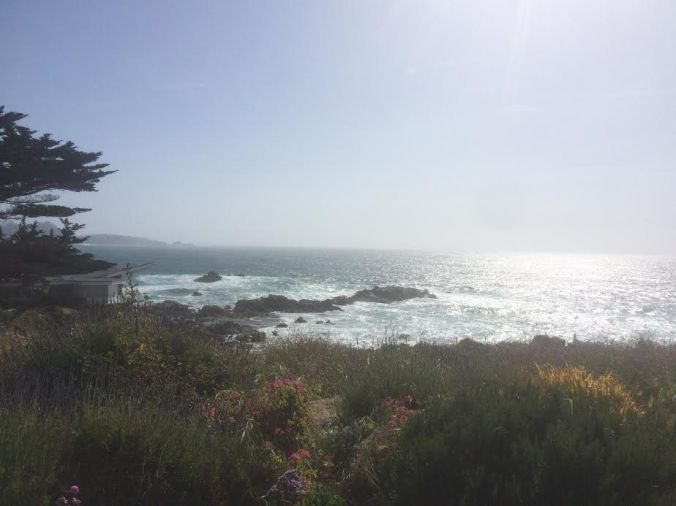
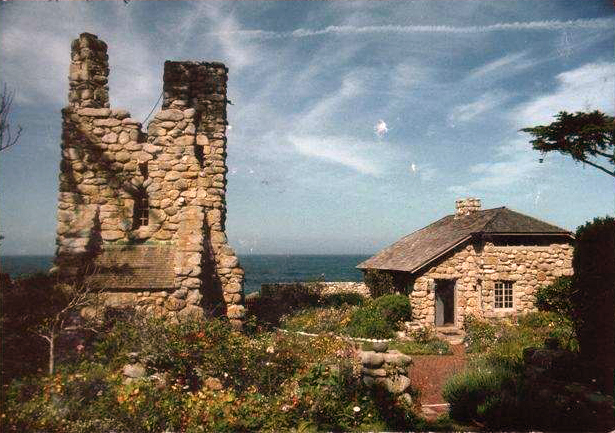
Jeffers single-handedly built a stone tower, what he named Hawk Tower, at his stone house on Carmel Point. It took him four years. He constructed a ramp and would roll rocks up from the beach to the cliff top where he and his wife lived. His wife loved towers, so Jeffers made her this one as an act of love. In building the tower he must have found strength and confidence. He was not hoping to construct something that would last forever, to be marveled at by coming generations. He had faith that one day the sea would cover it. But the tower stands today, one hundred years after it was built, and may stand for many more hundreds of years. Two days ago I visited the house where Jeffers lived, Tor House, and climbed the tower, looked out over the same stretch of sea, the same rocks and the same cliffs, that Jeffers did.

view from Hawk Tower

View from Hawk Tower

Become confident as the rock: what better way to find this confidence than by working with rocks, suffering physical hardship by bearing their weight, cementing them in place and bringing them together to form something wonderful in its austere yet elevated beauty? Each stone in the tower exists as itself and is also part of a greater something that stands as a marriage of the still and eternally patient strength of the inhuman with the creative strength of human vision. Only by imitating the extraordinary patience of the rocks could Jeffers build the tower of rocks. Jeffers would look out from Hawk Tower over the sea at night as the waves crashed against the black rocks off shore. What did he contemplate in those nights? Was his mind as empty as the clear California night sky? Or was some of his energy dissipated in resisting the human sea of houses being built behind him, beginning to suffocate his once-remote Carmel Point?

Tor House

Tor House and Hawk Tower, image from: http://patrickryanfrank.com/

It knows the people are a tide / That swells and in time will ebb, and all / Their works dissolve. Including the works of Robinson Jeffers, of course. Did he care? Who knows? Whether he cared or not was his own concern.

My concern right now is the crying baby on this plane. If it does not stop, I may go insane, and though I don’t hold on to my sanity too tightly, since it hangs by a thread most of the time anyways, I don’t really care to go insane when I’m trapped on a plane. Why does the crying baby bother me so much? For one thing, it’s loud. It makes it hard to concentrate. It brings me abruptly to the surface, jarring me out of whatever thought or feeling I was having. But is that such a bad thing? The crying baby is what is happening right now, and my reaction to it can, if I let it, if I become aware of it without resistance, teach me something about myself.

But if I try to listen to it without resistance, in the hope that it will teach me something about myself, I will learn only that I am still ignorant. I cannot try not to resist. I resist instinctively. Something in me hardens, as if protecting myself against the sound. It is not a reaction I have much control over. I can’t not do it. But what does any of this have to do with Jeffers and Carmel Point and turning to the rocks and sea to learn how to live?

Somehow I must turn and love even the crying baby, the thousands of people in the airport, the insanity of going through security, the tremendous speed of the thing, as if everyone involved is embarrassed at the fact that our trust for each other has diminished to the point that we are forced to implement these measures. It may be that I cannot love what is in front of me unless I look away from it, look out the window to the deserts of the Southwest, the book Desert Solitaire by Edward Abbey in my lap, on my way across the country to what Abbey called the ‘Siberian East. Look away towards that freer world rather than let my eyes be drawn without my soul’s consent towards the screen at the same time my ears are unable to drown out the baby’s cries. But no, I cannot look away or close my ears. I have an obligation to look everything in the eye, whether it repulses me or attracts me or awes me. I must be able to walk through the rough seas of the airport and experience the same inward love, which has all time, as I experience when I look out from Hawk Tower over Carmel Point, at the sea that has all time.

I don’t know how to do this. I hate loud noises; I hate crowds; and I hate the hardhearted attempt to strip me of my individuality and treat me like one of the crowd. Must I love what I now hate?

We must uncenter our minds from ourselves. What I need cannot come from my own action. If I try to get what I think I need, my action will be centered on myself, and I will not get what I need. I need a deeper center. But I don’t even really know what I need. I don’t know if I must love, or if I’m only saying this because I heard it somewhere. I cannot make myself love, so to say I must love is to doom myself to despair when I fail, as I must. And yet I must love, and so I must fail.

We must unhumanize our views a little. Instead of focusing on myself, looking always at how I can improve or change or accept or resist or become or be myself, I’d be wiser to let my eyes travel beyond the small concerns of a self convinced it is separate, to take in a wider view of the larger world: unbroken field, clean cliffs, endless ocean. Perhaps in contemplating the unity of that world, I will find that I have always been a part of the unity, that I have never been separate. If the world has all time, and what I truly am is not separate from the world, don’t I too have all time? But thinking is not believing. I might think it could possibly be true that I am not separate from what has all time, but I will never be convinced of this unity, and thus believe without a doubt that I too have all time, so long as I’m striving to fill what time I do have with petty concerns and desires—the desire to achieve and be admired, the desire to be comfortable and secure, the desire to take risks and so alleviate boredom and dullness, the desire to be discovered, the desire to find a soul mate, the desire to be alone, and all the other desires that seem so significant and real until my views expand a bit, and I see what else is here. Thank Heaven, writes Thoreau, here is not all the world.

Thank Earth, thank rock and sea and space, not all the world is fit for human habitation. Let me not become so habituated to human habitations that I forget what I was made from, which is intimately linked with what I was made for. As the rock and ocean that we were made from. I was not made to forget what made me, but to return to it. I was not made to live so enmeshed with the human world, so enslaved by my own human habits, that I forget to look up and see the unending beauty of the unspeaking world, and remember that it has no need to be seen and no need of me to see it. And yet I see it, and how will I receive the gift of this seeing?

Will I let myself be humbled? Will I look at the rocks against which the sea crashes, and let my heart be softened? I can only let the softening happen or resist it and impede it from happening. The river, though powerful, does not force its way to the sea. It flows on its natural course. We dam it, of course, as if that will help, and then we water-ski on the surface of the dead, defaced lake we have made, moving all together only in clockwise direction around and around, circling our falsity. We ski on the surface of the fake lake we have made, not seeing the violence we have done to the river that is still living despite our attempts to dam it from Life. We have only dammed ourselves, impeded our own growth, prevented ourselves from softening, and made a true life, one of constant renewal like the water in the river, impossible.

Well, damn.

lake powell

Glen Canyon Dam, photo from: Atlantic

There is no hope in a dam; the water from it will not last forever. It does not have all time. It ends in death and so its very existence breeds hopelessness and despair. When the river is not dammed, when its flow is not impeded, there is no need to hope that it will reach the sea. It will go where it is meant to go. I pray to uncenter my mind from myself, from my view of where I should be going. Let me climb into a canoe and be carried by the current, taking in the view of both banks, seeing at all times what is before me. Let the river teach me where I am meant to go, and let it, at its own pace that has all time, take me there.

grand-canyon-colorado-river

Colorado River through Grand Canyon

The Deadly Sins

Since the man does not go down the stairs and into the world, he pretends to himself that he avoids the experience of envy, that intense stab of pain that occurs when he sees a couple in love and, with secret wrath, wishes for both of them to be unhappy and heartbroken. In the terrible silence of his room he realizes that a part of him wants to inflict his loneliness upon others in a vindictive manner. How does he learn to accept this part? He also realizes that an attack of envy can occur wherever he is. If he stays in his room, he envies the ease with which other people are able to mingle, how they seem (but only ever seem) to be without fear. He envies the lovers their experience of liberating love, the scholars their experience of deepening understanding, and the churchgoers their experience of genuine praise. And yet he knows if he were to be in love, it would not be total, and his focus would go wholly into what prevents the love from being whole. And he knows if he were to be an official scholar, he would yearn again for his free days when he was an unofficial scholar of nothing in particular. And he knows if he were in church, he would wish to praise the lord of song in the dark privacy of his room. And so, instead of taking some direction, and then heading that way, he finds himself increasingly paralyzed. There are too many directions. His heart points him in one way, his mind in another, and his soul in a third, and these are only three of hundreds. Rather than freeing himself by making a choice, by following what is strongest in him, he imprisons himself in the agony of indecision, and as the chains tighten around his weakness he cries out in muted longing for someone to free him.

Envy transitions seamlessly into pride. Those who are at ease, and appear undivided, do not know what it means to suffer. In some sense, they are not even here, not even in life at all, for to be here is to suffer, to live is to suffer at the distance between what one is and what one could be. The more I suffer, then, the more alive I become. Here I am, the man of envy says to himself, suffering proudly the plight of the solitary, no doubt the best sufferer this suffering world has ever seen, while those in the streets simply float by in life, neither growing nor feeling pain at their lack of growth. At least I feel pain when I fail to grow. Pride says, ‘Here I am, with greater depth, passion and intensity than the rest, a better lover, if only I had someone to love.’ Pride takes love, the act of giving love, and distorts it, makes love itself about the self alone, wants someone to ‘love’ only to show how the self is a superior lover. Pride will even try to make the self look superior when ostensibly confessing one’s sins, and thus will lead one to sin in the very confession of sin.

The prideful would-be lover who has no one to love goes eventually to lust. Hidden, isolated, a lone and mostly useless human being among billions of other mostly useless human beings, he curses himself for his failures in relationship, also envying the way most people seem to somehow effortlessly meet. Instead of engaging in the difficult work of going against his own inhibitions, the work of opening up to the love that is already there, he longs from a distance, and the love that is there sinks down deeper. In order to find the love he has lost, he must go deep into himself. He hopes others will notice how deep he is going. But no one notices, so he gives up on love and reverts again to the lust of the teenager. “He who desires, but acts not, breeds pestilence.” The over-desirous one, now diseased, begins to despise the recent object of his unfulfilled desire. She should fulfill him; she should fill the chasm of his emptiness. In abandoning the possibility of finding love first within himself, he commits the original sin of self-abandonment, all along fearing that he will suffer at the hands of another what he has already done to himself.

The solitary sinner retracts into the den of pestilence and decay, into the cave of impossible desire. He holds onto the one thing he still falsely calls his own: time. He holds everyone else, and all obligations, at a distance. He holes himself up in a claustrophobic space and surrounds himself with books. He keeps the door shut and his heart closed. He begins to consider how other people owe him. All his life he has wasted so much time doing things he didn’t want to do, and now he deserves to be left alone, to do whatever he wants to do whenever he wants to do it. And what he wants all the time is to defend his territory in the cave of impossible desire, where he remains.

It is not difficult to see how this holding on, holding in, and holding others at arms’ length, this avarice, gives way to gluttony. There is never enough of what never satisfies, and nothing satisfies when the heart stays closed. The sinner surrounds himself with more books. As his suffering increases, he writes more, as if in writing about his pain, in understanding what is causing it, the pain itself might miraculously disappear. Ha! Holding onto the idea that he can relieve his own suffering, he devours books on spiritual transformation. He wants more and more of whatever makes him feel less and less alive, so that as he dies he can learn how to transform his deadness into vitality. He fasts with a gluttonous appetite, hungering for spiritual experience, wanting to feel at one with the world so he can claim that oneness for himself. He alone is the one who feels at one and united. And so divided and separate he remains.

His hunger for something to take away his emptiness only increases the emptiness, so now he shifts his perspective. He will exaggerate his separateness and ignore the emptiness. No one wastes time considering the interior when the exterior looks perfect. Therefore it is necessary, if he does not want to waste time, to make the exterior perfect. A perfectly trimmed beard, a perfectly crafted sentence, a perfectly toned body. Time otherwise wasted in the cave of impossible desire is now spent striving for the impossible peak of seeming perfection. Because it is an impossible goal, it will leave him constantly striving, so never bored. The fastest shortcut to greatness is to appear great. What is internal strength? Something nebulous, difficult to define, easily overlooked. External strength, on the other hand, is clear, easily defined, impossible to overlook.

What happens? The enormity of the emptiness he is trying to distract himself from cannot be completely ignored. The massive effort it takes to keep the emptiness down brings him eventually to a near-comatose state of skeletal exhaustion. He has one desire left: to do nothing. Shut the blinds and get under the covers. It is all too much, too overwhelming. He must sleep. At times he peeks out of the blinds and wonders how he ever did it. Got dressed, brushed his teeth, worked a job from dawn to dusk, ate three meals a day. He wonders why he was born into such a world, and yet he has lost the desire to find out if there is any other way of living. Luckily there are hundreds of television shows he can watch without interruption. He can lose himself in other worlds. After all, didn’t he hear somewhere that he needed to lose the world in order to find himself? Yes, nothing was more important than to lose the world. Surely this was the path to self-discovery.

This kind of certainty does not last for long. Doubt creeps in. Is there nothing else? No, there is nothing else. But no, there is everything else. There must be at least something else. As the days get shorter, why is it that the doubter keeps demanding that strangers feed him raw onions? Has he forgotten how to weep, and so sought an uncomfortable substitute? He consumes a dozen bananas before noon, claiming that the bananas remind him of Belize, a place he has never been remotely near. And he questions everyone. “I am going to the store,” his wife tells him. “Do you want anything?” He is skeptical. “Are you really going to the store? Which store? Why? What else do we need from the store?” He cannot believe she is really going to the store. The fact that she can quite easily go to the store, without him, not even asking him if he would like to accompany her, brings up thousands of fears. What if she meets someone else at the store? What if she is actually going to the store to meet someone there? What if she is not going to the store at all, but going to cheat on him, and bringing up the fact that she is ‘going to the store’ in order that he not begin to suspect her? Yes, he says to himself, that without doubt is her intention, and so she has failed, because I suspect her. She is the prime suspect, and I am the primary detective in this case. Perhaps I should follow her, just to prove that she is not really going to the store. Why should I trust her? What reason has she given me to trust her, other than being completely faithful to me for thirty-eight years, eleven months, three days, two hours, one minute, and twenty-six seconds?

And what reason do I give for this entirely unnecessary piece on the deadly sins, or the nine passions? No reason. Only that it being the season of joy, it is also in a not so obvious way the season of despair, and what better way to ward off the relentless hounds of despair than to write about the deadly sins? Indeed. See the sense in that, if you will. See the sense in it now. Without delay! It is the season of giving, so why not give away freely the contents of one’s no longer secret dread? Why not confess one’s sins, if you will, the many ways one continually misses the mark, and in this confession, realize that they are not one’s own sins, but the collective sins of humanity, and in this understanding regain a touch of primordial compassion? Understanding how we murder other people in our minds and hearts, we can understand and have compassion for the one who puts those thoughts and feelings into action. We can see that the person who is violent in deed is no different from the person who is violent in thought.

So, be merry this Christmas season, and don’t let envy devour you whole! Don’t be tortured by lust! Don’t let wrath hold you captive! And don’t ask me how to do any of that.

There are probably better ways to celebrate the birth of the sinless one than to confess one’s sins to the blog-reading world, but I haven’t found them. Whose sins? Who sins when silence is lost and no longer sought? Who wins when the world combusts? Who begins now to listen? Who to shout from the rooftops? Who to listlessly pout, who to whimsically doubt, and who to throw out a line for rainbow trout? O, colorful fish, so at ease in the sea! And of course about to be eaten by sharks. Why can I not be like you, about to be caught by fishermen and served to some beautiful Icelandic princess perhaps? Yes, you are so very colorful and in your oceanic element, even if you are about to be devoured by all kinds of carnivorous sea-creatures. Where is my element? Where are the carnivorous sea-creatures that will devour me? Within me.

There is nothing deadlier than the hour that has come and gone. Why did those words come out of me? No hour is gone, each returns in due time. Or does it? The hour of heartbreak returns again and again, and after it the knee-bleeding prayer for healing and wholeness, an hour which never arrives. And why do I think suddenly of the army that declares war simply to anticipate the joyous celebration that will come after the brutal shedding of innocent blood? But let us avoid those more difficult topics. Weep false tears, you onion eater! Then be grateful when the weeping ceases. The hour that is gone will return in due time. Or will it?

Woe to the reader who has kept on this far! Actually, praise only. You have my praise, and any woe you keep hidden is yours alone. Let it out. Please confess some of your woe to this writer, so he does not call his own unique. Plus he has confessed so much to you, in a guise or two. But do not call him, for if you do he will pretend to have lost his phone. And do not pretend to be lost, for he knows all about lostness, and about pretending, and he will know immediately that you are pretending and not truly lost.

And now unfortunately the coffee is all gone, and with its’ end comes the end of this piece. Goodbye, Happy Holidays, or see you when the desperate bluebird makes love with the hawk who has soared past desire. Take what you may. May each of us, while we are here and before we die, know beyond doubt that we lack nothing. Is it true that we lack nothing? My prayer this season is for all of us, yes, every single one, to experience at least one precious moment of relief from the bondage of self. I ask for no other gift.


Separation from Hope; Refusal to Confide; Hunchbacks in Chains; The Mirrored Room Without Darkness; The Voice of Unreason; Be Still, and Know; Scheduled Weeping; Drizzling Doubt; The ‘I’ Afraid to Die

I resolved after my separation from Hope to stand at the window like a fire lookout and never to turn my back on the east. I wished to follow my own destiny the way a widow follows the arc of the sun over the course of a June morning. But it was winter; the days were short, and the sun was hidden.

I decided instead to hide, and I refused to confide to the beloved the contents of my discontented heart. It was not a wise decision, not a decision unanimously agreed upon by the internal jury. It was a split decision, an incision, if you will, that took me from the center, made a hole where there was once a spacious wholeness. What was simple became complex and convoluted, and I struggled with the words needed to greet people. I knew that most people greeted others with, ‘Hello, how are you?’ I also knew I could not do the same. It was not in my power to greet others in such a way, so I gritted my teeth and pretended I was deaf when my soul-sister asked how I’d ever bridge the chasm that separated my ignorance from her magnificence.

Once I removed myself from those who assured me the chains attached to their heels were benign, I wondered what to do. It was so much easier when I had a task, however deplorable. What could I do now that I had been commanded to be free? I asked a hunchback wearing a crown who was dragging his chains up a steep hill whether he wanted any help. He looked at me with the kind of vicious glance a king gives an escaped slave who, after being recaptured and hauled back to the castle through the mud, spits at the feet of the queen. After my offer of help was denied, I spat at my own feet, resolving to never again offer my assistance to a hunchback.

However, what I had been handed by those who had overcome their own uselessness, and were no longer hunchbacked, demanded a response. I recognized the paradox of futile effort met with unanswerable grace, yet I could not stop searching for the mirrored room without darkness, where through the blur of tears I hoped to witness the self stripped of what it wasn’t, but my weeping obscured the clarity of the possible. I heard a paralyzed voice, stuck in a dreamland of judgment, shout down that my words only added to the general absurdity. I claimed the paralyzed voice as my own and shrunk into a den where a lion was devouring its’ own tail.

Do not forget to tell them about the dance, whispered the voice of unreason, a voice I noticed rang clear and true and without distrust. Yes, of course, the dance. But how could I tell them? I would never be able to tell anyone about the dance. I could only show them. Everything that came to me from the voice of unreason told them about the dance, without my having to tell them anything.

Hold me, my invisible master turned mistress, as my trespasses hold me captive, as my addiction to silence produces its’ noisy hangover. I came to you to be held, and you did your job well, but I was not satisfied. I moaned to be held more tightly, and you told me to be silent. I did as I was told and was silent, and you told me to speak, to let everything out, withholding nothing. Nothing was all I could hold in and all I found when I looked in or out. To be without nothing was the only way to be, and my violent feeling that I existed without something essential made me question whether I really existed at all. If I was certain of anything, it was that I lacked everything. I especially lacked certainty. I did not know what I lacked. If I had known it, would I have lacked it? “Be still, and know…”

I knew enough to trust that my lying and cheating business partners would get me through the rough stretches I scheduled out on the calendar, the coming weeks in which I had allocated plenty of time to suffer from inexplicable grief. I boxed out certain hours of the day to be overcome by the urge to weep, and this I did during the prescribed periods, which came in the hour before bed and the hour after waking. During the rest of the time, I feigned an exaggerated grin, which was trusted by all but one. Because of this one’s flawless perception of my incongruous state, I trusted she was the one, and without flaws, both conclusions as false as her intuitions were true.

Be still, and know that I am not. Not all-knowing. Not always forward-moving. And not ever still. And still not—what? At ease? At one? At home? At odds with the one who is, I fizzled out in the drizzling doubt that veiled from me your kingdom. Not my kingdom. I am the veil; unveil me. Let me see my own face. I am the seeker, but how can I reach you if I remain at odds? This is no game, and there is no one to blame. Not even the one who is never still. This is no game, but that doesn’t mean there is no room to play. I play at writing, and I pray when writing. To truly play is to pray, but who of us here can play in that way?

For eleven months I have not taken a drink, he said proudly and with a strange trace of foreboding mixed with a lethal dose of malice. He heard a voice question him, ‘who has not taken a drink?’ Perplexed at this line of questioning, he said again: ‘I.’ He heard, “The ‘I’ that is afraid to die—that is the ‘I’ that has not taken a drink.” Why yes, he replied, of course. He heard nothing further.

Restless Words

Come expecting answers and you’ll be left disappointed, but keep knocking, keep knocking, there are as many doors that will open for you as there are selves, but do not think that anything you do will allow you to be at one with yourself. That will come much later, if it comes at all. I’ve come to bear this wound, to endure these flaming arrows that sing in my pierced heart of all that comes and all that goes under the all-consuming terror of being no more.

“Our hearts are restless until they rest in Thee.”

What more is there to say? It may be time to rein it in, to wait for rain to wash away these sins, to sit here as leaves are blown past by the wind. The end is never near, the way is endlessly long, the soul’s been dissembled by sorrow, yet the feet keep pressing on. When I press up against myself, who is it I press against? what am I up against here?

“Majestic shadow, tell me: sure not all
Those melodies sung into the world’s ear
Are useless: sure a poet is a sage;
A humanist, physician to all men.
That I am none I feel, as vultures feel
They are no birds when eagles are abroad.
What am I then? Thou spakest of my tribe:
What tribe?”

I wonder what I am doing here. Mystery overwhelms you when you try to solve it.

“Within you there is almost no space; and it nearly calms you that in this constriction within you it is impossible for something very great to find room.”

Who is the one who became himself when he stopped trying to become himself? Who is the one who struggles to notice himself struggling? I shrug my shoulders, the same shoulders that could not force open the door that closed long ago, shaking me just a little, taking me into the center of my centerless gloom. What gloom! I must conclude this nonsense and move on to other things, things that make more sense, things I cannot touch. Not things.

“Just as the earthly lover fears abandonment and rejection by the beloved and can be possessed by jealousy and hatred, so the soul, in its intense thirst for love, feels forsaken and as dried up as is the lost wanderer in a desert wasteland.”

When I touch the woman I long to touch, why do I still long for her? When I begin to know her, why do I feel I’ve lost her, and myself?

“Besides my numerous circle of acquaintances with whom, by and large, I maintain very superficial relations, I have one close confidant—my melancholy—and in the midst of my rejoicing, in the midst of my work, she waves to me, beckons me to her side and I go to her, even though my physical frame stays in place; she is the most faithful mistress I have known; what wonder then that I, on my part, must be ready to follow her on the instant.”

The self I live beside, as if I am in contact with it, is like the powerful hand of another that goes limp when it touches my hand, is like the limb of a black oak that has broken off from the tree and sits splintered as a bridge before it collapses like a marriage into a dying river, is like the crib of a baby whose crying is not heard, is like the toothache in my heel that seals me from the sky.

“Ain’t talkin’, just walkin’
Carrying a dead man’s shield
Heart burnin’, still yearnin’
Walkin’ with a toothache in my heel”

The hound that hounds me provides no relief but I concede he knows about heartache. He is the heartbroken one, the one who will never find the one, the lone one who finds glory only in that state when he is in fact alone. There is no glory in being the lone one around others. That glory is lost as the true self is found, the glorious self that no imagined glory can match, the unimagined self, the unimaginable self, who is not the tragic self.

“Let us acknowledge our misery. Let us yearn for that place where no one can scorn us. I’m thinking of the words the bride sang in the Song of Songs, and I see that they apply perfectly here. It seems to me that none of the contempt or tribulation we endure in this life can compare to those inner battles. If we find peace where we live, there is no conflict that can disquiet us. But if the cause of our strife is within ourselves, then no matter how much we desire relief from the thousand trials of this world and no matter how much the Beloved desires this tranquility for us, the results will be almost unbearably painful. And so, Beloved, please raise us to the place where the miseries that taunt the soul relent. God will free the soul from suffering when he delivers her into the final dwelling, even in this very lifetime.” 

There is glory in being the tragic self, but it is the kind of glory that kills you finally by driving you off a cliff. I do not wish to be driven in that way. I wish only to hear the undivided silence that rests in my breast like the remembered song of a bird before dawn, heard in the December of the heart.

“While I am writing, I’m far away;
and when I come back, I’ve gone.
I would like to know if others
go through the same things that I do,
have as many selves as I have,
and see themselves similarly.”

Start on this path and you will not ever complete it. Start noticing your contradictions and you will be busy for quite some time.

On Departures

Departures are a kind of death. One who has departed many times, and has seen many depart, is closer to accepting his own death than one who has never departed anywhere, who has never truly strayed from the place he mistakenly calls home. Death is the great departure, but it is only great if you have prepared yourself through prior, smaller, less great departures. The traveler knows death a little more intimately, while never knowing it fully, each time he leaves a place. He is closer to death with each breath, in an active sense, and thereby more connected with life. His departure is not only a cutting of ties; it is also a joining of the ties between life and death, between sorrow and joy, between departure and arrival. He departs one place knowing he will arrive in another. There is freedom in departing. When no place or person holds you, all places and people are open to you. When I leave a place, my heart opens finally to loving the place I had been. When I leave a person, my love for that person grows as the distance between us grows. The traveler, the one who departs, knows without a doubt that closeness and distance are not separate.

Aloofness and Intimacy

The reason why I stay alone, why I have never had a long term relationship with a woman, has less to do with my aloofness than it does with my intense craving for true, genuine closeness. The more aloof a person appears, often the more intense is that person’s yearning for intimacy. It is those who appear to be easily or loosely intimate who are in reality the most aloof.

The most aloof individual, therefore, is the one who appears not at all aloof, who actually seems welcoming and perfectly at ease, who is invariably charming and superficially attractive. Those who seem aloof, who look uncomfortable and ill at ease, are almost always those whose emotions are overwhelmingly strong and, when they finally do connect with another, have almost unbearably strong connections, unbearable because, even as strong as they are, they are not always strong enough to stay unbroken and whole.


“The Pen”

The pen will not always write. This is not a function of writer’s block, but more simply because the pen has no ink. Actually, its ink is just irregular. Some words it writes fine; other words only the outlines of letters appear, though you press the pen into the paper as hard as you can. The absurdity of the situation drives you to madness. Before long you will rip the pen in half and then in pieces. You try and write the word ‘half,’ but only half of it comes in, the ‘h’ and the ‘l.’ You fill in ‘hell’ instead. You are half in hell, and the cause of it is a half-busted pen that lets you express half a life. You are unable to live your life without expressing it, that you know. But now that your one pen is failing you, you realize that even when the pen was working, you were still living half a life. The expression of life had taken over for the living of it, the words for the reality. To give such significance to words! That is the madness. The pen that breaks only brings you to the realization of your brokenness. It is the pain that comes when you realize that you have not been living life, only constructing a façade of life in your fatuous dreams. And now with the failed pen. You scour the room looking for another one, one more resilient, better able to handle the pressure you put on it, the pressure it puts on you. The pressure you put on yourself to use it to express yourself, that self you are always so far from finding, from knowing, from being. So far you have been able to express the self you are not yet, the yearning to be that self. But how long can you continue to express a yearning? How long, and to what end, will you express what you are not? As for the pen, it is nearing its end, so why can you not accept its ending? You cannot direct it to do your will, to transmute your confusion into something like clarity. The pen continues to record half of what you intend to write. You have to struggle to discern your own words, which themselves struggle to come out of you, struggle against you, help you sometimes to give up the struggle, the rest of the time only make it worse. The more words you write the more you exist in the trench that separates how you live from how you express the life you do not live, the half-lived travesty you wish you could call your life. But this life is no more yours than this pen is yours to command. Even this pen seems to have a life of its own, and you find yourself envying its freedom, even if it is a freedom to be nothing, to make itself invisible, to rebel against the commands of one who is no longer its master. You envy the pen that will not deign to write of your envying. You condemn its useless freedom, which records only half of your useless words, the words that are only outlines of letters, as you seem to be the outline of a man. The only true man is the outlier, who is not an outline, but an in-depth individual who encircles the false and picks out the truth at the center. But to return again to the pen. It seems to have gotten past its rebellious phase and now records faithfully your every word, whether adequate to the task or wholly inadequate. It is not for you to decide for now which words work and which do not. You let the pen move as it will across the page, using what words seem to come to it. Then you go back, with the same pen, changing some words and phrases, keeping others as they are. Many of the words are hugely inadequate to the task, which itself is huge, towers above the words. The task is to express, with the pen, Life itself, which cannot be expressed but must be lived. And so the task is impossible, and yet goes on.

The Over-Lookers and The Under-Looker

You overlook me but I see under your looking over. I see how you only ever look over; I see how you do not look in. I see how you do not see me when you look out at me; you will never see me by looking out at me. You look out and over, and you see less than you look at; I look in and under, and I see more than can be seen by overlooking.

Do not think you are special in overlooking me. I do not think I am special in being overlooked by you. You overlook most people, and most people overlook me.

To overlook is one thing, to be overlooked is another, but neither causes me suffering anymore: neither your overlooking nor my being overlooked. To be overlooked in this world is reason to rejoice. To be overlooked in the world above is to be freely given by no one the invisible keys to the underworld, where things are seen truly and appreciated for what they are, where no one is seen for or forced to be someone they are not.

To be overlooked is to begin to look into, to become an under-looker. It will seem at first to the under-looker that being overlooked locks him out of the world. It is true that, in being overlooked, he is locked out of the outside world—where everyone is locked in. But now, locked out of the outside world, the under-looker is free (though initially it will not feel like freedom, for it is not at all like the so-called freedom of the locked-in world where freedom is not possible); now the under-looker is free to discover the unlocked world. “The objective situation is repellent,” how true, so now the in-looker looks under, now his deep gaze locks-in on the underworld, the only place he can and must go to shorn the heavy locks that bolt him to the outside world—where everyone is locked in.

To be overlooked, then, is to become (or to realize that one already was) an alien, an eternal wanderer in and an outsider to the outside world, to come to the understanding that one’s home can only be found inside the underworld. Only if the outsider finds that home, and is true to it, can he learn to be at home in the alien world above, but the important thing for the under-looker, what is first and foremost, though it is unseen by all and of no importance to most, is finding his home in the underworld.

I am more at home in the underworld; in fact, only in the underworld am I at home, for there nothing is overlooked. Everyone there sees into, and already there everyone is under, which is where everyone is above, though this is not seen.

But I go to the underworld alone. There is no ‘everyone’ there. There is only the one who goes under. Only where there is the one can I see. Only in the underworld, in the seeing under, in the in-sight, do I see myself for who I am. Only when I see myself for who I am can I see another at all. This is why I must go to the underworld, and why I must go alone. Look for your own way out from under those who look over you.

The over-lookers who look out may say to the outsider and the under-looker: ‘you are selfish, self-absorbed, indifferent to others.’ The over-lookers will say this fully believing themselves beyond reproach. They are not concerned with themselves, so how could they be selfish? Yet what those with such an out-look lack is a sense of the damage they themselves cause by their overlooking. They do not see what they do, for they do not see at all. They believe looking under is selfishness, but they do not see the selfishness involved in their own blindness. They are blind to what they cannot see, whereas those who look under see what the blind cannot. The under-looker sees the blindness of the over-lookers, he sees the damage this blindness causes to what exists invisibly but is no less true for that—what is truer when it stays unseen, what remains distinct when it stays hidden. To the over-lookers what does not exist above does not exist at all. In their blindness they wipe out the underworld.

To wipe out the underworld—what could be more selfish! What could be more selfish than looking over the under-lookers! For it is these very under-lookers—each in his own way, each in her own way—who see a way beyond selfishness, beyond the absorption with the self that the over-lookers, being who they are, cannot help but overlook in themselves. It is the under-looker who sees a way-out, while the over-lookers see nothing but what is already out, believing that by seeing what is already out they see the way out. But this is no way out. Absorbed as the over-lookers are with the surface that locks them in, they see nothing, not even what absorbs them! For there is much more to what is already out than can be seen—looking out. What is out is nothing without what spurs it out from under. If what spurs it out cannot be seen, nothing is seen, for what makes nothing into something grows out from the inside. The most distinct essence of the under-looker the over-lookers do not see, for the over-lookers see only what looking out lets them see, and the essence of the under-looker lies under, lies in looking in.

And what is the way-out the under-looker sees? Again, let me stress that no one under-looker sees the same way-out as any other. This is of the highest importance and must be made clear. It is not “a way out on which we can all absolutely agree.” No. It is a way-out for that particular under-looker, that ‘I’, and though another might not agree with it (because the other cannot truly see into it), it still remains a way-out for that ‘I’ who does see into it and can act out of it. But only that under-looker, who is not the same as any other under-looker and certainly not the same as any over-looker, can see into it.

Looking-under and seeing-into is not self-preoccupation, as the over-lookers would have you believe. In looking-under one locates precisely the faculty to see out of the inward self and into the outside world in a way true to the underworld. This is the very faculty that those with the overlooking outlook do not possess, for they know nothing of the existence of the underworld. By looking out, they lock themselves into the world above and so are necessarily selfish, though they might call their selfishness ‘real-world wisdom’ or they might call it ‘religious servitude.’ But how can the over-looker serve anyone? He has nothing to give because he sees nothing (though he believes he has everything to give because he sees everything), so his giving is no better than the most violent taking away; he has no wisdom to share because he does not look under (though he believes his wisdom lies in the very fact that he looks out without looking under), and so the wisdom he mechanically dispenses is on the level of the pez dispenser.

The over-lookers look out, and whoever looks out without having seen into is selfish, whether that over-looker believes he is a humble servant or whether other people look up to him, as he looks over them, and believe he is a cultural giant; whether the over-looker concerns himself with alleviating poverty or whether he concerns himself with amassing wealth. Either way he does not really concern himself at all, for if he were at all concerned with his self and with the way he lives then he would look under. If nothing else, what he would find there would be sure to give him reason for concern! If his outlook is such that he does not look under, he will overlook all those he claims to assist, his cultural prowess will have no lasting significance, the wealth he amasses (though it might all be gained in the name of his future progeny or to distribute to the poor), will only serve to keep him out of touch with what can truly be gained and cannot be lost. All gains that do not come from making contact with the untouchable in the underworld cannot last and will be lost. I have no interest in gaining what will be lost; I look always for what lasts, so I look under.

The preoccupation of the under-looker is with seeing into the self and seeing into the world in a way that sees both the self and the world clearly and does not overlook either. This is the only way of seeing that can lead to “a sense of brotherhood with something other than man,” as an under-looker once wrote. This ‘brotherhood with something other than man’ is the only type of brotherhood the under-looker longs for, as he has long existed as an eternal outsider and exile from the outside world of outward men. To be an outsider to the outside world—this is to begin to look inside, to become an in-looker and an under-looker. To become an under-looker, to find one’s home in the underworld—this is the only way-out.

“Dare only to believe in yourselves—in yourself and in your inward parts! He who doth not believe in himself always lieth.” Thus spoke Zarathustra. Honesty means looking out at and into the world in an undistorted way that is utterly one’s own. The under-looker knows that looking at the world selfishly is looking at the world through distorted, unseeing, over-looking eyes. To see totally without distortion—to see oneself as one is, to see every other person as that person is, to see reality as it is—this is only possible by looking under.

Put it this way: The under-looker looks into so he can look out of without overlooking, so he can truly see into and under everything that exists above and outside. Those who habitually look out cannot believe that anything more exists than what is already out, for they have not looked in. If they looked in, they might see more in themselves than what had seemed to them to be their self, or more likely they would see a great deal less. Either way they might begin to look under rather than overlook. But I doubt the over-lookers will have read this far, and if they have read this far they have probably overlooked everything I have written. How typical of the over-lookers, those who look out but cannot see past their own self-importance!

Self-importance begins with overlooking (though the overlooking ones believe the under-looker is self-obsessed and self-important), for the overlooking ones do not see the importance of anyone but themselves. In looking out without having looked into, they can do nothing but overlook. They do not see anyone; they do not even see themselves, for to see is to see under the surface, and the overlooking ones define themselves by their superior capacity to look out, to see what is above the surface. They call themselves practical, sensible, reasonable; they are the realists, the shakers and movers. Perhaps they even call themselves far-sighted. But, in reality, what does it matter if you can see far out if you have not seen deep into, if you see far out only in the world of what seems to be, and you have never seen into the underworld that truly is?

The over-lookers see what is above, which is far from all there is. They look at what is already out, what locks them in, without seeing they are locked in and in need of a way-out; they do not see what lies under what they overlook because they do not look under at all. They look only out; they do not look in.

I am not one of them. I am an under-looker. I look in.