Carmel Point, Robinson Jeffers
The extraordinary patience of things!
This beautiful place defaced with a crop of suburban houses-
How beautiful when we first beheld it,
Unbroken field of poppy and lupin walled with clean cliffs;
No intrusion but two or three horses pasturing,
Or a few milch cows rubbing their flanks on the outcrop rockheads-
Now the spoiler has come: does it care?
Not faintly. It has all time. It knows the people are a tide
That swells and in time will ebb, and all
Their works dissolve. Meanwhile the image of the pristine beauty
Lives in the very grain of the granite,
Safe as the endless ocean that climbs our cliff.-As for us:
We must uncenter our minds from ourselves;
We must unhumanize our views a little, and become confident
As the rock and ocean that we were made from.
I am on a flight from one coast to the other. In spite of myself, I can’t stop looking up at one of the sixteen screens that hang above the seats on either side of the aisle. There’s no sound, but my eyes are drawn up by the moving images. The screens are all showing the same TV show, which I’ve never seen or heard of; I stare at it for a minute before I realize what I’m doing. A minute lost. I don’t have all time. I have only this minute, and if I fear losing it, or regret that I lost the last one, then I am not in it. In this minute I am in the center of a plane, surrounded by crying babies and soda-swilling compatriots, catered to by flight attendants, swiftly propelled across the country. Taking advantage of modern convenience. Something Jeffers may have scorned me for.
Without that convenience, though, I would not have spent the last week with my family, in California. So it is not all bad. But it is definitely not all good. If I do what is convenient all the time, what is easiest, I am not truly living. I’m moving on autopilot.
In the Jeffers poem, the first twelve lines describe the landscape, what is sometimes called the more-than-human world. Only the last three tell what Jeffers believes we, as humans, must do: uncenter our minds from ourselves, unhumanize our views, become confident as the rock and ocean. Convenience does not breed confidence. Neither does being catered to. What will breed confidence?
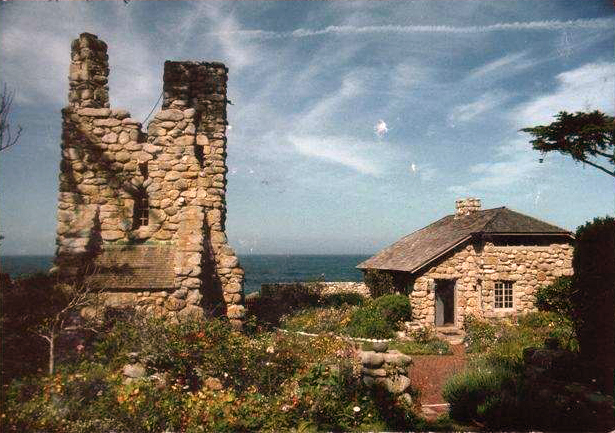
Jeffers single-handedly built a stone tower, what he named Hawk Tower, at his stone house on Carmel Point. It took him four years. He constructed a ramp and would roll rocks up from the beach to the cliff top where he and his wife lived. His wife loved towers, so Jeffers made her this one as an act of love. In building the tower he must have found strength and confidence. He was not hoping to construct something that would last forever, to be marveled at by coming generations. He had faith that one day the sea would cover it. But the tower stands today, one hundred years after it was built, and may stand for many more hundreds of years. Two days ago I visited the house where Jeffers lived, Tor House, and climbed the tower, looked out over the same stretch of sea, the same rocks and the same cliffs, that Jeffers did.
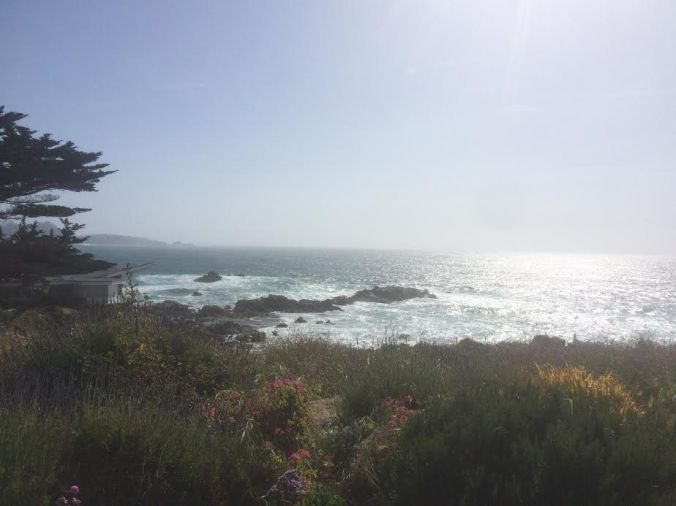
View from Hawk Tower
Become confident as the rock: what better way to find this confidence than by working with rocks, suffering physical hardship by bearing their weight, cementing them in place and bringing them together to form something wonderful in its austere yet elevated beauty? Each stone in the tower exists as itself and is also part of a greater something that stands as a marriage of the still and eternally patient strength of the inhuman with the creative strength of human vision. Only by imitating the extraordinary patience of the rocks could Jeffers build the tower of rocks. Jeffers would look out from Hawk Tower over the sea at night as the waves crashed against the black rocks off shore. What did he contemplate in those nights? Was his mind as empty as the clear California night sky? Or was some of his energy dissipated in resisting the human sea of houses being built behind him, beginning to suffocate his once-remote Carmel Point?
It knows the people are a tide / That swells and in time will ebb, and all / Their works dissolve. Including the works of Robinson Jeffers, of course. Did he care? Who knows? Whether he cared or not was his own concern.
My concern right now is the crying baby on this plane. If it does not stop, I may go insane, and though I don’t hold on to my sanity too tightly, since it hangs by a thread most of the time anyways, I don’t really care to go insane when I’m trapped on a plane. Why does the crying baby bother me so much? For one thing, it’s loud. It makes it hard to concentrate. It brings me abruptly to the surface, jarring me out of whatever thought or feeling I was having. But is that such a bad thing? The crying baby is what is happening right now, and my reaction to it can, if I let it, if I become aware of it without resistance, teach me something about myself.
But if I try to listen to it without resistance, in the hope that it will teach me something about myself, I will learn only that I am still ignorant. I cannot try not to resist. I resist instinctively. Something in me hardens, as if protecting myself against the sound. It is not a reaction I have much control over. I can’t not do it. But what does any of this have to do with Jeffers and Carmel Point and turning to the rocks and sea to learn how to live?
Somehow I must turn and love even the crying baby, the thousands of people in the airport, the insanity of going through security, the tremendous speed of the thing, as if everyone involved is embarrassed at the fact that our trust for each other has diminished to the point that we are forced to implement these measures. It may be that I cannot love what is in front of me unless I look away from it, look out the window to the deserts of the Southwest, the book Desert Solitaire by Edward Abbey in my lap, on my way across the country to what Abbey called the ‘Siberian East. Look away towards that freer world rather than let my eyes be drawn without my soul’s consent towards the screen at the same time my ears are unable to drown out the baby’s cries. But no, I cannot look away or close my ears. I have an obligation to look everything in the eye, whether it repulses me or attracts me or awes me. I must be able to walk through the rough seas of the airport and experience the same inward love, which has all time, as I experience when I look out from Hawk Tower over Carmel Point, at the sea that has all time.
I don’t know how to do this. I hate loud noises; I hate crowds; and I hate the hardhearted attempt to strip me of my individuality and treat me like one of the crowd. Must I love what I now hate?
We must uncenter our minds from ourselves. What I need cannot come from my own action. If I try to get what I think I need, my action will be centered on myself, and I will not get what I need. I need a deeper center. But I don’t even really know what I need. I don’t know if I must love, or if I’m only saying this because I heard it somewhere. I cannot make myself love, so to say I must love is to doom myself to despair when I fail, as I must. And yet I must love, and so I must fail.
We must unhumanize our views a little. Instead of focusing on myself, looking always at how I can improve or change or accept or resist or become or be myself, I’d be wiser to let my eyes travel beyond the small concerns of a self convinced it is separate, to take in a wider view of the larger world: unbroken field, clean cliffs, endless ocean. Perhaps in contemplating the unity of that world, I will find that I have always been a part of the unity, that I have never been separate. If the world has all time, and what I truly am is not separate from the world, don’t I too have all time? But thinking is not believing. I might think it could possibly be true that I am not separate from what has all time, but I will never be convinced of this unity, and thus believe without a doubt that I too have all time, so long as I’m striving to fill what time I do have with petty concerns and desires—the desire to achieve and be admired, the desire to be comfortable and secure, the desire to take risks and so alleviate boredom and dullness, the desire to be discovered, the desire to find a soul mate, the desire to be alone, and all the other desires that seem so significant and real until my views expand a bit, and I see what else is here. Thank Heaven, writes Thoreau, here is not all the world.
Thank Earth, thank rock and sea and space, not all the world is fit for human habitation. Let me not become so habituated to human habitations that I forget what I was made from, which is intimately linked with what I was made for. As the rock and ocean that we were made from. I was not made to forget what made me, but to return to it. I was not made to live so enmeshed with the human world, so enslaved by my own human habits, that I forget to look up and see the unending beauty of the unspeaking world, and remember that it has no need to be seen and no need of me to see it. And yet I see it, and how will I receive the gift of this seeing?
Will I let myself be humbled? Will I look at the rocks against which the sea crashes, and let my heart be softened? I can only let the softening happen or resist it and impede it from happening. The river, though powerful, does not force its way to the sea. It flows on its natural course. We dam it, of course, as if that will help, and then we water-ski on the surface of the dead, defaced lake we have made, moving all together only in clockwise direction around and around, circling our falsity. We ski on the surface of the fake lake we have made, not seeing the violence we have done to the river that is still living despite our attempts to dam it from Life. We have only dammed ourselves, impeded our own growth, prevented ourselves from softening, and made a true life, one of constant renewal like the water in the river, impossible.
Well, damn.
There is no hope in a dam; the water from it will not last forever. It does not have all time. It ends in death and so its very existence breeds hopelessness and despair. When the river is not dammed, when its flow is not impeded, there is no need to hope that it will reach the sea. It will go where it is meant to go. I pray to uncenter my mind from myself, from my view of where I should be going. Let me climb into a canoe and be carried by the current, taking in the view of both banks, seeing at all times what is before me. Let the river teach me where I am meant to go, and let it, at its own pace that has all time, take me there.

Colorado River through Grand Canyon

 Brian Leibold