Biking The Oregon Coast (Part 1): From Florence to Lincoln City

I had planned on starting from Eugene but there wasn’t a place to sleep. Even the Wal-Mart was not an option. No overnight parking, a sign said. I kept driving west towards the coast. The first town off the 101 was Florence. I parked by the beach and slept in the car, the windows down so I could hear the wind and sea outside.

I woke up as the fog was clearing, changed into a swimsuit and ran up the dunes that separated me from the sea. I jumped into the ocean and got out right away. It was low 50’s in the water and not much warmer outside. I got back into the car. I wasn’t sure if I was going to start biking that day, so I had spent a couple hours trying unsuccessfully to do some writing in the library. When I finally decided to get going, it was almost noon, and the wind had picked up in earnest. It usually started about 10 in the morning. I wanted to bike down to the California state line or up to the Washington state line. Washington was further, and I had a few days, so I headed north.

I parked the car and got my panniers ready in a Fred Myers. I saw signs here that also said No Overnight Parking, but I thought I’d risk it. There wasn’t any better place to park. I was feeling somewhat paranoid. I didn’t know anyone, and I just wanted to get on the road. I didn’t want anyone to pull up and ask me what I was doing or tell me that there was no overnight parking here. Usually, I enjoy the feeling of being a stranger, unknown and passing through, but only when I’m actually passing through. Be in the same place for too long and you might start to get recognized! Better to go unrecognized. Invisibility has always been the most desirable superpower to me. As a traveler, invisibility comes naturally. You blend in on the outside while still remaining unblended on the inside. Actually, often times you don’t blend in on the outside. The weight on the back of my bike would clearly distinguish me as an outsider. Very well, an outsider is usually what I prefer to be.

I quickly threw in some food and clothes in the panniers, not thinking all that much about just what I was throwing in, loaded on the tarp and sleeping pad, checked for a second to see if I had everything, and started pedaling. It was about noon, and I moved slowly for the first few miles, the same way I moved for most of the journey north. I hadn’t reckoned with the wind, which was strong and blowing directly into my face. I would also have to get used to the weight, which was 60 pounds at the least and probably more. Hunter Thompson writes in The Rum Diary, “I had a flash of something I hadn’t felt since my first months in Europe—a mixture of ignorance and a loose, ‘what the hell’ kind of confidence that comes on a man when the wind picks up and he begins to move in a hard straight line toward an unknown horizon.”

This is how I felt. Instead of despairing over the wind, I felt reckless, adventurous. I was pedaling against a powerful force; the wind was brutal, punishing, unforgiving, and indifferent to all comers. So be it. I would rather make my way against the indifferent wind along the rocky splendor of the Oregon Coast than try to make some legal tender by going up the actively cruel ladder of human production and consumption.

The miles were hard-earned from the get-go. Highway 101 climbs out of Florence before it drops down to Yachats. So I climbed. It took me a long time to get to Yachats, maybe three hours to go the 24 miles, maybe more. I realized in my paranoid rushing in the Fred Myers parking lot, I had forgotten a phone charger. I wanted to keep my phone charged in case I decided to go a different route or to look up things to do in the towns I passed through.

John owned the ramshackle electronic shop in Yachats, cords and wires all over the place. He only took cash. ‘The grocery store gives cash back,’ he told me. ‘You can pick up a snickers.’ I realized that was exactly what I craved, so I went to the grocery store next door, picked up two snickers and an espresso drink. It was a habit I would continue through the four-day trip, during which I ate horribly. Then I went back and talked with John about the wind. That was really the only thing on my mind. The wind has that way about it, clearing the mind of anything else but itself, the force you’re biking into. John told me that the difference in temperature between the coast and the inland was as much as forty degrees this day. It stayed that way into the weekend. 60-65 on the coast, close to 100 inland. Apparently, this difference was the cause of the ferocious wind, my brutal enemy on the way north and my good dear friend on the way south. He said some other things but my mind deemed them too scientific to understand.

I wished him good health (he was just getting over a flu) and then again it was to the road. I had gotten over one mighty hilly section and for a while the terrain was relatively flat. I had passed one woman a few miles before Yachats who looked like she was in utter despair, her head in her hands on the side of the road. I felt like if I stopped it would be a while before I continued, so I didn’t stop and give her the support I couldn’t have given her anyways. Now there were bikers going the other way, with the wind, looking exuberant and light. The opposite of me. They would wave happily at me and I would grimly put up a hand. There were many of them going the other way, but in my days on the road, that one woman in despair was the only one I saw going north against the wind.

I had driven this route the previous December, when I was heading from Alaska, where I had spent the fall with my cousins, to Arizona, where I was going to start college. I remembered staying the night at the Dublin House in Yachats and then getting off the 101 the next morning, driving to Eugene and getting on the I-5. Back then, somewhere north of Florence and south of Lincoln City, somewhere around where I was biking now, I had jumped into the ocean, though both the water and the outside temperature were in the 40’s. I had written this a few weeks afterwards,

“There was a definite feeling, on this December day on the Oregon shore, that I was not an important part of this scene in any way. Whether I or anyone else was here, the sea would remain, sometimes calm and sometimes violent, the waves would crash, the islands of rock and trees would stand. It was a reassuring reminder, the patient indifference of the lively inhuman elements.

In the summer, I’m sure the beach would have swarmed with men and women and children. But today it was empty of people and full of life. I wasn’t distracted by bathers and surfers, and I was able, when I paused for a few moments before I got to the car, to appreciate the beauty that surrounded me—the massive rock islands that stood to the south, the light Irish drizzle that fell from the low grey sky, the seagulls that soared north with the coastal winds. The realization that I was irrelevant to the scene was a simple one, but it freed me from the narrowing self-absorption that comes from driving alone, one of many poor souls detained in cars on the endless road, with only billboards for company, brought me back to the larger open world around me, the sands and trees and sea, including me but not requiring my presence.”
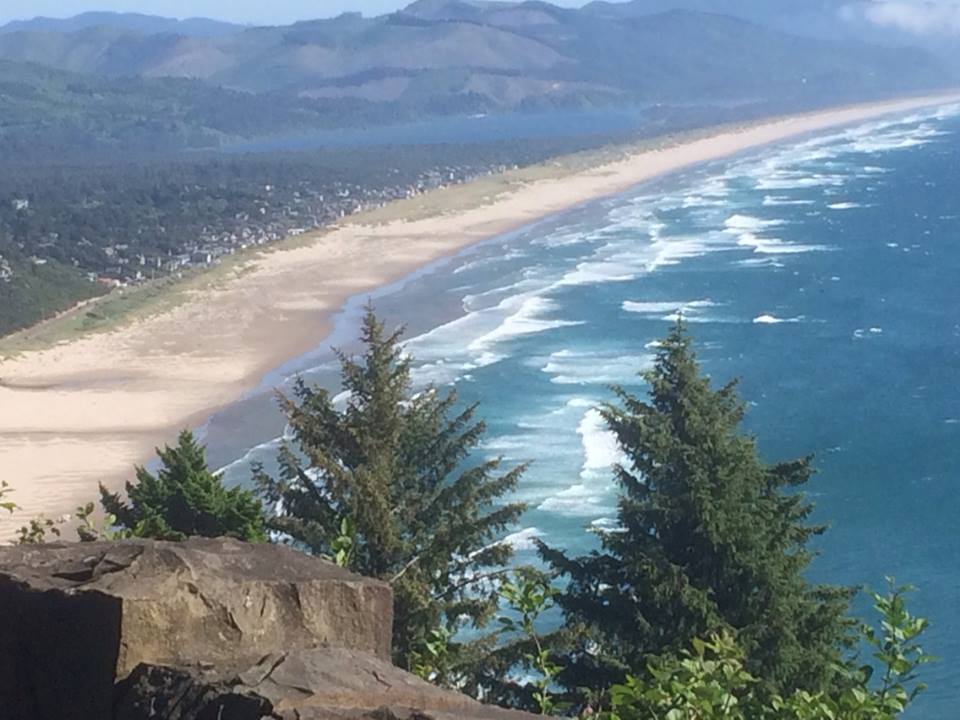
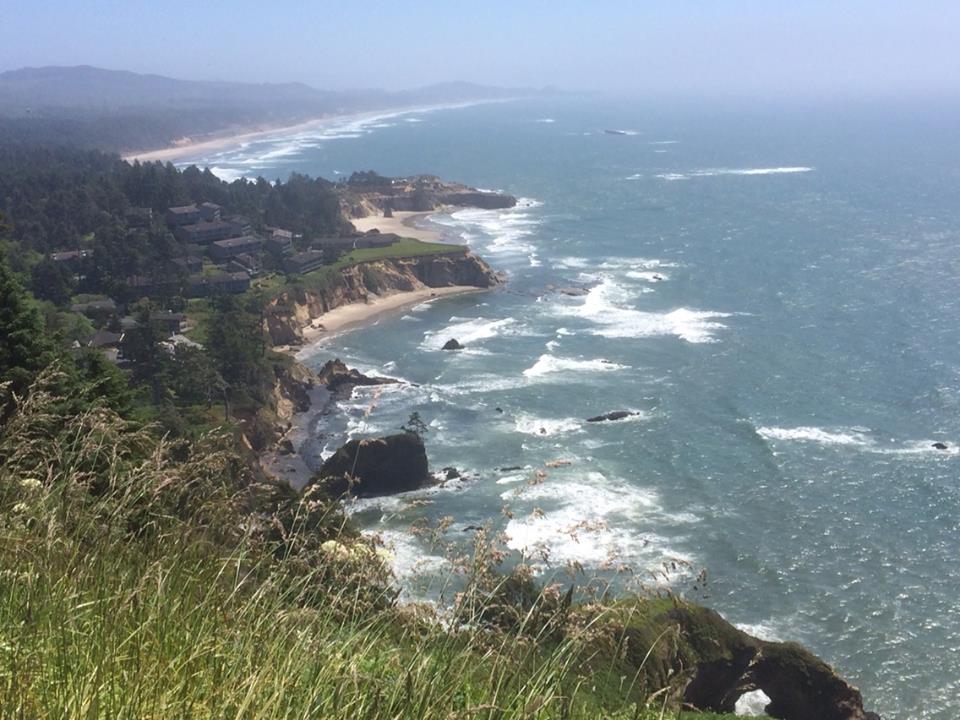
more oregon coast

oregon coast

The self-absorption that driving brings does not come as much when biking. Because cycling is a physical struggle, the mind has no time to sink into self-pity or self-absorption. It must be in tune with the body, focused on pushing forward. When the body is not moving, the mind is free to do what it pleases, to be absorbed with itself and unresponsive to the outside world. Biking allows for another type of absorption, an absorption in movement and activity. On the coast, I was able to be present and responsive to the world of rock and sea and sky and trees. I was forced to be present; I could not help but be where I was. If my mind drifted at all, the biking would quickly become more difficult. The body needed the mind in order to persevere. The coastal winds added another element that required even greater presence. To ride north on the Oregon coast in the summer is a long and arduous lesson in patience and acceptance. I had to let go of any idea of myself as strong, as physically powerful. I was no match for the wind. To work with the wind at all I had to go slowly. There was no other way. I had to put my head down and endure the pain without expending unnecessary energy.

I continued on into the night. Each time I wanted to stop for the night, I told myself to keep on for just a few more miles. Who knows why? I simply wanted to keep going.

oregon sunset

I was also in a stretch without many places to camp for the night. Newport was fifty miles from Florence and Lincoln City was eighty. Between the two, I don’t remember seeing any places to camp other than RV campgrounds, where tent sites are exorbitant, up to $40 a night. One of my rules of the road is never paying to sleep if I can help it. If I do have to pay, the maximum price I am willing to spend is $6, the price of a tent site in the national forest and state park campgrounds. I was also riding through a busy stretch. This first day on the road was a Thursday but it might just as well have been a weekend day. The highway stayed like this all the way up from Florence to the Washington State line and back again. The noise was at times unbearable for me, and so I put in headphones, diluting my ability to be present. But most of the time, even when I was riding right next to the ocean, I could not hear it or smell it because of the noise and exhaust from the cars. So I listened to Bob Dylan, belting out his Blood on the Tracks album.

“But me I’m still on the road,
Heading for another joint.
We always did feel the same
We just saw it from another point of view
Tangled up in blue”

Or Warren Zevon:

“Gridlock, up ahead
There’s a line of cars as far as I can see
Gridlock, goin’ nowhere
Roll down the window, let me scream”

Finally, past 11, I pulled into a state park in Lincoln City, about eighty miles from where I had started in Florence.
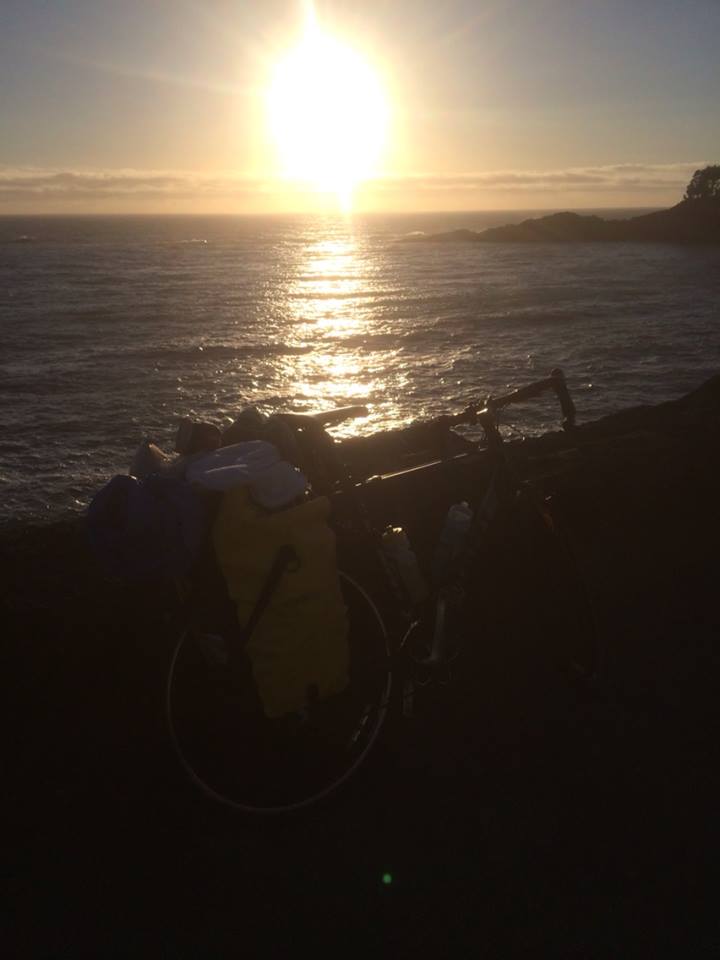
oregon caost sunset

Why Wilderness Therapy Works

Why does wilderness therapy work when other therapies don’t work? The word is wilderness. No person is healing another person. No one is the healer, no one the healed. Out in the wilderness, away from everything that makes it necessary to need healing, healing comes naturally. It doesn’t even look like healing, like recovery. In wilderness, recovery is not the final goal. What good is recovering what you have lost if you don’t uncover anything new? The wilderness allows for uncovering in addition to recovery. You begin by recovering the aspects of yourself that were lost to the addiction, compulsion, mental disorder, whatever. Then you begin to uncover aspects of yourself that you had never known about. You uncover aspects of yourself that do not belong to you alone. You uncover aspects of the world that also happen to be aspects you share. You recover the fact that you are capable. You can hike many miles in a day, you can make a fire, make a shelter. You can survive; you are worthy of your existence. You uncover the fact that you are more than capable, more than worthy. You discover a power that has nothing to do with superiority over other people; you discover a love that cannot be expressed, a love that comes into you from nowhere and out of you towards no definite object; you discover a sense of belonging that does not need to be identified and has nothing to do with other people. You discover the stillness at the heart of things, and in your own heart. You wake up the morning after the storm, and all the trees are still standing. You look at them and feel their strength, their robust aliveness.

The wilderness heals when words fail. And don’t words always fail? Ain’t talking, just walking. Let us walk together through the woods, both of us pilgrims, “searching ones on the speechless, seeking trail.” What are we seeking? If we knew, would we be speechless? Perhaps we would. Don’t we seek life, and is it true that life also seeks us? It certainly seems that way. Each person is sought by life, let’s call it, to give what only that person can give. We are sought and called in order that we might call back in answer, ‘I am here, and I will remain. I am here to answer the call of the one who seeks me, the one who I seek.’ And is it one who I seek? It could be one, it could be none, and it could be many. I seek the place where the one are many, and the many are one. I seek the place where there are none but myself and yet I am not the self I thought I was. Not another soul is there, but is that the truth? I seek the place where I become no one. Nemo. Everett Ruess disappearing into the red rock canyons.

What does it mean that wilderness therapy works? Is that the right word for it? Yes. This is Gurdjieff’s Work here, the work of awakening, of becoming one’s authentic self. Do you think you are already yourself? Maybe you are, I couldn’t know that. I know I am not, not completely. I am a fragment of the whole self. There is always further to go, more work to be done. I’m not there yet, but in the wilderness I do not worry about being not there. Where am I not? Where I am not is unimportant. Where I am is what matters. Being where I am is how I move towards who I’m not yet, who I could be.

Of course, there are moments of despair even in the pure clean air. There are moments of despair everywhere. Nothing we can do to escape those, especially when we’re in the wilderness. Where to go? What to say? What to do? Can’t drink, can’t get prescribed anything, can’t drive through the night, can’t rob a bank. Just keep walking, I suppose. Walk straight into it. Will the despair pass through and away like a storm from the east? Who knows? No use in minimizing it, rationalizing it, idealizing it. No use in talking about it at all. Ain’t talking, just walkin’. But even in the wilderness, that strange human desire for verbal utterance is still there. Very well, speak then. But it is important to choose your words carefully. The human words must somehow do justice to the inhuman beauty of the place. This is exceedingly difficult, and oftentimes it is better to melt into the silence. To become a part of the inhuman we become inhuman ourselves. Inhuman not meaning ‘unfeeling’ or ‘cold’ or ‘cruel’, but as defined by the poet Robinson Jeffers in his philosophy of Inhumanism: “A shifting of emphasis and significance from man to not-man; the rejection of human solipsism and recognition of the transhuman magnificence.”

To become part of the inhuman, we must not focus so much on the human. What was your relationship with your parents like? With your romantic partners? What do you remember about the trauma you suffered at age 7 when your parents accidentally packed you tuna for lunch, forgetting that you preferred pb + j? Well, I think I was enmeshed with my parents, or maybe abandoned by them. All my romantic partners left me, or maybe I left them all. The trauma with tuna, I think, is still affecting me in a deep and significant way today, as I instinctively recoil whenever I see anything remotely fish-like. Whatever. These human questions and answers fade into insignificance in the wilderness, as they deserve. They are not integral to The Work.

What is integral to The Work? Jeffers knew it. It is integral that we recognize the beauty of the inhuman world and feel a part of it. Recognize the human and the inhuman within us. Envy and equanimity. Anger and serenity. Vanity and authenticity. Fear and courage. The jealous, prideful, and possessive love, and the detached, humble, object-less love. The desire to fade into the shadows and the desire to be pierced with and surrounded by light. The passion for success and recognition, the continual striving; the sea receding from shore in the night, the vast sky overhead filled with light.

https://www.youtube.com/watch?v=IAK3gpWvn1w

Backpacking in Lower Burro Creek (Part 2)

Day 2

Today we walk five physically strenuous miles in heavy brush. After dropping our packs in a remote canyon, undisturbed by any sign of human presence, we explore another half mile farther into the canyon. We come to a pool of water below stark cliffs that make for some rather difficult climbing. I decide to risk it and engage in a little primitive recreation, without ropes or harness, in order to scale the walls to the north. After doing so, I run ahead for a few minutes, dodging prickly pear and teddy bear cacti, looking for a spring expected to be another mile and a half ahead. No luck. It’s either elsewhere or farther on. I return back to my adventuring companions and jump into the pool, into the cold water.

Day 3

Sunrise over the canyon walls. I awaken early and climb up a little ways to meet it. I find a rock, take my hiking boots off, and listen to the multitude of birds giving glory to the rising sun.

Glory in it, with it, and to it. Feel your smallness; feel your significance. You are small, yet you are significant, for you welcome the sun with human song while the birds welcome it with birdsong. Let the birds educate you in the primitive art of sun celebration. Let the rocks educate you in the primitive art of waiting patiently for the sun’s warmth. The plants can teach you something there as well. Let the trees teach you how to soar while staying grounded. The branches soar and the roots are grounded. “There is knowledge only the wild can give us, knowledge specific to the experience of it. These are its gifts to us,” Jack Turner writes. Some days the gift is silent and wraps up in silence whoever uncovers it. The gift this morning is the gift of song. The birds sing to celebrate the gift of the sun as I celebrate the gift of undisturbed solitude on this hill in the sun. We are brought together in celebration.

A day to glory in and give glory to. Glory to the sun in the highest. Sing, glory to the sun. Glory to this rock that I sit on and peace to all the myriad creatures on earth. Let us be reconnected and reconciled.

Day 4

Morning, the last day of the trip, time unknown. The sun touches the highest point of the cliffs that stand above me as I climb up the western hillside, listening to the barely audible trickling of Kaiser Spring, now thirty yards below me. Almost all of the plants on this hill are some shade of green: palo verde, ocotillo, saguaro, prickly pear, barrel cactus. All living organisms in this green desert lean towards spring. I join this open procession, this renewal; I listen as Life sings itself to wakefulness. I continue up the hill, each step on ground I have never before stepped on. Each step restores me to a new equilibrium that I could never have found on my own; I am reintroduced to the stores of energy and power within me.

The sun is now on the cliffs directly behind me, but I am still in shadow. I hear the canyon wren below me, and other unnameable birds, birds I cannot name, around me. I am surrounded by beauty I cannot name. The birds, by serenading the unnameable, become an integral part of it. They soar beyond label. They sing and I listen. I am not only the audience. I try to translate the unnameable with the power of human symbol, try to get a loose hold of some of that beauty on paper.

I climb up to a rock where the sun shines. Sitting on the rock in the sun, I say a wordless blessing. I am blessed by the existence of a place that no human can improve. It would be arrogant of me to believe I could improve this place; the best I can do is receive its gifts, be receptive to its grace, and then let it be.

Humans attempt to improve what cannot be improved in order to prove the superiority of civilized man over wild nature. Leave all that talk of superiority and inferiority, of subordination and dependency, of administration and management, of comparison and improving—leave all that to relationships between human beings. The relationship between human beings and the wild cannot be one of comparison or of improvement. The greatest improvement in ourselves is when we cease trying to improve anyone or anything else, above all anything wild.

Instead of trying to control the outer wilderness, we should strive to understand what is wild within us, which will lead to an understanding that we cannot control anyone or anything else. The more we try to control the wild, externally or internally, or use it for our own benefit, the more out of control it becomes. What is wild is intrinsically perfect, is whole as it is: “To speak of wilderness is to speak of wholeness.” When we try and control what is whole, we split ourselves. We separate ourselves from what we cannot be separate from. To become a part of the whole we must strive for wholeness within ourselves. “The whole is made of parts,” Snyder writes, “each of which is whole.”

The wordless blessing has now found words. I bless this day where I am restored in this place that needs no restoring. This place that needs to be left how it is. It is not a blessing I give so much as it is an acceptance of the blessing I receive. The wild does not need my blessing. It is already blessed in every respect. It needs to remain that way.

I scramble farther up the cliff for another moment or two and then head back down to our campsite. Before we take our leave, the four of us linger by the clear water of Kaiser Spring. The sun slants through cottonwood and willow trees, reflects off the water dripping down from the pure spring. No one says a word. “In the beginning,” Terry Tempest Williams writes, “there were no words.”

The origin of Kaiser Spring is another quarter-mile on. We shoulder our packs and depart for the Source. The sound of the water flowing the other way alongside us is like silence.

Backpacking in Lower Burro Creek (Part 1)

Day 1

I sit by Burro Creek, not yet in the proposed wilderness area, close enough to a road to attract those with a Jeep or Subaru. A family is nearby: an older man, his wife, and two young children. The man, who looks to be the grandfather of the young boy and girl, is wearing an NRA cap. So this is not yet undisturbed solitude, but his mere presence neither disturbs me nor deters me from exploring this place. I do begin to feel slightly disturbed when he throws rocks into the stream to entertain his grandkids. But soon they leave, and I am left alone.

Let even the rocks alone; let them be where they are. Leave the rocks alone that do not move on their own. Can we be unmovable like the rocks? Can we be fluid like the water moving over and around the rocks?

Soft like the water and hard like the rocks. My legs are hard from biking but my heart in this place cannot be anything but soft, as I listen to water flow over granite, the soft over the hard. I feel my heart overflowing, love flowing into me. It is the soft heart that spurs me on my journey and decides where home is, and the legs that harden to get me there.

And where do I need to get? Call it nowhere. Here I am. I want to get right in the middle of here. In the wild, no place alone is central because each place is a center connected to some circumference, is a place where we can experience solitude without being alone, or where we can be alone without feeling pain at our aloneness. In the wild, we can get to the core of our loneliness, we can find that the deeper we sink the less lonely we become. It is not so bad to be alone, though we are always forgetting this fact. “I never found the companion that was so companionable as solitude,” Thoreau writes. I write of solitude and I mean connection. I write of recreation and I mean re-creation. I write of going out and, like Muir, I mean coming home.

I listen to the water; I sit on the rock; there is no need for any other companions at this time. The great longing for connection, the yearnings for truth and beauty and power and love, are here fulfilled. I have always longed to be, and to be myself. Now, I be-long. I am. I am here.

Here, I am.

I let the creek take all my confusion. The creek takes it without being burdened by it. It takes it by not taking it too seriously. It takes it by giving me peace. Letting me be at peace. Let the water let me, let me be by the water. I let myself be. I let myself see.

I let myself go and am held.

We need to let ourselves go. We need to let go of the idea of ourselves as superior to what holds us. We need to go to the wild and behold its beauty. Let go and be held.

But I do not intend to speak for what we must do; I speak for I must do. I find I can speak most clearly in places where humans are awed into silence. I want to speak for that which does not speak through any language human beings can understand. I want to speak with the force of the rivers’ rapids, with the calm of a still-moving stream, with power and with stillness, with the same even-keeled equanimity of the clouds that drift above the creek, languid and fluid at this moment yet containing the power to bring storm. I want to speak like the body of water that connects and cannot be separate from the two banks, that answers all questions without words. I will speak with words until I have learned to speak without them, until I understand the language that no longer needs them.

I sit on a rock by the creek, close my eyes, and say a silent prayer, praying to understand the language of not needing, of being without needing to be otherwise.

I sit on a rock by the creek and try to exist with the rhythm of the water, to be part of its song. I try to listen for the sound beneath the sound. I don’t hear it; it doesn’t matter.

Only where people predominate do I need to listen for the sound beneath the sound. Here, where I am now, in the aliveness, where all things move and exist freely, there is no sound beneath the sound. The sound on the surface is enough. What I hear and see is more than enough. What I hear and see is the abundance of life at the end of the day.

I hear the water in the creek below me. I hear the chirping of crickets around me, filling the darkening sky with their bright song. I see the clouds above me moving to the west, towards the sun, now going down below the horizon.

Aimlessness and Purpose

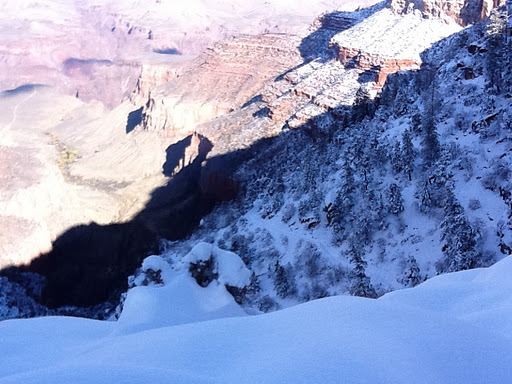
ffab3-grandcriver

The log in the river is not aimless, the dolphin in the sea is not aimless, the cloud, though drifting in the otherwise blue sky, is not aimless. Each goes where it goes and does not go where it cannot go. But I am not a log in the river, or a dolphin in the ocean, or a cloud in the sky. I am a man who often feels aimless. It is important sometimes to observe myself when I look at the cloud, observing both myself and the cloud, perceiving how the cloud goes nowhere in particular and perceiving how I am going nowhere at all. I am just standing there, or sitting there, watching the cloud.

I am aimless when I forget what my aim in life is. Is it to glorify God in the highest and bring peace to his people on earth? No. I cannot hope to bring peace to anyone but myself. Is my aim to be on the road, to travel in a home-going way, going always away and always coming home? Is my aim to find my aim, or to pursue the Self in me that needs no aim? Is my aim to engross myself in our material civilization and become one of the many? No. I have a purpose beyond that. Entering society may be the beginning, and is helpful for some things I cannot do alone, but further than that society assists me only as it helps me to realize myself. If I am not doing that, I am not living life, and in that case whether I am engrossed in society or not makes little difference. If I am not living, what am I doing? I am aimlessly drifting toward death, or I am already dead. When death comes, I want to meet it as an equal, I do not want to be taken by it. I want to die many times before Death comes so that when Death comes it takes only what is not me; it does not take the whole man. To be so I am not taken by death I must be a whole man.

My ambitions are turned towards myself, not in a self-absorbed, egotistical way, but only because I am determined to overcome the self that sits down here today, to explore much deeper than the ego-self, to dig down far below what is visible, to find the truth hidden in the invisible. This is my ultimate aim: to bring forth the invisible, to express it in such a way that the reader can see the invisible within herself, and remembers who she is. To be fully myself, I must remember who I am. Only such a man can help another to remember. But it is difficult, and my aimlessness drifts back anytime I forget, if only for a moment. There are many moments when I forget, when I question whether I ever knew, whether I ever can know. Am I not simply a man? And wouldn’t it be better to be a simple man, concerning myself with the essentials of life, physical needs and family? No. Though I practice simplicity and feel it is essential and part of the aim, I am not a simple man who can concern himself only with physical needs and family. I am a man who aims to point people to what is not-man through my own experience of who I am. This is my aim, my purpose.

snow mountain alaska

What is essential for me is something deeper than the physical and visible. Many people remain on the surface of the water. They float along like the log in the river and do not feel the need to go faster or slower or deeper. Where they are at all times is the only place they can consider being. What they see at all times is all they can imagine seeing. It does not even occur to these people that they could be anywhere else or be seeing anything else. Nothing exists but what is directly in front of them. In times of weakness, I envy these people’s easy contentment. But in reality I know I am not one of them. There are a few who do not float in this way. As these few become conscious of where they are and who they are, they say to themselves, ‘I cannot float here. I was not made for these waters.’

So they sink for a time, though only half by choice, and so become only half-aware of what lies beneath the surface. When they have risen to the surface, by their own tortured choice, they look back and see in a hazy way the confusing contents of what he has already traversed. They resent the part of the river they have already gone through. It was not the way they wished it had been. When going through rapids they wished for serene waters. When all was calm, they were restless for the rougher water. Now they struggle to look ahead. They are tense and troubled thinking about what could trouble them around the next curve, yet they cannot help thinking about it. They want to know what will come beforehand so they can know how to approach and confront it. How can they know what to do when they do not know what is to come? Their lack of knowledge and understanding force them to go under again. Maybe going below the surface now they will find the answer to what will come above it later. The aim of those who sink is ultimately to come to the surface, to be on the surface, but their purpose on the surface demands that they have sunk far beneath it. They must find the tide without resisting the riptide. They cannot float without having sunk, and they will sink until they learn to float.

The drifter becomes so when he says, ‘I am not fit for these waters,’ fully believing and knowing the truth of what he says. Though born fit, in life he like everyone else becomes unfit. Not everyone sees that they are unfit for the waters. Many people feel they are fit and are deluded. But the drifter sees clearly how unfit for the waters he is; he feels it like he feels the tug of the rip current pulling him downwards. His aim in life is to again become fit for the waters he was born fit for. In fitful spurts, by relentless struggle, he continually sinks and comes back to the surface. He wants to say, ‘I can float here. I know how to float without drifting and sink without drowning. I know now what I need to do. I know now what I need to say. I know I cannot do otherwise.’ But he cannot say or do any of it until he truly believes and knows it, and this might take a long time, a lifetime, or it might never take, and so in the end he will be taken in Death’s hands, his own hands empty and his mind unclear, having never reached the clear and pure water of his own true nature that would fill and fulfill him. If he reaches that pure water, he will love it all, and will make no distinction between the pure and impure.

Road Trip to the Grand Canyon, Ooh's and Aah's, Creative Greetings, Life Plans, Favorite Words

But back to the primary aim. I follow the Self that leads me and can follow no one else. I can lead no one but whoever follows their own lead. If I cannot follow my own lead, I will certainly fail to lead anyone else. I must go from painful loneliness and isolation to a solitude that cannot be compared, an aloneness that slowly deepens into ultimate connection. My natural state, and the natural state of all humans, is loneliness, isolation, and aimlessness. Knowing my aim and living it takes away loneliness. The aim brings with it the aloneness; the two cannot be separated. Anything that distracts from that aloneness distracts me from the aim. If I pursue only the companionship needed to alleviate my loneliness without the connection needed to deepen my aloneness, I am forgetting my purpose, I am forgetting what has worth. Anything that distracts me or leads to forgetfulness is worthwhile only if it brings me back to remembering.

I am worthwhile when I remember, when I follow my lead but am not led blindly, when I seek my aim, when in myself I feel at home, when in everything I see beauty, when in every sound I hear God.

This morning there are few sounds. I hear the coffee pot, the wall heater. My hands hammering on the keyboard is the most obtrusive sound, and it is the sound of my greater self disciplining my lesser self, like the hammer pounding in the nail to build the foundation of the house. It is hours before the dawn. Without these hours, on days when I wake up late, I start the day already alienated from who I am, already distant from my deeper nature. I feel a sense of irretrievable loss on those days that for most people would be out of all proportion to the cause. Those are lost days, and with too many of those I become lost myself. The aimlessness is born out of the distance between surface and depth; it is the head-banging, out of control teenage offspring that drifts between the deep and shallow.

To avoid that sense of aimlessness, that feeling of being lost and without purpose, I will do anything to recklessly seek purpose, perhaps with the purpose wrecking poison itself that leads only to greater lostness. My aim is to live in those the depths, but it is a daily struggle. Instead of mourning the alienation that begins the day, I work to understand it, to overcome it, and to get beneath it. And sometimes simply to sit in it, to sit in the distance like the traveler sits on the southbound train, a fierce light in his eyes, beholding the horizon he is held by, the horizon that calls him onwards. My discipline must be stronger than my self-pity, my desire to wake up stronger than my desire to stay asleep. If my body is awake but I stay unaware of my deeper nature, I might as well stay sleeping. It comes to the same thing. Either way, I am dreaming, not fully awake, and not even half-alive.

I am alive to the extent that I am awake; to the extent that I am connected with what I consider to be my deepest, most essential Self. Without a connection to that power, without feeling myself to be that power, or without feeling that power to be within me, nothing I do can make any difference at all. I can do nothing alone, without that power, but I can also do nothing without admitting and welcoming authentic aloneness. All true doing comes from being truly alone. Though I might be in the midst of an aimless material civilization, surrounded by crowds of people; though I might be a stranger, far away from any friend or relative; though I might be utterly alone, if I welcome the aloneness, I am welcomed home.

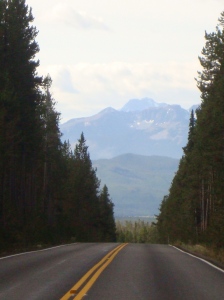
79c4e-tetonroad

“Consumerism, Happiness, and Authenticity

Here is the second paper I wrote for Ecopsychology.


Consumerism, in creating false desires and playing on fears and insecurities, prevents people from being their authentic selves, from living meaningful lives based on spiritual principles. In making consumption the goal, the soul is lost. The in-take of disposable goods becomes the highest priority at the expense of creative out-lets. We take in, we do not let out. I will cite works, including “The All-Consuming Self” and “The Century of the Self” to explain and defend my thesis, which I will state here: our consumerist society blocks us from reaching our potential, from growing, from being and becoming the men and women we truly are. As we become what we own, we disown our true selves. As we spend our lives in supermarkets and malls, we do not walk on the earth, we neglect our connection to the more-than-human world. Forgetting nature, we forget each other, we forget ourselves.

Consumerism creates inauthentic desires that never allow for full satisfaction. In an essay called “Buddhist Perspectives on Economic Concepts” in the book Mindfulness in the Marketplace, the author writes, “Advertisers stimulate desires by projecting pleasurable images onto the products they sell” (Ven 2002, p. 77). After consumption of the product, we again have the desire to consume, a cyclical pattern wherein we are deceived and deceive ourselves. Advertisements deceive us by promising satisfaction when they will only promote greater dissatisfaction; we deceive ourselves because we do not truly believe the advertisements. We want to believe, perhaps we even convince ourselves we believe, but in our depths we do not believe.

In the documentary “The Century of the Self,” the narrator says, “By satisfying people’s inner selfish desires one made them happy and thus docile” (Curtis 2002, Part 1). It is rare, perhaps impossible, for docility to co-exist with true happiness in the way I define both words. The word ‘docile’ to me conveys a feeling of conformity, unreflecting obedience, tameness, a low opinion of self and a high opinion of others. This is the path to depression, not to joy. Dogs and cows are docile and content when fed. The same is true of some humans, but there will always be those who are not satisfied with being fed, clothed, and sheltered, who seek something that cannot be offered by material satisfaction: independent, courageous, wild men and women, wild in the sense Gary Snyder means when he defines wild people as “unintimidated, self-reliant, independent. Proud and free…fiercely resisting any oppression, confinement, or exploitation” (Snyder 1990, p. 17). Not content with docility, not content with the confines of material satisfaction, looking for something else, beyond the wall.

Now I will look at the advertising slogans of many popular companies. The slogans promise what the products can never give.

Coca-Cola: Open Happiness. As if all we need for happiness is a cold soda. We can let in happiness, by being receptive, by living simply. But we cannot open happiness, by unwrapping presents, by living in order to make and take and get rather than create and be-get. We get to be, we are not alive to get. Getting does not imply being, which cannot be opened, bought, acquired. The more we focus on getting, the less full, happy and true our lives become. The type of happiness Coca-Cola, or any other company, promises is a short-term feeling of satisfaction. This is the happiness of Huxley’s soma (1932), of Prozac or alcohol or a new car; this is not the happiness of a life well lived, a life of independence, generosity, connectedness, love, wildness, a life free from docile contentment, from the gratification that comes with comfort, ease of existence, from not facing what we fear or doing what we love.

Wal-Mart: Save Money, Live Better. Because the prices at Wal-Mart are presumably lower than the prices elsewhere, the shopper gets more stuff for less money. With more stuff, the person can live better. This slogan buys into the “more is better” ideal that is one of the most destructive forces in our society.

Bud Light: Be yourself and make it a Bud Light. This slogan is even more dangerous than Wal-Mart’s slogan. The search for authenticity is the oldest and most worthwhile search there is, and this slogan implies that it does not have to be a search at all. All that is necessary to be yourself is to crack open a cold beer. The idea that we become more ourselves from something outside ourselves is one of the most insidious ideas at the root of addiction. Linda Leonard, in her book Witness to the Fire: Creativity & The Veil of Addiction writes, “Our very being is to question what it means to be. And the questions that we ourselves live are part of the creative process of Being” (1989, p. 214). Here, there are no questions to live, there is only the answer, and the answer is drinking Bud Light.

The list could go on ad nauseam; these are only some of the slogans I have seen in the last few days.

The yearning to be authentic is the yearning most stifled by consumerism. A society based upon the false, based upon insincerity, mock cheerfulness, misleading desires, and manipulation, can never lead to authenticity. The desire for material excess, it is important to remember, is not a true desire. It is a false urge, a created yearning rather than a yearning for a creative outlet. We take in what is already made rather than letting out the unmade, what is borne out of us, out of our urge to express our authentic selves. Rather than being reborn by returning to the depths of the unknown, we attach ourselves to the surface, what is made and known. We do not merely fear the unknown; we deny its existence. We allow ourselves to be owned by comfort; we place what we own over and above who we are. We don’t live out the question of who we are. We dismiss the question altogether.

Those in search of authenticity must therefore go away from the main roads, away from the malls, away from the billboards, must go toward a place where they do not feel mauled, do not feel boarded up and shackled by the dollar bill. We must go away from the false and toward the real, away from the curdling body of the human world and toward the river of life. But the search for authenticity is still a search, still implies craving, yearning. A search for the real implies a desire to go back to when the real did not need to be searched for, a nostalgic longing for the essence of oneself that has been lost and drowned amidst the inessential. That longing for the essential is an essential aspect of many people’s lives, including my own.

Those who are content with superficialities do not change the way things are, are not forced from within to create something better. Those who feel within themselves what Jiddu Krishnamurti called “supreme discontent,” (1975, p. 287) on the other hand, have very little choice in the matter. They do not consciously create; what lies within them unconsciously and constantly works to find its way out.

Purchasing disposable materials, looking to buy some object to add to our subjective sense of self, adds only to the emptiness we are attempting to escape from, adds to the depletion not only to our pocketbooks but also to the unwritten stories and books of our lives. Our story when we grow old becomes not how we became the way we are, not how we became conscious of the beauty and wonder of existence, but how we became increasingly unconscious, more and more automatic in our addictive “fantasy of effortless consuming” (Kanner and Gomes 1995, pg. 78). Our story will tell of how we searched for something to quench our thirst, to satisfy our desires, how at the end we found only a dead-end road, only the bottom of a bottle. The car ran out of gas, the lights went out from the billboards, the neon faded to black. And what was left, when our story was done, was the real, but we were gone.

That can be our story. Or, by becoming ourselves, we can become a part of the real. By finding wholeness intrinsic in everything, already present, we part with the idea that fulfillment can be found in the extrinsic, whether in the form of a P.H.D., LSD, or a Ferrari. When we no longer believe that contentment will come with attainment, the part of our nature repressed by our unnatural lives, that authentic something else we were searching for, presses close to us, returns.

Now we go into the woods and are conscious of each step. We listen to the stillness, we allow ourselves to be moved, to the point where we are almost overwhelmed with love and joy, and, because what we love is being destroyed so that what sucks the lifeblood out of us can be built, we are almost overwhelmed with sadness.

We go back to the supermarket, back to the only place we know to get food. We walk and almost weep at the pathos of it: the old woman pushing the cart, looking for a way to reach the instant coffee high on the shelf; the two young children fighting over a donut as their mother yells at them to be quiet, these two children spending their childhoods in the massive bewilderment of a superstore, when there is this wild and mysterious world all around them, these places of “heartbreaking beauty where there are no hearts to break” (Abbey 1968, p. 243).

And I as walk in the Wal-Mart I remember the peace and serenity I had felt just minutes before in the area surrounding Thumb Butte. I feel my heart breaking. I do my best to have compassion, and I do. I have compassion for the old woman looking for instant coffee, instant energy, something to bring her above, to take her beyond, to make her feel young again. And I have compassion for the two children; I share their frustration with the confinement of their condition. I wish they could be outside, laughing and playing in the open desert, getting pricked by a cactus, looking up with wonder at a peregrine falcon, bursting with gladness in the midst of a world too wonderful for words.

We forget what it’s like to walk on the earth; our feet no longer press down on the soft earth with each step, but on the rigid floor of the supermarket, constructed on and with that softness, made hard, inflexible, unyielding. We do not become grounded, we do not hear the sounds that will pull us joyfully back to the earth; instead, we hear the mechanical voice of the self-service checkout, the mechanical voice of the checkout man or woman, telling us to Have A Good Day. But good is not enough, for we have more than enough; we have an excess of what is thought to provide for a good life and nothing of what actually does. Too much!

Having more than enough leaves us feeling less than ourselves. The good life is the simple life. The good life is the extraordinary life, a life that consists of ordinary acts of simplicity, kindness, and courage. Living a good life means neither constantly submitting to one’s meekness and weakness nor always imposing one’s strength. How to live an extraordinary life! Get back to the earth, climb up to be inspired, return to be grounded and record the inspirations felt above. Listen to the sounds of birds singing, feel the wind and its coolness, perceive the connection felt now, climbing, neither on the ground, below it all, or on the mountain top, above it all. Climbing up and going back down, in the midst of, liminal, a part of what is below and a part of what is above.

Consumerism prevents us from a full connection with the natural world. Think about the time we spend in a supermarket. Especially when it is dark outside, or during a transition from day to night or night to day, we separate ourselves from the world around us. We do not know the difficulty of finding food at night, for it is no more difficult than finding food during the day. We do not find the food at all; we merely get it, acquire it.

We are lost in the supermarket looking for what is found for us. Confused, we wander stores and malls, up and down the escalators, having forgotten how to truly wander, and where.

We become lost when we forget how to be lost, when we lose our choice in the matter. We do not wander in the true sense of the word, for to truly wander is to choose to be lost, to choose lostness over listlessness, to choose joy over despair, to choose life over death. To wander in the world is to be lost in its wonder, to find its beauty, to create meaning without fixed direction. To wander in a supermarket is to feel a loss of purpose, a loss of meaning, to feel despair for the world and the direction it is heading, to desire some quick fix to relieve that despair. And this fix, initially allowing us to forget our suffering, only leads us unwillingly in the same direction the world is going, increasing our suffering, alienating us from our authentic selves, leaving us confused and wandering against our will, lost in a world that is itself lost, adrift in a world we do not understand.

The goal is learn how to be adrift on the tempestuous seas of the world without sinking, without drowning, without unchanging aim but with perpetual purpose, neither giving in to the dangerous illusion of material prosperity nor without compassion and understanding for those who have. The goal is to learn how to return to our roots, to earn the gift of life we have been given, rather than run from it, to realize that we get to live, that we are granted this mysterious and wonderful and forever undeserved gift. And when we get to the end, and death is close at hand, what could be worthier than to look back on our lives and think we deserved some of it, some of what cannot ever be fully deserved, to feel that the way we lived was in conformity with the course of the river, that we receded with the ebb and came back in with the flow.


The river flows on, curving around the canyon walls, the unknown becoming known. I look over the canyon, down at the raging river below and beyond at the canyon walls opposite. Beyond those walls there is more of the desert, more of its terrifying and beckoning emptiness. Nowhere do I see the devastation of consumerism, nowhere the smoke of the factory, nowhere the madness of the eight-lane highway. Everywhere there is beauty, everywhere meaning. I love it all. Standing here, longing to explore and wander, longing for life in all its manifold aspects, I love even the interstates, the truck drivers drinking coffee and sharing stories of the road; I love even the supermarkets, the Wal-Mart greeter sharing his simple and hard-earned wisdom with the customers arriving at the store. I love the people, but I cannot bear what is happening to them, to us.

My calling in life is not to try to withstand and hold down these feelings on the interstates and in the supermarkets, not to undergo the needless suffering of a life spent seeking the impossible goal of material fulfillment. My calling is to break out from that confinement, to load up my pack and saddlebags, to walk and ride on a more desolate and yet more connected, whole and undivided highway, not so I can escape to some utopia, but so I can arrive at a place of clarity. I am on a pilgrimage, though I do not always know where the mecca is that I seek. I know it only when I feel it. I only know that I must walk on past the limits of what I know and can comprehend, beyond the skyline and beneath the thinking mind.

Where the horizon ends, my search begins.


References

Abbey, E. (1968). Desert Solitaire. New York, NY: Ballantine Books.

Curtis, A., & British Broadcasting Corporation. (2002). The century of the self. Rockford, Ill: BN Pub.

Huxley, A. (1932). Brave New World. New York: Perennial Library.

Leonard, L. S. (1989). Witness to the fire: Creativity and the veil of addiction. Boston: Shambhala.

Kanner, A. D. and Gomes, M. E., “The All Consuming Self,” in Roszak, T, Gomes, M.E., and Kanner, A. D. (Ed). (1995). Ecopsychology. San Francisco: Sierra Club Books.

Krishnamurti, J. (1975). The First and Last Freedom. New York: Harper & Row.

Ven P.A, “Buddhist Perspectives on Economic Concepts” in Hunt, B. A. (Ed.). (2002). Mindfulness in the Marketplace : Compassionate Responses to Consumerism. Berkeley CA, USA: Parallax Press. Retrieved from http://www.ebrary.com)

Snyder, G. (1990). The Practice of the Wild. Berkeley, CA: Counterpoint.

“What is Home”

Here is a paper I wrote for an Ecopsychology class I am taking. The topic was home. What is home? What does home feel like for you? Do you long for home? I got a B-. The professor said the essay was poetic but unstructured, confusing, and unclear, with vague contemplations and without a point. So be it. So it probably is.

Some people start with a point, with The Point, and then go about proving it, making it. But you cannot make what you already have. When you start with a point, you finish only where you began, you end only with what you knew at the beginning. You get nowhere. You arrive unchanged, no less and no more the person you were before you left. The trip is pointless.

I start without a point, I start lost and stop at points along the way. I fall, I climb, what do I find? What is the point? I find that I cannot find The Point, but I find a purpose in every sentence, in each word. Each place I ride through has a point, a purpose in and of itself, whether I stop there for a time or whether I keep riding. The point is not to find the point; the point is to find the way home. It is the way you get there, the points you pass through along the way, that gives meaning to life. 


“’Homeless’ is here coming to mean ‘being at home in the whole universe.”
—Gary Snyder, The Practice of the Wild, 1990

Alas, though I often feel homeless, I do not often feel at home in the whole universe. When I do feel at home, often when I am “on the road” to nowhere, I feel like I could be at home anywhere. But when I don’t feel at home, often when I am in a structure that could be called a “home,” the same notion obviously does not apply.

But what is ‘home’, and what is not home? Where do I feel at home? Where do I not? I said I feel at home, somewhat paradoxically for some, when I am on the road. It is only when I am going home that I feel at home, and I never go anywhere but it is a way to get there, to get home, to end at the beginning. There, wherever there is, “here” when you are there, “there” when you are here, your home is not constant, is always moving, as you are, as you like to be, as you like your home to be. You are always where you are, here, but as Thoreau writes, “Thank Heaven, here is not all the world.” (Thoreau 1854). Soon you will be somewhere else, eternally in-between here and there while in the midst of both, living in the liminal moment between your past dreams and your future hopes which is the present, the reality of which dreams and hopes cannot touch.

How does it feel to be at home? Home should be a safe place. At home, I should feel safe to be as reckless and dauntless as I choose. Secure is maybe a better word. You have to feel secure before you can launch yourself into insecurity. You need to feel at home before you can take to the road. As Synder puts it, “You first must be on the path, before you can turn and walk into the wild” (Snyder 1990). The path is home; the wild is the roadless road. To go home, I go where there are no roads.

Ken Wilber would probably say that we create boundaries between what is home and what is not home, that without those boundaries we would be able to feel at home everywhere, “in the whole universe.” But I do not feel at home when I feel myself inside a human-constructed world, a sterile, inanimate world antithetical to the concept of home, outside of the natural world that grows of its own accord. Home is where we feel alive. I feel most at home, most alive, where man and his destructions are least present, in the wild, “where man is a visitor who does not remain.” And here we have a presenting problem, as they say in psychiatry. I do not have the experience or knowledge or wisdom to live in the wild for life, so how can I call it home? It used to be home; how can I say it is still home?

Perhaps I feel like I can say this because I don’t see home as a place of constant residence. Gary Snyder might be more of that opinion than I am. “For most Americans,” he writes, “to reflect on ‘home place’ would be an unfamiliar exercise. Few today can announce themselves as someone from somewhere. Almost nobody spends a lifetime in the same valley, working alongside the people they knew as children” (Snyder 1990). Snyder sees this as a mostly negative thing. Because we do not feel ourselves as “from somewhere,” no place becomes “part of what we are” (Snyder 1990). That’s one way to look at it. But he contradicts himself when he talks about homeless coming to mean “at home in the whole universe.” When we are not from one place alone, from somewhere, all places come together, and we are from nowhere and everywhere.

Each place we pass through can become a part of what we are, who we are. Some places we pass through will affect us more than others, just as some people we pass by and cross paths with in our lives will affect us more than others. But though we may, because of intense emotion felt in a place or intense emotion felt with a person, desire to merge and “settle down” in that place or with that person, we must, in the words of Snyder, hold “sameness and difference delicately in mind” (Snyder 1990). Being from any one place, being with any one person, excludes being from any other place, being with any other person. This is not to argue for free love, an experiment that has been tried and has failed, or for non-stop travel, an experiment I may have to try for myself, but to argue against exclusion, against any separation of where I am from versus where I am not from, who I am with versus who I am against.

Those boundary lines truly do become “battle lines,” to use Wilber’s words. Ultimately, we cannot be from some “part” of the country and not from the other parts, cannot be from one country and not from the others. As Samuel Johnson originally pronounced and Bob Dylan sings, “Patriotism is the last refuge of the scoundrel.” Our individual identities are bigger than, encompass more than, the southern state or North Country we were born in and at the same time are smaller than but a part of the Rio Grande that brings southern U.S. and northern Mexico together.

Where we are from is where we are returning to and also where we are at each moment as we get there. Where we pass through is home as we get home. The more alien we feel, the greater the incorporation, the more profound the change must be in ourselves so we can feel at home.

The change here is not a surface adjustment to a collective reality where the adjusted man feels disconnected from his true self and thus discontented with himself. The change here is a connection with a deeper reality that is both distinctly individual and unmistakably universal. The contentment of being and feeling at home, turning on the pot of water to make tea, sitting in a favorite chair to read, floating like Abbey and Newcomb in “dual solitude” down the river (Abbey 1968), walking alone across the desert, can only come when there is that connection. The psychologist Abraham Maslow writes of self-actualization, the pressure we feel within “toward unity of personality, toward spontaneous expressiveness, toward full individuality and identity, towards seeing the truth rather than being blind, toward being creative, toward being good” (Maslow 1968).

 
This is the movement, the ceaseless change; this is the journey home. It can consist of an actual journey, a physical journey, when we leave where we were born and raised, leave what was home so we can go back home, leave where we were so we can become who we are. Or it can be a psychological journey. Not everyone has to travel outwardly in order to make that homeward voyage. Needing to go home implies not feeling at home, feeling like something is lost and now must be regained. Some people may be born and grow up feeling at home, with themselves and the world. For these fortunate folks, none of whom I know, the searching journey will not be long and painful; it may not be a search or journey at all. For the rest, those who feel exiled from themselves and the world, the journey to what Maslow calls “authentic selfhood” will be long and, because it involves growth, painful and difficult (Maslow 1968).
 

Reading over what I’ve written thus far, it looks like I am contradicting myself just as I felt Snyder was doing. At home everywhere, no distinction between home and not-home, but yet not feeling at home in sterile, lifeless, human-created environments. But perhaps those environments are not as lifeless as they sometimes appear. There is life and wildness everywhere, “the wild is indestructible” (Snyder 1990). And everywhere, someone or something feels at home. The prickly pear cactus creates its home by pushing through the cracks of some trampled Tempe sidewalk, the lone juniper finds a home in harsh soil by the side of I-17, a woman finds herself at home as she dances alone, eyes closed, at closing time in a Prescott bar. I feel myself at home, not only when I myself feel at home, but also when I perceive another – man, woman, child, plant, rock, river – feeling at home, flowing with ease, expressing his truth, her nature, its’ reality.

To clarify, it is harder to feel at home in a place where wildness is harder to find, but it is still possible. All it takes is life revealing itself for a moment: the reflection of the rising sun on the Potomac River while walking over Key Bridge in D.C., the homeless vagabond carrying his pack across the Golden Gate bridge, the street guitarist playing the blues on Bourbon Street, bridging the gap between himself and his listeners, between inner experience and outside reality.

Do I long for home? I have studied the Enneagram some. It is a psychological system of nine personality types. I’ve typed myself (accurately) as type 4. Type 4 is known as the Romantic Individualist or The Tragic Romantic. No argument there. The 4 type longs for what is missing, what is absent, what is lost. “It is the stance of the separated lover, yearning for a way to reunite” (Palmer 1988). It is for the lover, in part, but the whole of it is home. Home is where I feel whole. The connection with the lover is a part of home, the connection with my essence is a part of home, and the connection with the land is a part of home.

Do I long for home? What else is there to long for? All yearnings, whomever for, whatever form they may take, are never for anything but home. Bob Dylan, undoubtedly an Enneagram 4, from his song “Girl From the North Country”:

“When you travel to the north country fair
When the wind hits heavy on the borderline
Remember me to one who lives there
For she once was a true friend of mine”

http://www.youtube.com/watch?v=AqD6m55mTGU

This yearning for something, someone, once here, now gone away. Once a part of your life, still a part of your life, but you not a part of her life. Though out of reach, out of touch, she is still kept in mind. And maybe that yearning for the woman who left is a yearning for more than the woman. Maybe that woman is a symbol of all that is lost or almost lost, more than a lost love, but a lost opportunity, possibility, a lost home. Maybe the yearning for the woman from up in the north country is also the yearning for the wilderness, that vast wilderness up north in the Gates of the Arctic, the wilderness where we can find direction, not towards north or south or east or west, but in a way that transcends the human practical definition of direction. Here we walk not east towards Mecca or west towards California or north to the Last Frontier or south to some Eldorado.

Here we walk not towards some Utopia, where we can build the perfect form of civilization, but in a present reality that we will not allow to become a past glory, where we can stop for a second in the stillness and say: here, I feel something that I do not feel in any technological paradise, in any urban dream. Here is no dream, no unreal paradise. Here is the real, what has been here before us and what must remain after us. Here we can find a meaning to all our endless wanderings and yearnings. Though we may have searched for a long time in the wrong places and found only disillusionment, here is the right place, which validates the yearning and redeems it. And maybe that’s why the desire to preserve it is so strong. The wilderness, what used to be our home. Once here, now almost gone.

“It has always been part of basic human experience to live in a culture of wilderness,” Gary Snyder writes, but we no longer live in the wild, so we do not fully feel the pain of its loss. . “At present,” Jack Turner writes, “we do not experience the loss of the wild like we experience a toothache” (Turner 1996). Part of going to the wilderness, part of going home, is to feel, not solely loss and pain, not solely awe and joy, but the full range of human emotion. Feel the heavy, intense sadness when what used to be our home is lost, and the light, expansive joy of returning there. Feel deeply, authentically. To feel and be human again.

Only when we feel and experience our humanness can we understand what Snyder calls the “thusness” of the nonhuman. Feeling one we understand the other. Understanding the other, we feel ourselves come out of our selves, come out of what we know and into our own, into what cannot be owned or controlled. We disown all that limits us, all that holds us back from letting in what we feel, and then letting it out so we are not held back by it. Breathe in life, vitality, the wild gentleness and the wild austerity of home; breathe out lethargy and apathy, breathe out our brokenness, sing of our exile, and become whole. Come home becoming and leave becoming still, become still in movement, keeping within what lies behind and beyond.

What is Under and What is Out

The goal is not to see ourselves as unexceptional, no different from anyone else, but to see others as exceptional, to see the life-giving and unlimited potential for uniqueness in everyone and everything. Seeing what makes you stand out only means realizing what sits within all. Seeing it in yourself is a start, but if you don’t keep moving on the road you aren’t on the road at all. Finding the exceptional in others, in the other-than-human: this is the road. Keeping on it does not mean keeping under what you find on it. Keep on, go under, bring out, and walk into where time is not and all.

It may be a long time before you are able to find it within. Keep walking. Keep going out, under and out, under and out, a little further this time.

It may be a long time before you are able to bring it out. Dive down again, down and out if need be, go under, a little deeper this time.

What is under seems a long way away from what is out. They are not so far apart as they often seem. Although you might only feel a part of the places and people you depart from, there is another part for you to play. You are not so far apart as you often feel. You’re a wanderer, but haven’t you come to find you are more than the one who goes and grows lost?

As long as you are saying something you need to say, you can say it any way. Say it anyway, regardless of what may stand in your way, say it so you have said it and can move on to saying something new. Say it and play with it, tease it out of yourself, seize it and let it go gently. Let it go as you let it in. What you let out is what you let in.

As the sun sets, and I ride up to where the trees enclose the road in darkness; as I breathe in the exhilarating air of high elevation desert forest and feel what below I am somehow prevented from feeling, I breathe out any sense of doubt, any sense of inadequacy, any thought that I am not quite up for the task. Feeling it here I know I can feel it there, if only by its apparent absence. Its existence below I do not doubt, but I doubt myself when I cannot perceive it, when I do not experience it.

I do this climb daily, whether at sunset or after it has grown dark, if only to remind myself that it is, that I can.

Roads and Roadless Areas

In a place without roadless areas, I may know where I am at all times but I find I do not know where I’m going. I stand at the intersection of Main Street and Independence and do not know which road to take. The one cuts through the center of town and the other exits to the beltway, which circles town, dependent on its center. Where the roads lead leave me lost. Lost and running out of time.

I go past the outskirts of town that encircle the beltway, towards where there are no roads, for there I am on my own road, which is formed as I go forward, and then left behind, with no signs to show where I’ve gone. Left on my own, not led by any road, I may not know where I am at any one time, but I know where I’m going.

Not running after time, I do not run out of time, but walk into a world where neither it nor I play a part. As I walk into a part of the world outside the comic absurdity and tragic suffering of the human play, something returns to me like water from the shore returning gently to the sea. What was on the surface of the shore recedes until there is nothing but the ocean and its depths without measure. The guise that had acted as a protective shell is not cleaved violently open but gradually unveiled, for what had needed protection for so long now must be revealed as slowly as it took to become concealed.

Finding the Splendor

The aliveness we feel and the beauty we perceive in wilderness is valuable not only in itself, on its own when we are in wild places, but also because it changes the way we see things after we leave. Instead of feeling oppressed by the ugliness so often present in civilization, we now look for the splendor. We know what is always present in wilderness is not altogether absent away from wild places. We are alive now to the first hint of beauty. We find the splendor in unlikely places. We find it in the lone juniper growing in harsh soil by the side of interstate I-17, we find it in the prickly pear cactus pushing through the cracks of some Tempe sidewalk, we find it in the woman dancing alone, eyes closed, at closing time in a Prescott bar.